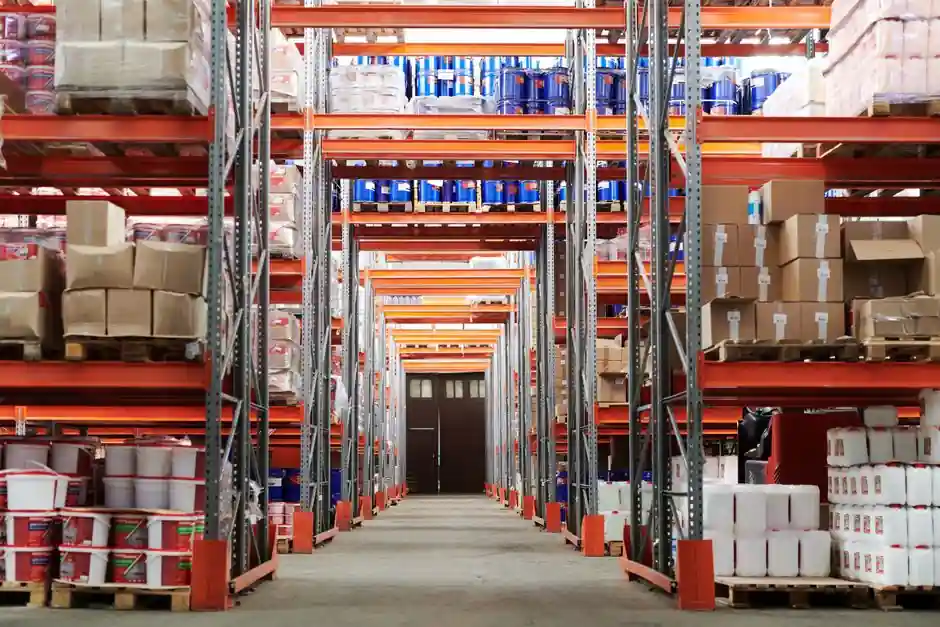
A counterbalance forklift and a reach truck solve different problems in a warehouse, and the wrong choice burns pallet positions or floor space you cannot recover. The decisive numbers are working aisle width, lift height, residual capacity at height, and the indoor/outdoor split of the duty cycle.
Counterbalance machines are the classic front-loader: load on the forks, cast-iron counterweight at the rear, no outrigger legs. Reach trucks replace the counterweight with two stabilizing legs and add a pantograph or moving mast that extends the forks forward, then retracts the load back into the chassis before the truck travels [S1][S3].
Aisle Width and Pallet-Density Math
Working aisle width is the single number that swings a storage-density calculation, and it differs by roughly 0.5–1.0 m between the two classes. A counterbalance truck typically needs 3.2–3.8 m of working aisle; a conventional 12–13 ft (≈3.7–4.0 m) warehouse aisle is sized around that envelope [S1][S7]. A standard reach truck brings that down to about 2.7–3.0 m (8–10 ft), and a VNA turret truck can drop it to roughly 1.6 m (≈5.5 ft) on a super-flat floor [S4].
That 0.5–1.0 m per aisle compounds across a hall: industry guidance commonly cites a 30–50% pallet-position gain when moving from reach-truck aisles to VNA aisles, and a meaningful jump over counterbalance aisles at the same building footprint [S4]. Before any spec, measure real racking distances, pallet overhang, and any protruding uprights; theoretical aisle charts routinely fail against on-site geometry [S1].
Lift Height, Residual Capacity, and Load Profile
Counterbalance trucks carry the heaviest nominal loads, with 1,500 kg to 5,000+ kg as the common band and special units above that, but residual capacity drops sharply above the first stage of mast lift, and most sit at ≤5 m practical lift [S1][S3]. Standard reach trucks routinely reach 12 m or more, with the chassis geometry (load over the drive wheels) keeping residual capacity usable at height [S4]. VNA turret trucks extend to 15–17 m, but only on floors flat enough to keep the mast vertical at full elevation [S4].
Pick by load profile, not by headline capacity. Heavy unit loads (≥2,000 kg) at low or mid height, or any outdoor work, belong on a counterbalance. Mixed-SKU pallets ≤1,500–1,800 kg stored above 6 m belong on a reach truck. Anything above 12 m with high throughput belongs in the VNA class, with floor-flatness and aisle-rail (or wire-guided) infrastructure in the spec from day one [S1][S3][S4].
Power Source, Duty Cycle, and Where Each Truck Actually Works
Counterbalance trucks ship as electric 3- or 4-wheel units for indoor fleets, and as internal-combustion LPG/gasoline/diesel units on cushion or pneumatic tyres for yard, dock, and uneven-surface work [S2]. Reach trucks are almost exclusively electric and indoor, because their stability math assumes smooth, level floors and a defined pallet rack interface; the spec sheet will rate them for indoor racking duty only [S1][S3].
That forces a fleet split in most distribution centres. Counterbalance trucks handle goods-in, dock, cross-dock, and yard, while reach trucks own the rack aisles. Sources on Swiss operations describe exactly this split: counterbalance at the ramp, reach truck in the racking [S1]. Trying to push a reach truck onto a yard apron or a counterbalance into a 2.8 m aisle both end in either damage or compromised safety margins.
Operator Skill, Attachments, and Ergonomics
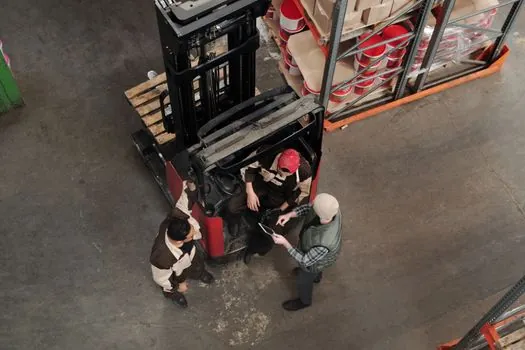
Counterbalance controls mirror road vehicles: steering wheel, pedals, gear-style selector, and hydraulic levers. New operators are productive in days. Reach trucks reverse the operating logic: the operator stands side-on, drives backward into the aisle, and uses simultaneous hydraulic/steering controls with the load trailing toward them. That is a trainable skill, but it is a different skill, and most sites gate reach-truck operators behind documented training [S2][S3].
Attachments also diverge. Counterbalance machines accept sideshifters, rotators, drum clamps, push-pulls, and bale clamps, which is why they show up in food, paper, and chemical sites where one truck services multiple SKU types [S2]. Reach trucks typically ship with a sideshifter only; adding clamps or other hydraulics is possible on some models but is not the default envelope, and it pulls residual capacity downward faster than on a counterbalance [S2][S3].
Total Cost of Ownership: Purchase vs Space Efficiency
Counterbalance trucks are cheaper on the day of purchase and stay cheaper to maintain, with a broad aftermarket and standardised parts across electric and IC classes [S2][S5]. Reach trucks cost more per unit and demand tighter floor and racking tolerances, which raises facility cost. The payback is per-pallet-position: in tight markets, the extra pallet positions unlocked by 0.5–1.0 m narrower aisles pay back the truck premium and the floor prep inside a few years [S5].
For an even tighter envelope, a VNA turret truck pushes aisle width to about 1.6 m and lift to 15–17 m, but only on a super-flat floor and typically with wire or rail guidance; that infrastructure cost is real and belongs in the same line of the business case as the truck itself [S4]. A mixed fleet (counterbalance for docks and yard, reach truck for storage aisles, and a small VNA unit for the tallest, densest bay) is the common configuration in European high-density sites [S1][S4].
Decision Matrix: Match the Truck to the Constraint That Hurts Most
Use this side-by-side as the selection filter. Each row is a decision criterion, and the right column is the binding constraint in most narrow-aisle builds [S1][S2][S3][S4][S7].
Criterion 1: Aisle width. Counterbalance needs 3.2–3.8 m; reach truck 2.7–3.0 m; VNA turret truck as low as ≈1.6 m. The narrowest aisle you can keep defines the truck class.
Criterion 2: Lift height. Counterbalance ≤5 m typical; reach truck 12 m+; VNA 15–17 m. Heights above 6 m with regular access push the spec to reach or VNA.
Criterion 3: Nominal load. Counterbalance 1,500–5,000+ kg; reach truck generally 1,000–2,500 kg depending on mast; VNA turret truck similar to reach with stricter residual curves. Unit loads over ≈2,000 kg at low/mid height point back to counterbalance.
Criterion 4: Environment. Counterbalance: indoor + outdoor, IC option for uneven ground. Reach truck: indoor, smooth level floor only. VNA: indoor, super-flat floor, often rail/wire guided.
Criterion 5: Operator profile and attachments. Counterbalance is road-vehicle-like, accepts many hydraulic attachments. Reach truck needs trained operators and ships with sideshifter-only as a rule. VNA needs the most specialist training and dedicated aisle infrastructure.
Selection logic: lead with the constraint that cannot be changed (aisle width, floor flatness, indoor-only or mixed duty), then check lift height against racking design, then load against the heaviest SKU, and only then price the truck. The cheapest truck to buy is rarely the cheapest system to run, because the building footprint and the per-pallet-position cost dominate over a 10-year horizon [S1][S5].
Trackable signals for the next planning cycle: a site survey of the actual tightest aisle on each rack row, the residual-capacity curve at your top lift height (not the headline capacity at ground level), and the share of truck hours spent outdoors versus in the rack. Those three numbers, in that order, pick the truck class without a sales call. For related material-handling throughput sizing, the conveyor sortation sizing method uses the same kind of per-hour rate-up discipline that should be applied when sizing the reach-truck fleet against pick rates.
Detailed specification references: rough terrain forklift.