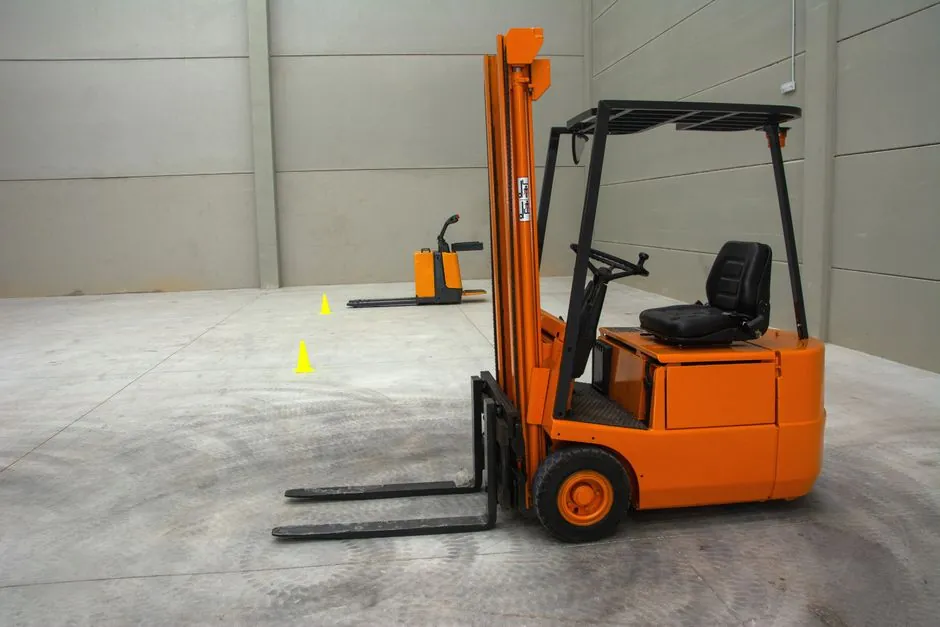
Per-pallet operating cost on electric material-handling fleets is governed less by sticker price and more by aisle-width productivity, energy use and maintenance hours; counterbalance forklifts typically run $25,000–$45,000 new while reach trucks run $35,000–$60,000, with the gap closed or reversed when storage density is monetised [S3].
Both classes are covered under the same OSHA operator-training framework, but Class I counterbalance rider trucks and Class II narrow-aisle reach trucks diverge sharply on duty cycle, lift envelope and aisle footprint, which is where per-move cost is actually set [S5].
Aisle Width Drives Cost-per-Pallet-Position
Counterbalance forklifts need a working aisle of about 3.2–3.8 m for standard 1000×1200 mm pallets, while reach trucks operate in 2.7–2.9 m aisles, roughly 0.5 m tighter per bay [S2]. Squeezing every row of racking down by half a metre can add pallet positions across a multi-row hall, and the per-position share of building cost, lighting, heating and fire-suppression drops proportionally [S2]. On a 10-row, 50-bay-long rack, the geometry of the reach truck can deliver 8–15% more storage positions on the same floor, which is the single largest lever on the building-amortised cost component of every pallet move [S1][S2].
Standard counterbalance rider trucks still need about 11–13 ft (3.35–3.96 m) of aisle, and reach trucks can drop to 8–9 ft (2.44–2.74 m) where rack and pallet dimensions are matched to the truck's right-angle stack dimension [S1]. This is why narrow-aisle reach operations and pallet racking selection are decided together, not in isolation, in any retrofit or greenfield spec.
Acquisition Cost and Resale Curve
Counterbalance forklifts use a fixed rear counterweight, simple mast and conventional automotive-style controls, which keeps the bill of materials short and the dealer network broad [S1][S4]. New electric stand-up counterbalance units list at roughly $25,000–$45,000, and new reach trucks at $35,000–$60,000, so the reach-truck premium is typically 30–40% on like-for-like capacity [S3]. Counterbalances carry stronger resale demand because of their versatility, which softens the effective depreciation rate per pallet move over a 7–10 year economic life [S1].
Reach trucks carry a more complex pantograph or scissor reach mechanism, plus steering and mast hydraulics tuned for narrow-aisle precision, which is where the acquisition premium is concentrated [S1][S3]. Operators moving from a counterbalance to a reach truck for the first time should budget additional training hours: stability behaviour changes with mast extension, and visibility into the rack is a different visual problem at 9 m of lift than at 6 m [S1][S4].
Energy, Battery and Maintenance per Shift
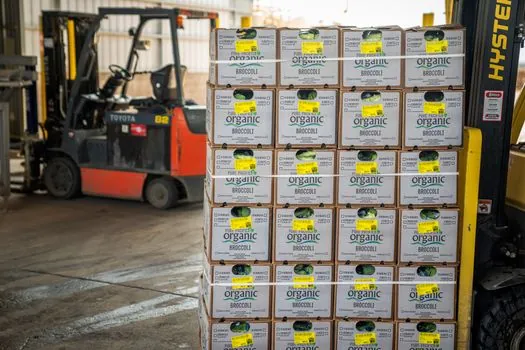
Both classes are typically electric in this duty cycle: reach trucks run on 36V or 48V battery systems sized for opportunity charging, and electric counterbalance stand-up units use a rear-mounted battery counterweight that doubles as ballast [S3][S5]. A 36V, 3,500 lb capacity reach truck reaches roughly 7.5 mph loaded, while electric stand-up counterbalances top out near 8 mph unloaded, so energy per pallet move is broadly comparable at low lift heights and diverges once the reach truck starts working above 25 ft [S5].
Counterbalances are mechanically simpler: forks, mast, hydraulic lift, steering axle, no reach carriage. That simplicity is why their scheduled-maintenance hours per shift are consistently lower than a reach truck's in industry comparisons [S1]. Reach trucks add maintenance burden on the reach carriage, mast rollers, side-shift carriage rails and stabiliser legs, and a pallet stacker used in conjunction still needs its own service intervals on hydraulics and load wheels.
Battery replacement is the largest single mid-life cost on either truck. Lithium-ion opportunity charging on 48V reach-truck packs is now common and trims battery-room space, but the pack itself still represents a meaningful share of the truck's replacement value at 5–7 years [S1][S3]. Counterbalances carry the same chemistry question, but the battery also acts as ballast, so the engineering incentive to keep the pack sized correctly for load charts is the same on both.
Productivity per Hour and Indirect Cost-per-Move
Throughput per operator is where the comparison flips for high-density warehouses. Reach trucks access lift heights of 30 to 45+ ft and load capacities of 3,000–5,500 lb (up to 6,000 lb on some models), while stand-up electric counterbalances plateau near 12–24 ft of lift and 3,000–4,500 lb [S3]. On a 35 ft rack with 3,500 lb pallets, the reach truck does work the counterbalance cannot do at all, and the only honest comparison is reach truck vs a reach truck on a different aisle spec.
Loaded travel speed for reach trucks is 6–7 mph, versus 5–7 mph for stand-up counterbalances, and turning radius is 6.5–8 ft vs 6–7.5 ft, so the reach truck gives up a small amount of agility in exchange for lift envelope and rack reach [S3]. For ground-level dock and trailer-unloading work, a counterbalance is faster on every cycle: no reach stroke, simpler hydraulics, the operator never has to think about mast extension. That is the counterbalance's natural habitat, and a manual pallet jack feeding it keeps short-haul pallet moves under one tool and one operator.
When Each Class Loses on Cost-per-Move

The counterbalance loses on cost-per-move when the warehouse is paying for aisle space it does not use, and when lift heights exceed about 20–25 ft without a specialty mast, which is the practical stability ceiling for many standard counterbalance units [S1]. It also loses when an IC-engine unit is run indoors: ventilation, exhaust and emissions-related service add a per-hour penalty an electric reach truck does not carry [S1].
The reach truck loses on cost-per-move when it is deployed in wide-aisle, low-rack facilities where its aisle-shrinking advantage is wasted and where the operator's reach-and-retract cycle adds seconds to every move. It also loses when the duty cycle demands frequent outdoor yard work, since reach trucks are indoor-only and exposure to uneven ground accelerates mast and wheel wear. For heavy dock and yard flows, an electric pallet truck often beats either truck on cost-per-move at ground level, and a plastic pallet fleet can trim further weight and pallet damage on the same routes.
Decision Matrix by Site Profile
On a 1,500 m² cross-dock with mixed dock and yard work, low racking and wide aisles, the electric stand-up counterbalance wins on cycle time, training cost and maintenance hours per shift [S1][S3]. On a heavy-manufacturing site with outdoor staging, an IC counterbalance with pneumatic tyres is the only viable option of the two, and any reach truck in that fleet should be scoped to indoor finished-goods only [S1][S4].
Track the following signals over the next two operating quarters: kWh consumed per 100 pallet moves on each truck class, and the ratio of battery-replacement cost to acquisition cost when the first pack is replaced. A wide gap there is a more reliable indicator of cost-per-move drift than published list prices, and it gives procurement a defensible number for the next fleet refresh.
See also our earlier report, Aluminum Extrusion Conversion Cost vs Profile Complexity.