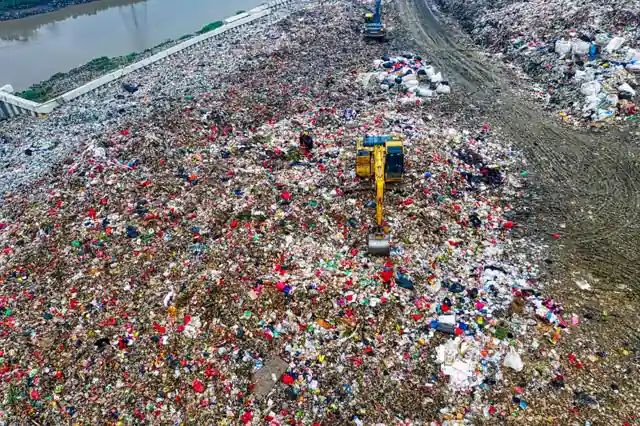
Crawler crane maintenance in landfill service is dominated by three wear drivers that don't appear on a general construction site: abrasive sand and glass fines, corrosive landfill gas, and tracked undercarriage fouling from daily cover soil. The top two failure-prevention controls operators cite are daily walkarounds and on-time preventive maintenance, per a 2020 industry review of landfill heavy-equipment best practices [S6].
The fleet in scope is narrow: landfills typically run dozers, compactors, tracked excavators, scrapers, loaders, and graders for cell construction and cover placement [S1], while crawler cranes appear as auxiliary lifts for leachate pipe headers, geomembrane panel placement, gas-wellhead work, and well-drill rig moves. Cranes are not the daily cell-building machine, but they are the machine that gets called in for the regulated, one-off lifts, so their maintenance program has to match landfill-specific duty rather than generic construction PM intervals.
Failure Mode 1: Undercarriage Wear from Sand, Glass, and Cover Soil
Track shoe pin and bushing wear accelerates when abrasive fines migrate into the pin joints, which is the normal state on a working face [S3]. The symptom is rising track tension as the greasable pin wears and the chain stretches, eventually visible as sprocket tooth profile change. The corrective action is daily clean-out of the sprocket, idler, and lower roller area, and a pin-and-bushing rotation interval roughly half of what a crawler crane on a clean industrial site would see, with crawler crane selection details covered in the crawler crane encyclopedia entry. The acceptance criterion is no measurable shoe pitch elongation beyond the OEM's rewear limit; once pins sit proud of the bushing, replace the pin-bushing set rather than re-shimming.
Daily walkarounds must include a visual check for oil streaks on the inside of the track frame, because landfill dust hides the leak until the idler seizes. Landfill heavy-equipment guides also call out daily fluid leak checks on every machine on site, not only cranes [S3], so undercarriage inspection is part of a wider daily-preventive program that also covers other mobile cranes working the same cell.
Failure Mode 2: Corrosion from Landfill Gas and Leachate Splash
Hydrogen sulfide and condensate from landfill gas attack boom paint, wire-rope lubricant, and electrical connectors in ways that a yard-bound crawler crane never sees. The symptom is stiff boom pins, surface rust blooming under paint within a service interval, and intermittent limit-switch faults in the operator cab. Corrective action is to wash the boom and exposed wire rope with a pH-neutral degreaser, not a high-alkaline soap, after each shift in active gas-extraction zones, then re-lubricate wire rope with a gas-resistant grease. [S4]
Leachate collection and removal system maintenance, governed by SWANA policy, also drives crane access patterns: well-headers, manholes, and riser pipes inside the cell are the work sites, and O&M manuals for active sites such as the Chaffee Valley Fill operation specify double-lined cells with mixing vessels sized around 6,300 gallons each and an active-fill surface protocol [S5]. The point for crane maintenance is simple: a crane working within 30 m of an active gas well or leachate manhole needs a documented gas-test before each lift, and the maintenance record should carry the gas reading as a logged field, not a checkbox.
Failure Mode 3: Hydraulic and Slew Bearing Contamination
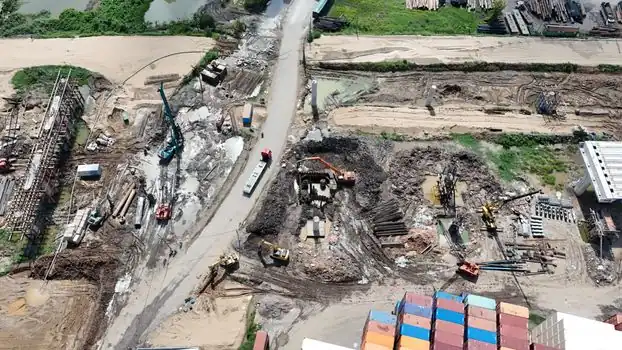
Landfill dust is a fineness-class abrasive that defeats standard hydraulic return filters faster than the OEM's normal-duty change interval assumes. The symptom is hydraulic oil temperature creeping 5-8 deg C above baseline under no load, and slow boom function at full extension, which together signal filter loading and possible water ingestion. The corrective action is a 250-hour hydraulic sample with particle count and water content, instead of the OEM's generic 500-hour interval, and a one-shot reservoir breathers swap to a desiccant type suited to humid landfill microclimates. [S1]
Slew bearing failure shows up as rotational drag after a static lift, particularly when the crane has been parked on uneven cell cover. Bolted slew-bearing torque checks should sit at a documented value: the SWANA-affiliated landfill operations guidance calls for keeping complete operating records including on-site mechanical equipment, and the equivalent crane-side practice is to re-torque slew bolts at the OEM interval, then audit with a torque wrench test on a sample of bolts. When slew-race brinelling is visible, replacement rather than adjustment is the only safe path, and similar systematic maintenance logic applies to other landfill-plant equipment covered in the vibratory feeder maintenance reference.
Who This Maintenance Profile Is For, and Who It Is Not For
This profile fits cranes dedicated to a single active landfill, working 1,000-2,000 hours per year on geomembrane, well, and pipe lifts, with predictable short-radius duty cycles. It is not a profile for crawler cranes rented in for a 3-month cell closure then parked on a contractor's yard, where standard industrial PM intervals still apply. Heavy-equipment programs that list the daily walkaround, on-time PM, and personnel training as the three top controls [S6] are designed for primary machines (dozers, compactors, excavators), so crane-specific items like wire-rope gas-resistance and slew-bearing torque need to be added to that base.
Daily operating plans for any landfill, including inspection of incoming waste loads, signage, and work-zone barricades [S1], also affect crane lifts because every pick inside an active cell is inside a regulated work zone. Landfill O&M manuals additionally require recordkeeping of on-site mechanical equipment maintenance [S2], so a crawler crane used for gas-well work should carry its own dedicated log, not share a job trailer clipboard with the compactor fleet.
Comparison: Three Maintenance Options Landfill Operators Run
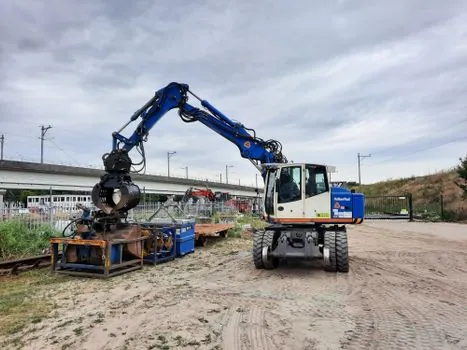
Operators typically run one of three maintenance structures for crane-class equipment, and the choice changes which parts fail first. The first option is OEM-interval PM only, cheapest upfront, but it cuts service life of undercarriage and wire rope in half on landfill duty. The second option is OEM-interval PM plus daily walkarounds with operator-led greasing, which is the structure most municipal landfills document, and which the published best-practice list ranks as the top two controls [S6]. The third option is a condition-based program with scheduled oil sampling and pin-bushing measurements, higher labor cost, lower unplanned-downtime cost, and the only realistic option for a crane on a CCR or ash-monofill site where the abrasive load is even higher [S7].
On a cost-vs-uptime axis, the daily-walkaround plus OEM-PM structure is the standard reference. The OEM-only structure trades lower PM cost for higher undercarriage and wire-rope replacement cost. The condition-based structure inverts that, with sampling and labor cost front-loaded but with a measurable drop in mid-lift failures, which matters for crane-class picks on geomembrane, where a mid-lift hydraulic drift is not a nuisance, it is a panel-tearing event.
Standards, Records, and Inspection Gates
U.S. landfill O&M documentation is typically written against state regulations such as 6 NYCRR Part 360-2.9 [S5], which sets the permit-side recordkeeping baseline that crane maintenance logs feed into. Federal program elements for any solid waste landfill still include random inspection of incoming waste, well-maintained inspection records, personnel training, and procedures for notification when regulated wastes are detected [S4], all of which set the documentation culture a crane log has to fit into. SWANA policy further requires that leachate collection system maintenance be written into the facility operations plan [S9], and a crane serving those systems falls under the same plan scope.
For a verifiable next action, a maintenance lead can do two things inside one shift: pull the last 30 days of crawler-crane inspection sheets and mark every gas-zone pick with a logged H2S or LEL reading, and audit one slew-bearing torque value against the OEM's stamped bolt circle value. Landfill-engineering service providers also publish operations, maintenance, and monitoring scopes that include mechanical equipment records [S8], which is the third-party benchmark a procurement team can use to grade an in-house program. Related process-side reading on heavy-equipment component failure is catalogued in the jaw coupling mining selection review, which uses the same symptom-to-cause logic that drives crawler-crane undercarriage decisions.
For the relevant spec sheets and selection criteria, see crane scale.