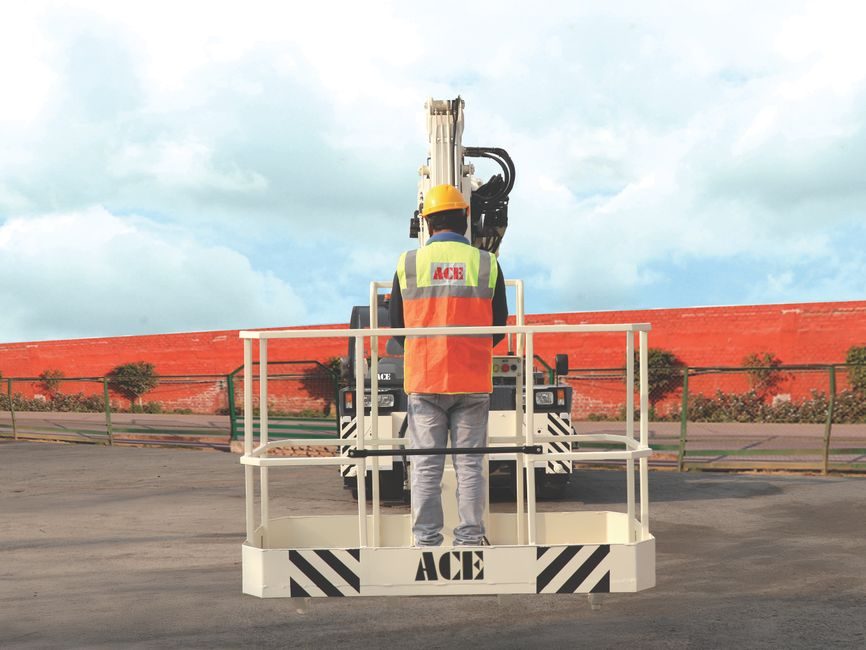
A truck-mounted crane is a lifting unit built on a road-going carrier — typically 3- or 4-axle — that can self-deploy between job sites at highway speed, with Liebherr's 3-axle LTC 1050-3.1E rated to 50 t max load, 48 m working height, 39 m horizontal reach, 85 km/h driving speed and 243 kW (330 hp) drive engine power [S1]. A crawler crane rides on tracked undercarriages, spreads load over a much larger ground-contact area, and is hauled to site in pieces rather than driven under its own power. The two architectures solve different problems on a construction or infrastructure project, and a 2026 buyer who treats them as substitutes usually pays for it in mobilisation cost, ground-prep cost, or both.
The 2026 supply base for truck-mounted units is broad and Chinese-sourced: Jiangsu-based OEM/ODM factories list knuckle-boom 25 t cargo-truck cranes in the US$ 40,400-40,700 per-piece range for 1-unit MOQ [S4], and Xuzhou Yingduoli lists both truck cranes and crawler cranes alongside concrete pumps in its export line [S5]. At the articulated end, Palfinger's PK 12502 SH shows what a compact truck-mounted crane looks like at the small-capacity extreme: 1,040 kg load, 9.7 m working height, 1,160 kg total weight on a 4-axle hydraulic chassis [S2].
What each machine actually is, and the design trade-off behind the chassis
A truck-mounted crane is a lifting structure — boom, slewing ring, outrigger box, winches, counterweight — bolted to a production road chassis with stabilisers deployed before any lift. The Liebherr LTC 1050-3.1E package reports 7 t total weight on the upper structure side and is described as compact, electric and electro-hydraulic, indicating the drive concept is being reworked for low-emission operation [S1]. The PK 12502 SH uses an articulated knuckle boom on a 4-axle hydraulic truck, with "Soft Stop" as a standard control feature for fine placement [S2].
A crawler crane carries the same upper works on a tracked undercarriage: two endless tracks, a tubular or box-section carbody, and a variable-position gantry that lets the upper be rigged without an assist crane. Compared with a truck-mounted unit of the same rated capacity, a crawler will weigh roughly 2-3× as much because the tracks and carbody replace the lighter road chassis, but the load is distributed across a track shoe pattern that delivers ground bearing pressure closer to 60-100 kPa than the 200-400 kPa an outrigger pad can produce. The published comparison framing on hydraulic cranes versus crawler cranes puts the divide cleanly: hydraulic truck units are agile and mobile, crawler units are powerful and heavy-duty [S6].
Capacity, reach and the numbers that drive the buying decision
Rated capacity on a truck-mounted crane spans two orders of magnitude in 2026 product lines. The Palfinger PK 12502 SH is a 1,040 kg articulating unit on a 4-axle hydraulic chassis at 1,160 kg total weight — purpose-built for last-mile cargo handling rather than structural steel [S2]. At the other end, the Liebherr LTC 1050-3.1E is a 3-axle telescopic unit rated to 50 t max load with 48 m working height and 39 m horizontal reach, with a 243 kW drive engine and 85 km/h on-road speed [S1]. Between these poles sits the bulk of the Chinese OEM market: 25 t knuckle-boom cargo-truck cranes on flatbed carriers, listed in the US$ 40,400-40,700 per-piece band for 1-unit MOQ from Jiangsu factories [S4].
Crawler crane capacity in the heavy-lift class routinely runs from 80 t up to 3,500 t and beyond for lattice-boom models, with the larger units (Manitowoc 31000, Liebherr LR 13000, Sany SCC, XCMG XGC series) needing to be broken into 4-8 truck loads for road transport. The relevance for a spec cut is not raw tonnes but the moment envelope: a 50 t telescopic truck crane such as the LTC 1050-3.1E carries a fixed counterweight pack and a fixed boom, so its load chart falls off steeply beyond roughly 30 m radius; an equivalent-class crawler can re-rig with a variable-position carbody, luffing jib and auxiliary hook to keep useful capacity at long radius. The tutorialspoint framing — crawlers for heavy loads, hydraulic truck units for lighter loads and mobility [S6] — maps directly onto this envelope difference.
Mobility, ground pressure and site access
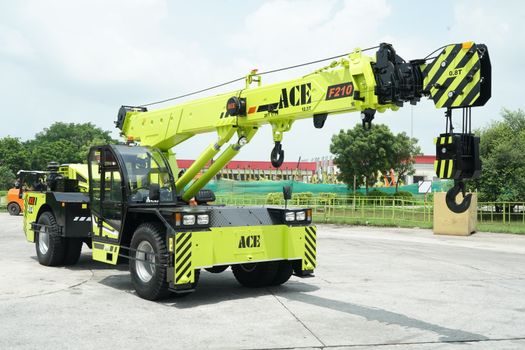
The single biggest operational difference is road speed versus ground preparation. Liebherr's LTC 1050-3.1E drives between sites at 85 km/h, arrives on its own three axles, and is ready to lift after outrigger deployment [S1]. A crawler crane of comparable capacity has to be transported on low-loaders, assembled with an assist crane, and levelled on mats or a prepared pad. On greenfield infrastructure work — wind farm foundations, bridge piers, pipeline spreads — the crawler's ability to "walk" short distances under load with the load chart suspended, then re-position without re-rigging, often outweighs the mobilisation penalty.
Ground bearing pressure reverses the trade. Outrigger pads on a truck crane concentrate load onto 0.4-0.6 m² of timber or synthetic mat, which on weak subgrade demands a layer of crushed stone or bog mats. Crawler tracks distribute load over the full shoe-ground contact length — typically 4-7 m per side — and produce 60-100 kPa of average ground pressure, low enough to work on compacted clay or graded fill that would fail under outrigger pads. The 2026 buying decision typically lands on a crawler for any site that is soft, sloping, off-road for more than 200 m, or constrained on truck unloading space; a truck-mounted unit is preferred for road-adjacent urban work, multi-site day-rate contracts, and any project where the lift radius stays under 30 m and the load stays under 50 t.
Criteria-based comparison: truck-mounted vs crawler, side by side
Lining the two against the same four decision criteria, with the Liebherr LTC 1050-3.1E [S1] and Palfinger PK 12502 SH [S2] as truck-mounted references and crawler-class ranges as standard industry envelopes:
Mobility: truck-mounted units score high — the LTC 1050-3.1E moves at 85 km/h on its own three axles [S1]; the PK 12502 SH drives on a 4-axle hydraulic chassis to any road-accessible site [S2]. Crawler cranes score low — they must be disassembled, loaded on low-boy trailers, and re-assembled, with site-to-site moves typically taking 1-3 days per relocation depending on size.
Ground pressure: truck-mounted units concentrate 200-400 kPa under outrigger pads, so weak subgrade needs mats or a stone layer. Crawler tracks spread load over the full track length for 60-100 kPa average ground bearing pressure, often allowing work without mats on graded fill.
Capacity at long radius: truck-mounted units have fixed counterweight and boom geometry, so capacity falls off sharply beyond roughly 30 m radius — the LTC 1050-3.1E reaches 39 m horizontally at reduced chart [S1]. Crawler cranes accept variable-position carbody, luffing jib and auxiliary hook, holding useful capacity at 60-100 m radius in the heavy-lift class.
Mobilisation cost and time: truck-mounted units win on small-to-midrange work because they self-deploy. Crawler units amortise their higher mobilisation cost once on long-duration heavy-lift contracts where multiple picks justify the 1-3 day site setup.
Who a truck-mounted crane is for, and who it is not for
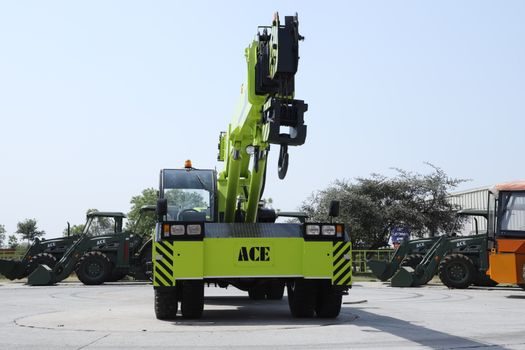
A truck-mounted crane is the right tool when the project is road-accessible, the lift radius is under 40 m, the lift count is high (multiple picks per day), and the site cannot absorb a 1-3 day mobilisation window. Concrete-pump placement, HVAC rooftop work, steel erection on low-rise commercial builds, and rental-fleet work all fit this pattern. The PK 12502 SH type articulated unit at 1,040 kg capacity is the right answer for utility-body and last-mile cargo work, not for any structural steel application [S2].
A truck-mounted crane is the wrong tool when the ground is soft and unreinforced, the radius exceeds roughly 40 m, the load exceeds 50 t, or the site demands pick-and-carry moves of 50-200 m off-road. In those cases a crawler crane is specified instead, accepting the mobilisation penalty in exchange for ground-pressure, capacity-at-radius, and walking-while-loaded capability. Buyers who try to substitute a 50 t truck crane for a 100 t crawler-class job either rent a larger truck crane than needed and exceed road axle limits, or accept lift-chart derates that force extra crane repositioning.
Failure modes, constraints and 2026 sourcing signals
The two dominant failure modes on truck-mounted cranes are outrigger punch-through on unprepared subgrade, and side-tip from slewing over an un-deployed outrigger. On crawler cranes the dominant failure modes are track shoe wear on abrasive rock, and carbody deflection when the upper is slewed out-of-level. Both classes share the upper-structure envelope: boom deflection under wind, slewing-ring bolt loosening after high-cycle service, and hydraulic-hose fatigue at the boom heel. None of these is unique to a specific supplier, so the 2026 sourcing decision tends to come down to dealer coverage, parts inventory, and the OEM's telematics portal — not headline specification. [S1]
On the supply side, the 2026 used and OEM market is bifurcated. Chinese Jiangsu-based factories offer knuckle-boom truck cranes at US$ 40,400-40,700 per piece for 1-unit MOQ with sample service available [S4]. Larger-capacity crawlers (300 t and up) remain dominated by Liebherr, Manitowoc, Sany, XCMG and Tadano, with the 2026 export trade routed through Xuzhou-based trading houses that list both truck cranes and crawler cranes in their catalog [S5]. A practical sourcing signal: request the load chart at the maximum radius you actually need, the outrigger pad load in tonnes per corner, and the counterweight configuration — not the marketing maximum. For adjacent context on chassis and boom decisions, the 2026 truck crane buying guide walks through capacity class and chassis selection, while a truck crane vs aerial work platform spec cut is the right reference when the question is whether a boom lift can replace a small articulating crane.
Trackable next signals: any 2026 Q3 release of an electric-drive truck crane above 30 t class, and any update to the Chinese export price band for 25 t knuckle-boom units, will reshape the cost-per-lift calculation more than any incremental change to load charts on existing models. Watch the Liebherr, Sany and XCMG product pages for direct datasheet revisions, and treat third-party listing prices as a reference band, not a firm quote.
For component-level specifications, see truck mounted concrete pump.