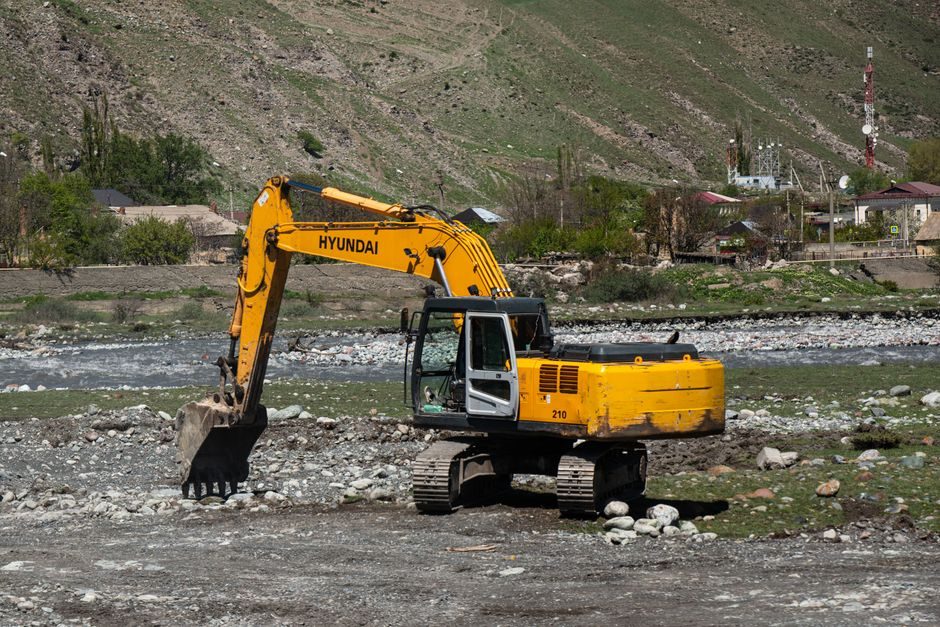
New crawler excavator FOB prices in 2026 range from about US$1,000-2,000 per piece for 1-2 t micro models to US$125,000-265,000 for 37 t mining-class units, with operating weight, emission tier and engine origin setting the dominant cost levers [S3][S5][S7].
Buyers comparing quotes should anchor on size class first: DirectIndustry lists 189 mini, 241 medium, 113 large, 19 midi and 10 micro crawler excavator models across 55 manufacturers in mid-2026, confirming a steeply tiered catalogue that mirrors the price curve [S2]. A useful starting reference is our crawler excavator selection guide on weight class, tail swing and powertrain tier, which lines up against the cost brackets below.
2026 FOB Price Bands by Operating Weight
Micro and 1-2 t mini class machines sit at the floor: Made-in-China listings for "Factory Cheaper Price" 1 t / 2 t hydraulic mini excavators with CE, EPA and Euro 5 documentation quote US$1,000.00-2,000.00 per piece with free shipping included [S5]. The 1.6 t SY16C mini-crawler from Evangel Industrial lists US$15,000 per piece for 3+ units and US$19,800 for 1-2 pieces, both with 1-year warranty and CE/EPA certification [S3]. The 0.8 t VTW-08 mini (0.02 m³ bucket, 1,200 mm max dig depth) drops into the same sub-US$10k niche via Okorder's bulk channels [S10].
Mid-range 5-8 t units step up sharply. A 5.7 t SY55U mini excavator, a 6 t XE60GA with air-conditioning, and a 7.5 t XE75GA with 0.33 m³ bucket cluster in the US$19,000-55,000 per-piece range depending on options and supplier [S3]. For 15 t production-class machines, the Oriemac XE150D lists at US$100,000.00 per piece FOB [S6]. At 21 t the SY215, XE215C and the Shantui SE335LCW (34.5 t) span US$35,000-66,700 per piece, and the 34 t HX350L/HX340HD/R350LVS group rises to US$280,000-340,000 per piece [S3].
For reference, the Cat 310 mini-excavator (9,601-10,182 kg operating weight, 51.8 kW / 70.43 hp Cat C3.3B Tier 4 Final / EU Stage V, 5,211 mm dig depth) carries Caterpillar's "up to 10% lower total ownership cost" claim built around the DPF, extended-life coolant rated to -37 °C, and 2,000-hour-plus service intervals [S1]. That OEM marketing line is the de-facto TCO benchmark against which the Chinese FOB quotes are measured.
Where the Cost Spread Comes From
Three variables explain most of the 30-100x price gap between a 1 t micro unit and a 37 t mining excavator. First, mass and structure: the 37 t XE370CA lists US$125,000-265,000 with a 1.0-1.5 m³ bucket, marine/mining/GM special-use rating, and standard export seaworthy packaging [S7]. Second, powertrain: Tier 4 Final / EU Stage V engines with DPF, DOC and SCR (as on the Cat 310) cost materially more than the EPA + Euro 5 + CE combination that most China-built mini units carry [S1][S3]. Third, hydraulics: load-sensing / flow-sharing systems and certified accumulators (the Cat 310 calls these out as standard) command a price premium over fixed-displacement open-centre circuits common on sub-US$20k machines [S1].
For a comparison, a buyer can also look sideways at related mobile iron: the telehandler price and cost guide 2026 covers a similar finance-and-attachment TCO structure, while the AGV price guide 2026 gives a yardstick once a buyer automates around the excavator. The recurring pattern across mobile equipment is that finance, attachments and service intervals typically add 15-30% on top of FOB over a 5-year horizon.
Decision Criteria: What the Price Quote Is Actually Paying For
For a buyer shortlisting a crawler excavator, four cost-defining criteria should drive the RFQ. (1) Operating weight class — pick the size first, then screen; DirectIndustry's 241 medium / 189 mini / 113 large split is the most representative population sample [S2]. (2) Emission tier — EPA Tier 4 Final / EU Stage V machines (e.g. Cat 310, XE150D, XE370CA) sit roughly 20-40% above equivalent China-built CE + EPA Euro 5 units of the same tonnage [S1][S3][S7]. (3) Bucket / work-tool envelope — 0.02 m³ on a 0.8 t unit versus 1.0-1.5 m³ on a 37 t unit changes utilization economics far more than sticker price suggests [S7][S10]. (4) After-sales / warranty — the 1-year warranty and Secured Trading Service terms on Made-in-China listings are a real cost line; OEM dealer support (e.g. Blanchard Cat) is part of the Cat 310 premium [S1][S3].
Buyers who do NOT need a crawler excavator are typically those working on finished concrete or asphalt pads (a wheeled excavator causes less surface damage), inside low-clearance buildings (a compact radius / zero tail-swing mini avoids the gate-height problem) or on long-distance relocations (a wheeled excavator drives between sites at 30+ km/h, while crawlers need a lowboy at 3-5 km/h) [S2]. The DirectIndustry taxonomy lists zero tail swing (38 models), short tail swing (36), long-reach (19), amphibious (12) and telescopic arm (4) as the main configuration variants worth screening before RFQ [S2].
Use-Case Mapping: Matching Class to Job
1-2 t micro / mini: utility trenching, landscaping, indoor demolition, rental fleet fill-in. The 0.8 t VTW-08 (1,200 mm dig depth, 2,450 mm radius, 4 km/h rated travel) targets contractors who need to tow behind a pickup rather than lowboy [S10]. 5-8 t mini: residential foundations, small site prep, cable/pipe laying; the XE60GA (6 t) and SY55U (5.7 t) hit this band at US$30,000-55,000 [S3]. 15-22 t mid-production: road building, commercial site prep, quarry scalp work; the XE150D at US$100,000 and the SY215 / XE215C at US$35,000-66,700 cover this slot [S3][S6]. 30-37 t large: bulk earthmoving, mining, demolition; the XE370CA's marine/mining/GM certifications and 1.0-1.5 m³ bucket target exactly this duty cycle [S7].
For fleet owners comparing brand-new vs used, the crawler excavator selection guide frames the spec gates (weight class, tail swing, powertrain tier) that re-sale value tracks most tightly; a Tier 4 Final / Stage V machine depreciates slower than a Euro 5 / China-IV equivalent of the same tonnage, which materially shifts the 5-year TCO breakeven point.
Failure Modes, Limits and Sourcing Risks
The most common specification pitfall on a 2026 crawler excavator quote is mismatching engine emission tier to jobsite regulation. A US$19,800 SY16C with EPA + CE will not meet Tier 4 Final requirements on a California highway project, regardless of price advantage [S3]. Conversely, a Tier 4 Final machine in a non-regulated market is paying for emissions hardware (DPF, SCR, DEF tank) that adds to first cost and service-interval spend [S1]. A second failure mode is bucket/work-tool mismatch: 1.0-1.5 m³ on a 37 t machine is correct for soft overburden, but in shot rock the same bucket forces the operator to under-fill and hammers the boom [S7]. A third is warranty geography: Made-in-China Secured Trading protects payment but not the freight of returning a failed engine; OEM dealer coverage (e.g. Blanchard Cat for Cat 310) bundles parts and field service into the premium [S1][S3].
Standardisation is a useful filter when reading FOB quotes. EPA Tier 4 Final and EU Stage V are the dominant regulatory benchmarks cited on new Tier-1 OEM units in 2026; the Made-in-China listings cluster around EPA + Euro 5 + CE as a combined compliance bundle, while China-IV (the domestic Chinese standard) appears in some Chinese-market quotes [S1][S3][S5]. ISO 6015 governs excavator mass and ISO 10567 covers lift-capacity ratings for crawler units, and these are the typical underlying test methods that OEM catalogues reference even if not always printed on the FOB sheet [S1][S7].
Trackable Signals to Watch Through 2026 H2
Two verifiable near-term signals should be on the buyer's dashboard. First, Euro Stage V supply and EPA Tier 4 Final lead times: with the Cat 310 and XE150D both still quoted as in-catalogue at mid-2026, watch for Q3/Q4 stock-out bulletins from OEM dealers, which historically push the China-built CE + Euro 5 share upward by 5-10 percentage points inside Europe and Latin America [S1][S6]. Second, the freight and inspection line: Made-in-China lists "Contact the supplier about freight and estimated delivery time" and offers optional pre-shipment inspection, which is the line item most likely to drift upward through 2026 as Red Sea / container rate volatility works through [S3][S10]. A defensible next step is to lock FOB price, separately itemise freight and inspection, and pin the emission tier in writing before placing a deposit.
For component-level specifications, see excavator, crawler crane, and linear guide.