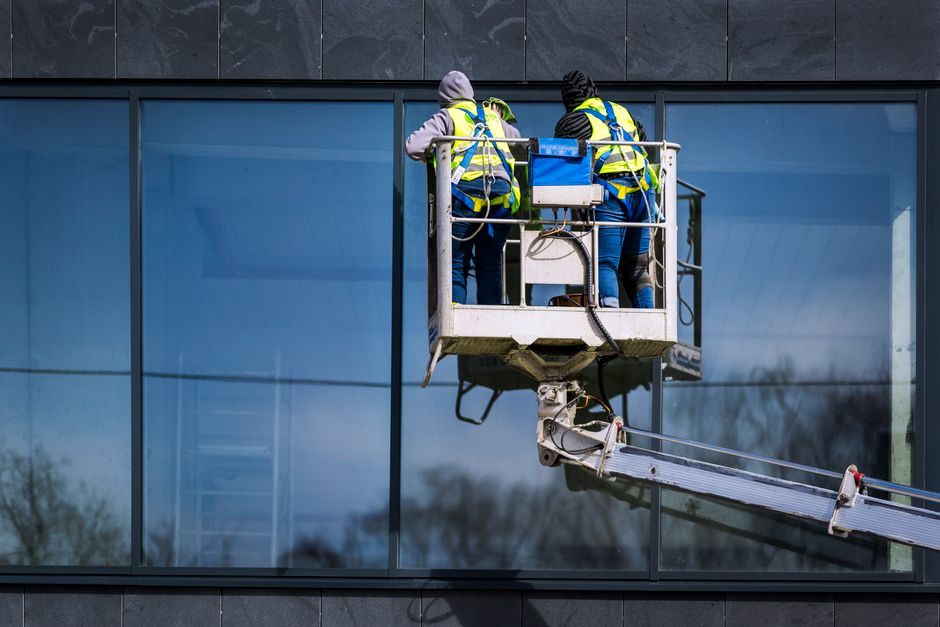
For indoor and light-outdoor duty, wheeled scissor platforms with basket capacities of 500 kg, 800 kg and 1,000 kg are the most quoted configurations on European B2B catalogues as of June 2026 [S1]. Wuxi Balance Machinery Equipment Co., Ltd. (Jiangsu, China) lists a self-propelled aerial work platform alongside its scissor-lift range, signalling that the Chinese mid-tier supply base is shipping both push-around and self-propelled variants on the same product line [S3].
Selecting the wrong drive type is the single most common capex mistake on aerial work platform (AWP) orders, so the gate is set on height, deck load, travel surface and indoor-outdoor duty cycle, not on price.
Define the duty envelope before picking a chassis
The first citable gate is working height. AWPs split into three reach bands: push-around scissor and mast lifts (typically 6–12 m platform height), self-propelled scissors (8–18 m), and boom lifts (12–30 m) for overhead clearance work [S2]. A wheeled push-around unit from the FPSE family covers basket loads of 500, 800 and 1,000 kg at the low-height end of that range, with no onboard drive motor [S1]. Wuxi Balance ships a self-propelled variant with on-board drive and hydraulic lift, so the deck travels with the operator rather than being repositioned manually [S3].
Floor loading is the second gate. A 1,000 kg deck rating on a 4 m × 2 m chassis implies a 125 kg/m² average load, but the rear-axle point load during a 1 m lift is closer to 400 kg per tyre on small wheels — relevant on raised office floors and mezzanines rated below 5 kN/m².
Drive and chassis options lined up against decision criteria
Four common configurations compete on most spec sheets, and they line up against reach, capacity, surface and cost as follows. Push-around manual scissors handle 6–10 m at 240–500 kg deck load on smooth indoor floors, cost the least but require manual repositioning. Self-propelled scissors reach 8–18 m at 350–1,000 kg with battery drive and 4-wheel steering for warehouse aisles [S1][S3]. Telescopic booms extend 12–30 m at 200–450 kg for outdoor steel and cladding work. Articulating booms add a knuckle joint for obstacles, trading 2–4 m of straight reach for access around structural steel.
The decision matrix is short: indoor warehouse → electric scissor with non-marking tyres; outdoor construction → diesel 4×4 boom; façade maintenance at variable geometry → articulating electric boom. A wheeled push-around unit in the FPSE range (500–1,000 kg) is the right pick only when the work zone is within 20 m of a charge point and the operator can push the chassis between bays [S1].
Power source, batteries and duty-cycle math
Electric DC drive with deep-cycle traction batteries is the default for indoor AWPs because zero local exhaust is required on enclosed sites. A typical 24 V or 48 V 200–400 Ah lead-acid pack delivers 4–6 hours of lift-and-drive duty, with a 8-hour overnight recharge on a 230 V single-phase input. For outdoor fleet, diesel or dual-fuel (LPG + electric) units dominate because continuous drive drains battery packs within 2–3 hours. [S1]
Hydraulic actuation is still the standard lift mechanism on most scissor and boom platforms above 8 m, including the self-propelled models out of Wuxi Balance's catalogue [S3]. Hydraulic aerial lifts use a single double-acting cylinder per scissor stack, which is why a 1,000 kg deck rating is achievable on a compact chassis.
Safety standards, inspection intervals and the load-test rule
The citable safety floor is periodic inspection at intervals not exceeding 12 months for any AWP placed in service, with a thorough examination after any event that could affect structural integrity. Functional tests must confirm the platform-leveling system, the lowerable rail interlocks, the emergency descent valve and the overload cutoff at 110 % of rated basket load. [S2]
For a 1,000 kg deck unit, the overload sensor must therefore trip somewhere between 1,100 kg and the structural yield threshold of the scissor arms [S1]. A documented load-test certificate is non-negotiable on EU sites; insurance write-backs routinely reject claims when the test sheet is older than the inspection interval.
Use cases by industry and what fails first
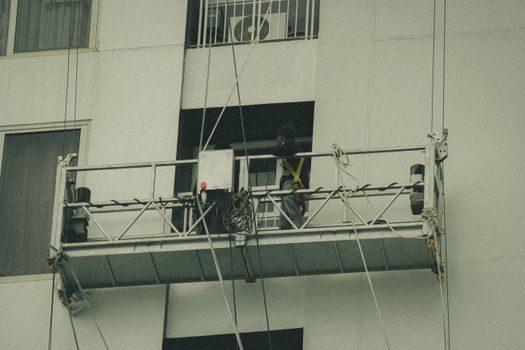
Warehousing and order picking: electric scissor 8–14 m, 500 kg deck, 2-wheel drive, 4-wheel steer, non-marking solid tyres. HVAC and mechanical service: articulating boom 12–18 m, 230 kg deck, electric drive for indoor, diesel for outdoor [S2]. Construction and cladding: telescopic diesel boom 18–30 m, 4×4 rough-terrain chassis, jib extension. Sign and lighting maintenance: push-around mast lift 6–10 m, 1,000 kg deck where two technicians plus material are on board [S1].
The three recurring failure modes are: (1) tyre wear on rough terrain exceeding 50 % tread before the annual inspection, (2) hydraulic seal blow-by on scissor cylinders older than 5 years in coastal atmospheres, and (3) battery sulphation on units left at <30 % state-of-charge over weekends.
Sourcing path, lead time and total-cost of ownership
European catalogue listings for the FPSE wheeled platform family put the buyer in front of 500–1,000 kg deck options on one product page, which is the cleanest way to compare OEM basket ratings before RFQ [S1]. Chinese mid-tier suppliers such as Wuxi Balance quote on Incoterms FOB or CIF with L/C or T/T terms, and lead times on self-propelled units typically run 30–45 days ex-works [S3].
For fleet buyers looking beyond access equipment, the same vendor-evaluation discipline used in AWP sourcing — load rating, standard compliance, after-sales network — applies to adjacent lift categories such as linear guide selection for motion platforms and crossed-roller guide sizing for high-stiffness lift tables. For mobile work where the AWP shares floor space with wheeled transport, the platform trolley decision tree mirrors the AWP one on deck area and load per wheel.
Track two signals over the next procurement cycle: OEM-published mean time between failures (MTBF) on scissor weld seams, and whether your shortlisted vendor can produce a 12-month inspection record on a comparable fleet.
For related coverage, see Aluminum Coil Selection Guide: Alloy, Temper and Thickness Criteria.