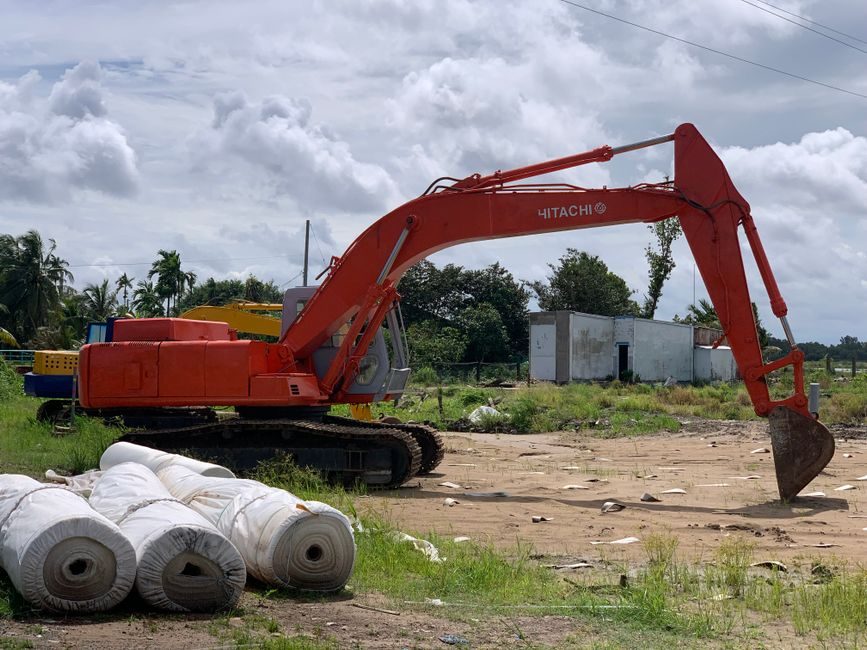
The crawler excavator market spans 544 cataloged models from 55 manufacturers on DirectIndustry, segmented by class (medium 241, mini 189, large 113, midi 19, micro 10) and power (diesel 535, electric 11, hybrid 1) as cataloged on 2026-05-29 [S1].
For a buyer, selection reduces to four gates: operating weight versus job-site transport limits, bucket capacity versus production target, tail-swing radius versus work-zone congestion, and engine emission tier versus the destination market's regulation (Stage V / Tier 4f for EU/US, China NR4 for domestic, Tier 2 still legal in many export markets) [S5][S2].
Size Class Boundaries and Bucket-Capacity Mapping
DirectIndustry's filter split puts mini excavators (<6 t class) at 189 SKUs, midi at 19, medium at 241, and large at 113, with the 0.12-0.32 m³ bucket range typical for a 7-ton machine such as the JCM 907B (operating weight 7,100 kg, Cummins B3.3 at 45 kW / 2,200 rpm) [S1][S2]. Bucket digging force of 53.6 kN and stick digging force of 39.9 kN on the same 907B are the two numbers that translate directly into production rate on broken ground versus loose fill [S2].
Track gauge, ground clearance, and stick length (1,650 mm on the 907B) drive digging depth and dump reach; undercarriage choice — fixed, variable, or retractable — is what separates a dedicated site machine from a roadable one [S1]. Walking speeds of 3.14 / 5.26 km/h (low / high) and a 70% gradeability are the headline mobility numbers for any 7-10 t crawler in this class [S2].
Tail Swing, Work Envelope and Site Geometry
Tail-swing geometry is the second selection gate: DirectIndustry counts zero tail swing (38 SKUs), short tail swing (36), and standard full-rear configurations, with demolition (32), long-reach (19), and amphibious (12) variants layered on top [S1]. The JCM 907B's 1,750 mm tail turning radius sets the minimum corridor width a contractor must clear against a wall or barrier; anything tighter pushes the spec toward zero-tail-swing [S2].
Zero-tail-swing and short-tail-swing models are non-negotiable for urban utility work in narrow streets, while demolition-rated machines add boom-arm guarding and reinforced cylinders for breaker or shear work [S1]. Long-reach booms extend the dig-and-dump envelope for pond, canal, and slope work where the machine must sit back from the edge [S1].
Powertrain, Emissions and Fuel Capacity
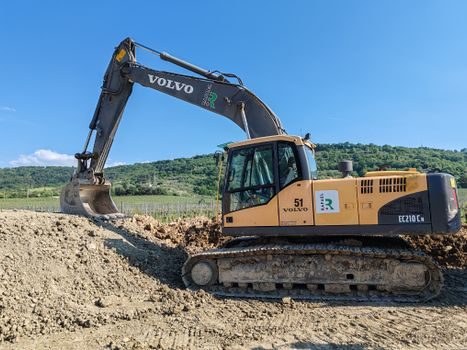
Diesel dominates with 535 of 544 listed models, against 11 battery-electric and 1 hybrid as of 2026-05-29; Volvo CE's crawler range is explicitly tagged "Stage V / Tier 4f" for the Australian market, indicating the European and North American regulatory ceiling [S1][S5]. The 907B runs a Tier 2 Cummins B3.3 at 45 kW with a 170 L fuel tank, a configuration still common in markets that have not yet enforced NR4 or Stage V [S2].
Rotation speed (11.2 r/min on the 907B) and hydraulic flow set cycle time; buyers comparing like-for-like machines should normalize on engine kW per ton of operating weight rather than raw kW [S2]. Fuel-tank size matters on remote pipeline or quarry shifts where refuel logistics are a daily constraint, and 170 L on a 7-ton machine is a typical 12-14 hour operating envelope at moderate load [S2].
Manufacturer Spread and Aftermarket Footprint
The 55-brand spread on DirectIndustry reads, by SKU count, as Kobelco Construction Machinery Europe B.V. (41), Kobelco Cranes (39), Deere-Hitachi (29), DAEWOO (26), Hyundai Construction Equipment Americas (23), HYUNDAI HEAVY INDUSTRIES (23), IHI (20), TAKEUCHI (19), SHANTUI (18), HYUNDAI HEAVY INDUSTRIES (17), HIDROMEK (16), BOBCAT (16), Case (15), Lonking (15), Lovol (14), Volvo CE (14), XCMG (13), KATO IMER (13), and SANY (8) [S1]. A broader OEM list lowers parts risk because wear parts — undercarriage shoes, track rollers, bucket teeth, pins and bushings — are increasingly interchangeable across the Chinese and Korean majors [S1].
Volvo CE explicitly breaks its excavator line into Large Crawler, Medium Crawler, Wheeled, and Compact Excavators with a "refine by operating weight (kg)" filter, mirroring the four-class taxonomy the rest of the industry uses [S5][S3]. Volvo also lists a dedicated electric-machines product line for excavators and other heavy equipment, the structural indicator that the 11 battery-electric crawler SKUs in DirectIndustry's catalog sit in a market that is no longer prototype-only [S3][S1].
Selection Criteria Compared Across Major Configurations
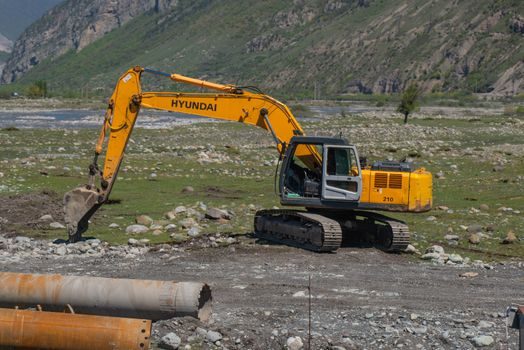
Comparing the four work-horse configurations on buyer-relevant criteria: a mini/compact crawler (0-6 t, 38 zero-tail-swing SKUs) wins on transport weight and urban access; a midi (19 SKUs, ~6-10 t) such as the JCM 907B at 7,100 kg balances bucket capacity (0.32 m³ max) with a 7,100 kg trailer-able mass; a medium crawler (241 SKUs, ~10-25 t) is the workhorse for foundation and utility work; a large crawler (113 SKUs, >25 t) is reserved for mining, quarry, and high-volume earthmoving [S1][S2].
On powertrain: diesel gives 535/544 model availability and proven cold-start, hybrid exists as a 1-SKU niche, and battery-electric (11 SKUs) is positioned for indoor demolition, tunnel, and noise-restricted urban sites where the absence of exhaust is a permit requirement [S1]. On certification: Stage V / Tier 4f machines are required for the EU, UK, and most of North America, China NR4 for domestic, and Tier 2 / Tier 3 remains legal across large parts of Africa, South America, and Southeast Asia [S5][S2].
Used Market, Lifecycle Cost and Resale
The used crawler channel is a parallel selection track: Cat Used lists crawler excavators across roadwork and large construction project categories, with a relevance-sorted search feed that surfaces factory-certified and dealer-listed units separately from third-party inventory [S6]. A used 5-8 year old Tier 3 or Stage IV crawler typically prices at 35-55% of new, with undercarriage condition (shoe wear, idler and sprocket life) being the single largest remaining-life indicator on a pre-purchase inspection [S6].
For buyers cross-shopping new and used, the gating question is emission tier: a Tier 2 machine is cheap to buy but cannot be registered on a Stage V job site, while a late Stage IV / early Stage V used unit often wins on total cost of ownership over a Tier 4 interim new machine [S5][S6]. Volvo CE's separation of compact, medium, and large crawler lines also holds on the used side, with operating weight in kg being the only filter that survives a resale handoff intact [S3][S6].
Where Crawlers Lose and What to Specify Instead

Crawler excavators lose to wheeled excavators on paved surfaces that see long repositioning moves: rubber-tired machines roll between dig points at road speeds, while crawlers must be loaded on a lowboy for any transfer over a few kilometers [S1]. They also lose to telehandlers on high-reach lift-and-place work, and to compact excavators only when the job site is genuinely constrained to under 2 t lift requirements [S1].
Two specification traps to avoid: do not pair a 70% gradeability claim with muddy untracked ground (real-world slope performance on saturated clay drops sharply), and do not assume a 170 L fuel tank means a full 14-hour shift under heavy hydraulic load — breaker work halves the burn rate window [S2]. Buyers sourcing on B2B platforms should also check whether the listed bucket capacity is the maximum SAE / heaped rating or a nominal average; the 907B's 0.12-0.32 m³ range is the wide-swing number, not a single working point [S2].
Next node: if a project needs both a crawler for site work and a wheeled machine for paved transfer, the Volvo CE four-class taxonomy (Large / Medium / Wheeled / Compact) gives a single configurator across new and used inventory, and the DirectIndustry filter set (size class, power source, application) is the cleanest side-by-side comparison tool across all 55 brands [S1][S3][S5]. Track the Stage V / Tier 4f share of new crawler shipments and the count of battery-electric SKUs past 11 as the two leading indicators for 2026-2027 [S1][S5].
For component-level specifications, see linear guide.