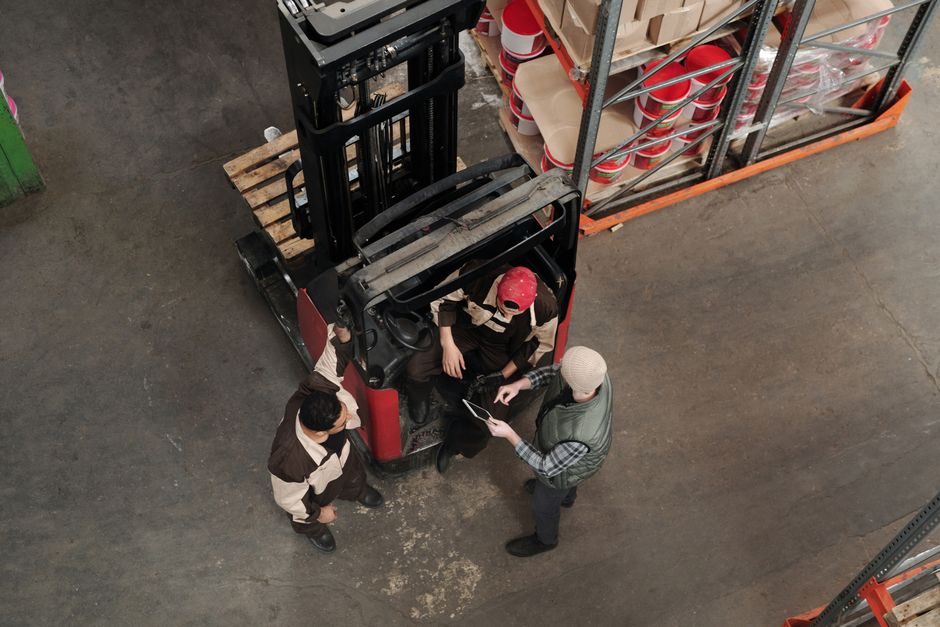
AGV unit pricing splits cleanly by load class: tow vehicles and unit load carriers typically land at $25,000-$60,000 per unit, pallet trucks and assembly line vehicles at $50,000-$100,000, and forklift-truck-class AGVs at $100,000-$150,000+ depending on lift height, payload and navigation stack [S2]. The global automated guided vehicle market was valued at $5.21 billion in 2019 and is projected to reach $13.52 billion by 2027, a 16.6% CAGR over 2020-2027, with Asia-Pacific holding the highest regional share that year [S2].
Vehicle price alone misleads buyers - a deployed AGV system carries 3-5x the sticker once navigation infrastructure, fleet software, safety scanners and WMS/WCS integration are layered on. A 20-vehicle tow train that quotes at $1.0M in vehicles routinely lands at $3.0-4.0M total installed, with the gap driven by magnetic-tape or laser-navigation hardware, PLC/WMS integration labour, and the safety-rated LiDAR scanners mandated on every unit.
Price Bands by AGV Type
Five vehicle types dominate procurement lists, and price scales with payload, lift mechanism and navigation complexity rather than brand [S2]. Tow vehicles (the simplest class, used to pull carts) start near $25,000 and rarely exceed $50,000 per unit in 2025 quoting; unit load carriers handling 500-2000 kg flat-deck loads cluster in the $40,000-$75,000 band; pallet trucks (jack-style, no lift) run $50,000-$90,000; assembly line vehicles sized for chassis or sub-assembly delivery sit at $60,000-$100,000; and forklift-truck-class AGVs with 3-6 m lift heights and 1000-2500 kg capacity start at $100,000 and commonly cross $150,000 when equipped with laser-navigation forks and reach-mast geometry [S2] - the crossed roller guide bearings in those masts are a non-trivial cost line on their own.
Navigation technology is the second price lever inside each band: magnetic-tape and inductive-wire guidance remain the cheapest to deploy (typical added cost $3,000-$8,000 per vehicle plus tape installation at $15-$40 per linear metre) but lock the path; laser guidance (reflector triangulation) and SLAM-style vision guidance add $15,000-$30,000 per vehicle but eliminate floor infrastructure, which pays back in plants exceeding 3,000 m² of route or those needing frequent re-layout [S2].
What Sits Above the Vehicle Sticker
For a 20-vehicle tow-train system quoted at roughly $1.0M in vehicles, total installed in 2025 commonly landed in the $3.0-4.0M band once a turnkey integrator scope was applied, per project disclosures cited in the Allied Market Research AGV study [S2].
The biggest single hidden line is integration: a fleet manager talking to SAP EWM, Manhattan Active WM or a custom WMS over OPC-UA or REST typically consumes 1,500-3,000 engineering hours at blended $150-$220/hr, which on a 20-vehicle build equals $225,000-$660,000 before the first pallet moves. Buyers comparing two integrator quotes that differ by more than 20% on total price should walk the BOM line-by-line - the variance lives in integration scope and the number of safety zones, not in the vehicle list.
Total Cost of Ownership Over 7-10 Years

Vehicle acquisition is 30-50% of 7-10 year TCO; the rest is batteries, maintenance, software subscriptions, navigation infrastructure refresh and integration updates. [S1]
Insurance, spare-parts pooling, and the cost of one cold-standby vehicle per 15-20 in service are the remaining TCO lines buyers consistently under-budget.
Selection Criteria and the Decision Grid
Four criteria separate the right vehicle type for a given duty: payload and lift height, route stability, duty cycle (shifts/day), and integration depth with the host WMS. The comparison below maps the five standard AGV types to those criteria, drawn from the segmentation used in the Allied Market Research framework [S2]:
Tow vehicles score high on cost-per-pallet at low lift, low on flexibility - they fit fixed-route cart trains on automotive and assembly lines. Unit load carriers hit the best all-round balance for distribution and storage applications and dominate the 500-2000 kg class. Pallet trucks add floor-level load handling without the cost of a mast. Assembly line vehicles are engineered for production-rate matching rather than throughput maximisation. Forklift-truck-class AGVs are the only choice when racks exceed 2 m or when pallets must be placed/retrieved from selective rack, but they carry the highest unit cost, the strictest safety-zone requirements, and the longest commissioning cycle.
Buyers weighing tow vehicles against forklift AGVs should run the math on three numbers: average pick face height in the warehouse, peak pallet moves per hour, and aisle width versus vehicle turning radius. Tow + manual forklift still wins on ROI when pick faces are below 1.5 m and aisle widths are under 2.8 m, because the forklift AGV premium is not recovered by labour displacement below those thresholds - a gap the linear guide mast assembly alone does not close. Above 1.5 m pick face and below 2.5 m aisle, the forklift AGV pays back inside 36-48 months on a 2-shift operation at full labour-loaded cost.
Who AGVs Fit, and Where They Do Not
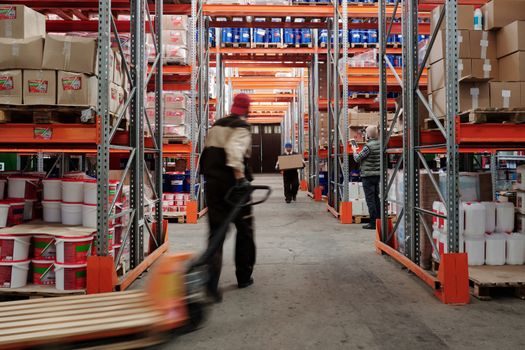
AGVs are a strong fit for operations moving more than 300 pallets per day on fixed or semi-fixed routes, for 24/7 production lines where shift handover is a bottleneck, and for cold-chain and cleanroom sites where reducing human traffic is a regulatory or yield issue. Allied Market Research lists automotive, manufacturing, food and beverage, aerospace, healthcare, logistics and retail as the principal adopting industries, with e-commerce growth cited as a structural driver for North American deployments [S2].
Magnetic-tape guidance in particular punishes plants that re-rack more than twice a year - the floor-strip removal and replacement alone runs $8-$15 per linear metre installed.
Standards, Safety and Sourcing Signals
Safety-rated LiDAR scanners and bumpers are no longer optional in 2025-2026 quotes: ISO 3691-4 (the driverless industrial truck safety standard) governs the requirement set that integrators must demonstrate at SAT, and the ANSI/ITSDF B56.5 standard remains the parallel North American reference. Buyers should require a documented risk assessment per ISO 12100 and a functional-safety file mapping each safety function to a Performance Level (PL) under ISO 13849-1 - including verification of any pressure transmitter loops feeding the safety PLC - otherwise the integrator has shifted risk onto the buyer's EHS team. [S2]
Sourcing signals worth tracking: the 16.6% 2020-2027 CAGR cited by Allied Market Research [S2] implies the integrator market is still capacity-constrained in 2025-2026, which shows up as 8-14 month lead times for laser-guided forklift AGVs and 4-6 month lead times for tow vehicles; if a quote lands materially under those lead times, the integrator is likely subcontracting commissioning - a risk for warranty support.
Two signals to track over the next 6-12 months: first, the spread between LFP and lead-acid battery quotes, which moved from a 50-60% LFP premium in 2023 to 25-35% in late 2025 and continues to compress; second, the publication of ISO 3691-4 amendment work covering mixed-traffic human-AGV zones, which will tighten the safety-zone engineering many 2024-2025 quotes were scoped against. Buyers with 2026-2027 deployment dates should pin their integrator scope to the standard in force at SAT, not at PO, to avoid mid-project re-engineering.
For related coverage, see Multi-Gas Detector TCO: Sensor, Calibration and Certification Cost Levers.