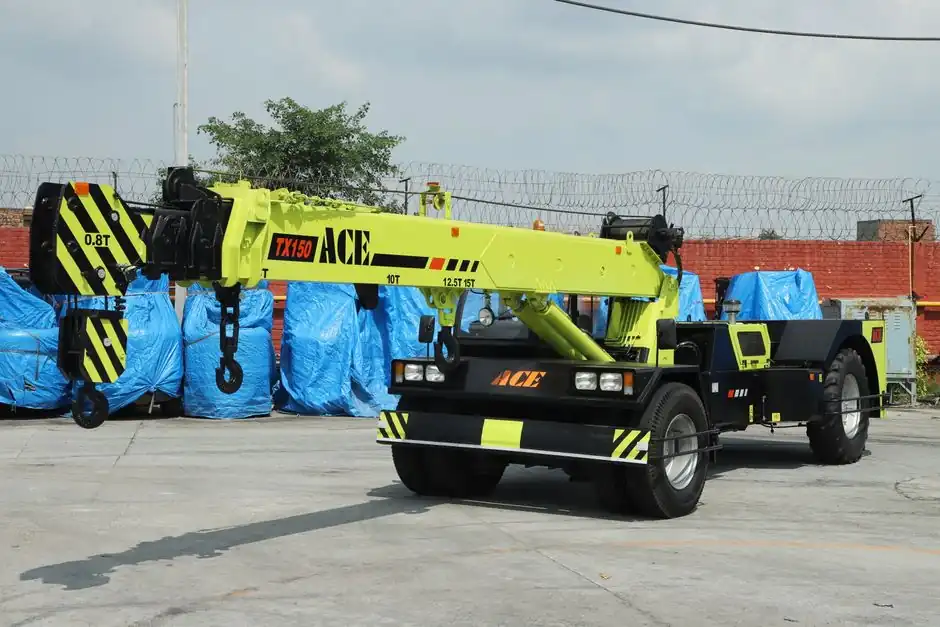
Crawler crane booms for safe lifting are generally operated between a 10 to 20 degree minimum and a 75 to 85 degree maximum, with the 70 to 80 degree band described as the practical sweet spot where the load stays close to the tipping axis and rated capacity is preserved [S4][S2].
Below 30 degrees the boom approaches horizontal and the operating radius (the horizontal distance from the crane's tipping axis to the load) stretches to its maximum, multiplying tipping moment and forcing the operator far down the load chart; above roughly 80 degrees the boom nears vertical, the radius collapses toward the boom foot, and the chart again must be respected because the geometry, not the hydraulics, is what governs capacity [S2][S4].
What "Maximum Boom Angle" Actually Means on a Crawler Crane
The maximum boom angle is the upper limit a manufacturer sets for the boom's centerline above horizontal, typically enforced by a mechanical boom stop at the boom foot and cross-checked by the Load Moment Indicator (LMI) [S3]. For lattice-boom crawler cranes, this upper limit is commonly stated as 70 to 80 degrees, a range chosen to prevent capacity loss at steep angles while keeping the structure stable [S5]. For telescopic boom crawlers, the same 70 to 85 degree band is quoted, the wider end reflecting the extra articulation of nested sections [S5].
Published operating data for crawler cranes shows typical upper limits of 75 to 85 degrees, with most modern machines clustering in the 78 to 82 degree band for general duty, and wind-energy erection work routinely running at 70 to 80 degrees to set turbine blades above 100 m hub height [S4]. A 300-ton class crawler, for comparison, can be rated to lift roughly 50 t at a 10 degree short-radius configuration but only around 5 t at an 80 degree vertical configuration, a tenfold swing that is governed entirely by the boom angle, not the engine [S4]. For broader machine geometry context, see the crawler crane encyclopedia entry.
Why 70 Degrees Is Treated as the Capacity Sweet Spot
At a 70 degree boom angle the load is held close to the crane's center of gravity, the horizontal lever arm from the track edge to the hook is short, and rotational torque on the tracks is at a working minimum, so the machine can use the upper end of its rated chart [S2]. As the boom drops through the transition zone toward 45 degrees, the load's horizontal distance from the tipping point grows sharply, the chart reads a much smaller number, and the operator must consciously trade capacity for radius [S2].
At 30 degrees the boom is nearly horizontal, the radius is at its maximum, and the load chart is at its minimum: this is the high-risk band where the law of the lever works against the machine, and most lift plans either avoid it or restrict it to light tag work with the superstructure carefully aligned over the tracks [S2].
Selection Criteria: Lattice vs Telescopic vs Articulating
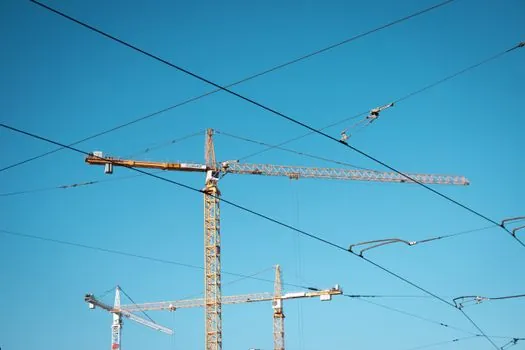
Boom type sets the usable angle window. Lattice booms on heavy crawler cranes typically run from about 10 degrees at the low end to 70 to 80 degrees at the high end, and they carry the largest rated charts but require pinned assembly on site [S4][S5]. Telescopic booms on crawler carriers are quicker to rig and reach 70 to 85 degrees, but at full extension their capacity is reduced compared with a lattice boom of equal length [S4][S5]. Articulating knuckle booms are a different category, with articulation arcs that can run 125 to 180 degrees between sections; they trade raw capacity for obstacle-avoiding geometry and are rarely used in heavy crawler duty [S5].
Compare the three side by side on the angles that actually drive a lift plan:
Lattice crawler boom: working window roughly 10 to 80 degrees, best chart at 70 to 80 degrees, longest reach per ton of machine weight, longest rig time [S4][S5]. Telescopic crawler boom: working window roughly 10 to 85 degrees, fastest setup, capacity drops as sections extend, preferred for job-site mobility [S4][S5]. Articulating boom: working envelope up to 180 degrees of joint articulation, lower raw capacity, used for obstacle-avoiding lifts rather than pure heavy lift [S5].
Factors That Compress the Safe Angle Window
Ground slope matters as much as the chart. Crawler tracks are tolerant of soft ground but slopes above about 1 to 2 degrees generally require outriggers, mats, or a re-rated chart before any boom angle is locked in [S4]. Wind, load sway, and dynamic picking cut into the upper end of the window: many operators cap working boom angles at 75 degrees in steady wind, with the exact ceiling set by the manufacturer's wind-speed chart for the configuration in use [S4].
Boom length is the second compressor. A 30 m boom on a given crawler at 85 degrees sits almost over the cab and the chart reads at its maximum vertical-lift value, while the same boom at 30 degrees puts the hook far out and the chart collapses [S6]. The combination of long boom and low angle is the configuration where lift directors most often require a second chart check, a tag-line plan, and a reduced travel radius around the load [S6].
Hardware That Enforces the Limit
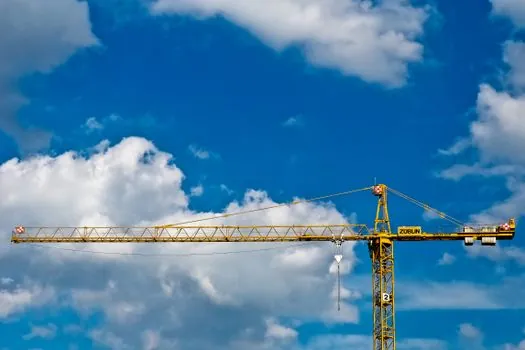
Three systems physically police the boom angle window. The boom stop is a mechanical device that physically blocks the boom from going over the manufacturer's maximum angle, normally set just below the published upper limit so the structure cannot be driven into a beyond-range condition [S3]. The Load Moment Indicator (LMI) continuously compares actual radius, boom length, load, and angle against the chart in the ECU and cuts lifting motion when the combination approaches the limit [S4]. On premium crawlers, systems such as Liebherr's Boom Booster automatically re-trim the boom angle to hold capacity during complex picks rather than letting the operator drift into a low-capacity zone [S4].
For mobile crane comparisons on transport and reach versus the crawler format discussed here, the mobile crane reference and the gantry crane reference cover the wheeled and rail-mounted alternatives. For weighing the load that any of these machines is angle-lifting, the crane scale reference covers the dynamometer and load-cell options used to verify the chart.
Who Should Respect the Window and Who Can Push It
Riggers and operators planning a routine pick should hold to the 30 to 80 degree band, treat 70 to 80 degrees as the default working zone, and avoid the 10 to 30 degree band unless the chart and the lift plan both confirm the radius [S2][S4]. Wind-farm erection crews are the main exception: turbine installation routinely runs at 70 to 80 degrees because the work is defined by hub height, and machines such as the SANY SCC2500A are rated to lift 250 t at an 80 degree boom angle for exactly that duty [S4]. Anyone working with a worn or non-OEM boom, a non-OEM chart, or a load that the operator cannot positively identify should treat the published upper limit as a hard ceiling, not a guideline, and lift below it.
For related spec-driven reading on equipment that lives on the same heavy-lift sites, the counter-capability procurement signals digest and the AMR market 2026 warehouse versus manufacturing floor breakdown sit alongside crawler lift planning on industrial procurement agendas.