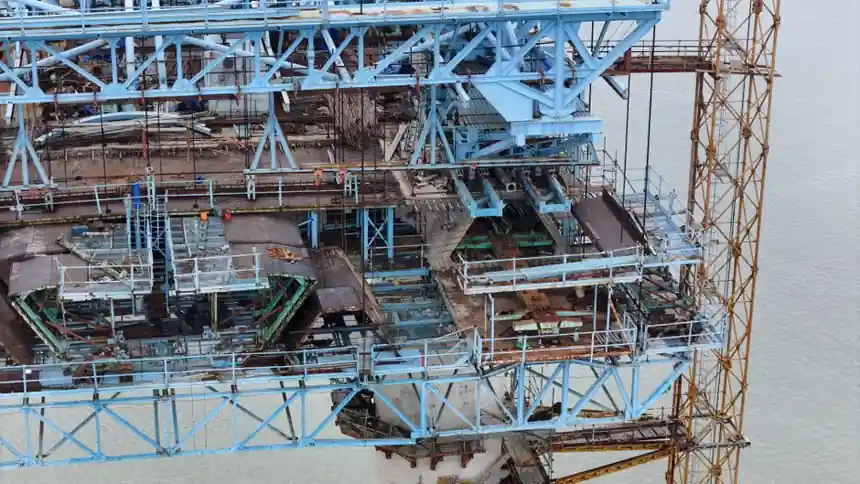
Track frame configuration on a crawler crane governs three engineering variables: transport envelope, ground-bearing footprint, and assembly labour on site, with telescopic-boom crawlers typically shipping on hydraulically extended side frames and larger lattice-boom crawlers shipping with fully removable side frames for separate loading [S1][S3].
OEM data shows the telescopic-boom GTC-600 class adjusts operating width hydraulically from 3.28 m to 4.80 m (with 750 mm shoes) without pinning the frames in a fixed position, and uses an AML-C rated capacity indicator to auto-select the correct load chart for that track width [S1]. For a deeper look at how base width feeds into pick-and-carry charts, see Reading a Crawler Crane Load Chart by Boom Length and Radius.
Two structural architectures: pinned-fixed vs hydraulically extendable
Tadano's GTC telescopic crawler line is shipped with track frames in a 3.28 m retracted transport width and extended on site to 4.80 m for full lifting capacity, with the AML-C system switching load charts at 1.5°, 2.5°, and 4° slope limits [S1]. The crane carries 71,300 lbs (about 32 t) in standard transport configuration and uses a Cummins Tier 4f QSB4.5 rated at 173 hp with two-speed track drives peaking at 3.4 km/h and 70% unladen gradeability [S1].
Lattice-boom crawlers such as the Kobelco CKE1100 (110 t max lift at 3.6 m radius) use a different architecture: a 99 t operating weight machine with 92.9 kPa ground pressure, 34 t of counterweight, and a self-removal weight split where counterweight and crawler are detached for separate transport loads of about 40.7 t each [S2]. For an overview of the basic machine layout, the crawler crane reference covers carbody, side frames, track shoes, and idler/sprocket geometry.
Removable frames: patent-level mechanics and on-site procedure
US patent 3,820,616 (filed Feb 1972, issued June 1974, assigned to American Hoist & Derrick) describes a dual extensible side frame where hollow axle members slide in the carbody and inside the side frame itself, allowing both lateral adjustment and complete removal of the side frames for separate over-the-road transport to bypass axle-weight limits [S3].
The patent explicitly states that complete frame removal overcomes the weight restrictions that would otherwise limit over-the-road travel, and that the lateral adjustment must happen at the jobsite using power means capable of overcoming the friction of the heavy crawler side frame on its sliding mounts [S3]. The wider design philosophy is captured in the gantry crane and mobile crane references, where modular undercarriage design follows the same axle-weight and transport-width logic.
Decision matrix: which configuration fits which job

Four criteria line the two architectures up against each other. (1) Transport envelope: extendable frames give one shipping width per pinned position (3.28 m on the GTC) while removable frames split the machine into separate loads of roughly 40.7 t (CKE1100) [S1][S2]. (2) On-site setup time: hydraulic extension is minutes with the AML-C auto-charting, full removal-and-reassembly is hours requiring a helper crane for the side frames [S1][S3]. (3) Lifting stability: wider extended footprints lower ground pressure and increase overturning margin, which is why the GTC charts switch with width and slope [S1]. (4) Reconfiguration range: the patent design allows both incremental sliding and complete detachment, which neither a pinned-fixed frame nor a simple telescopic frame can do alone [S3].
For lattice-boom cranes destined for long-term bridge, shaft, or steel-erection work where the crane will sit for weeks, removable frames with a quick-reconnect carbody interface typically pay back the extra rigging labour [S2]. For rental telescopic crawlers that move between short-duration pick-and-carry jobs, hydraulically extendable frames are the lower-friction choice because the AML-C chart switch removes the operator's manual width calculations [S1]. When evaluating how this interacts with boom angle and radius, the working envelope discussion in Crawler Crane Boom Angle Limits for Safe Lifting: 70 to 80 Degree Working Range provides the matching geometry.
Rigid vs oscillating frames: ride and stability trade-off
Field experience on dozers with rigid (non-oscillating) track frames shows a clear ride-versus-stability trade-off: rigid frames ride rougher over rocky ground but hold a steadier line on side slopes and during single-shank ripping, while oscillating frames with an equaliser bar smooth the ride and keep both tracks loaded on angled terrain [S4].
Operators running D65 and D41 Komatsu machines report that oscillating frames level better up to final cut and put more power to the ground on angled approaches, but rigid frames are preferred for steep hill work and ripping because the machine does not "flop around" on the slope [S4]. The same logic carries to crawler crane side frames: a rigidly pinned frame at full extension resists swing-induced tipping moments better than a loosely guided sliding frame, which is one reason telescopic crawlers still pin the track width once the AML-C chart is selected [S1].
Field realities: maintenance, wear, and track shoe selection

Maxtop's 2026-02-26 crawler crane component guide flags the track frame, track shoes (crawler plates), main boom, and jib as the wear items that drive maintenance planning, with track frame inspection for excessive wear or damage called out as a recurring task [S6].
Tadano offers optional narrower 750 mm-class track shoes that pull the GTC's minimum operating and transport width down to 2.59 m, and overall height can be reduced to under 2.44 m, which is a configuration lever that pinned-fixed frames cannot offer [S1]. For storage and yard logistics between deployments, the stacker crane reference covers the related narrow-aisle undercarriage geometry, although stacker cranes are rail-bound and the comparison is purely on the transport-width axis.
Self-rigging and jack-up systems on modern telecrawlers
Self-propelled telecrawlers now ship with on-board jacks mounted to the carbody frame, used both for easy installation of the track assemblies and to hydraulically lift the upper for track service, which removes the need for a secondary crane during removal-style maintenance on the side frames [S7].
This is a meaningful shift from the 1974 American Hoist patent, where the carbody had to be craned or jacked externally to separate the side frames; modern OEM designs integrate the cylinders, so the "removable" frame workflow is closer to a controlled shop procedure than a field rigging event [S3][S7]. Buyers comparing this against lattice-boom modular designs should weigh the self-rigging kit against the heavier separate-load transport option, which is the same trade-off the CKE1100 self-removal weight split is designed to address [S2].
Failure modes and what the research flags as watch items
The dozer field-repair thread documents a recurring failure mode worth translating to crane undercarriages: broken mounting bolts between the frame rail and bell housing on a John Deere 350, which froze the side frame and forced a full frame-rail removal to extract the broken studs [S5]. The recommended field procedure is to split both tracks, remove the dozer equipment, drop both side boxes and fenders, then jack the powertrain up to clear the front crossmember before unbolting the frame rail [S5].
The same bolt-failure mechanism applies to crawler crane carbody-to-side-frame interfaces when the side frame is pinned at full extension and the crane picks heavy eccentric loads: the crossmember bolts take the entire moment, so a periodic torque audit on those fasteners is part of any removable-frame maintenance plan [S3][S5]. For a related bolted-joint discussion, Dock Leveler Rear Frame Shimming and Weld Sequence: Installation Spec covers frame-leveling tolerances and weld sequencing that translate directly to side-frame shimming on crawler undercarriages.
Track frame configuration on a crawler crane is therefore a design choice, not a specification footnote: telescopic crawlers win on speed of width change between jobs, lattice-boom crawlers win on axle-weight compliance for long hauls, and the 1974-vintage American Hoist dual-extensible design remains the engineering reference for any modern OEM offering both lateral adjustment and full removal in one undercarriage [S1][S2][S3]. Next signals worth tracking: the next AML-C firmware revision note (which controls the auto width-and-slope chart switch on GTC-class cranes) and any new lattice-boom OEM self-rigging kit that closes the gap with telecrawler on-site times.