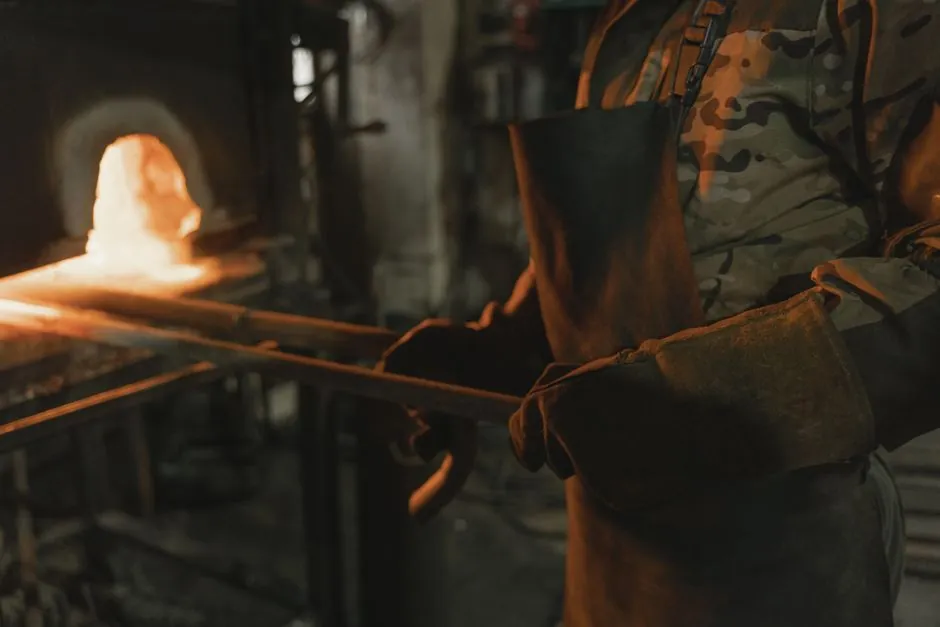
Small-foundry crucible furnace capacity spans 18-2,000 kg across mainstream product lines, with the 50-200 kg band explicitly positioned for small-to-medium industrial operations, repair shops, and production foundries [S1].
Within that envelope, hydraulic-tilting induction models from CDO cover 18-100 kg for iron or stainless steel and 50-250 kg for aluminum or copper [S3], while gas- and oil-fired crucible melting furnaces from WOLFU run 0.1-2.0 ton (100-2,000 kg) at 80-1,000 kW depending on configuration [S4].
Capacity bands and what they actually mean on the shop floor
Buyers and engineers classify crucible furnace capacity into four working bands: hobby (1-5 kg), workshop (10-30 kg), small-to-medium industrial (50-200 kg), and heavy industrial (500 kg and up) [S1]. The 50-200 kg band is the practical sweet spot for most small foundries doing real production work, because it is large enough to pour a meaningful number of castings per shift but small enough to start cold and reach temperature in a workable shift window.
Within a single OEM catalog, the spread is wider than the band name suggests. CDO's hydraulic-tilting induction series lists five standard models covering 18-100 kg for ferrous melts and 50-250 kg for non-ferrous melts, with a separate CDO-HT family sized for 50-250 kg non-ferrous [S3]. The same vendor's gas-fired series (HORCF) starts at 100 kg (HORCF-100, 45 kW, 60-90 kg/h melt rate) and steps to 250 kg (HORCF-250, 100 kW, 150-220 kg/h) [S6]. That is a 2.5x capacity jump for a 2.2x power increase, which is the kind of scaling curve a process engineer should sanity-check against local electricity or gas tariffs before ordering.
Fixed versus tilting: when each makes sense
Fixed crucible furnaces used as melting devices in aluminum die casting foundries generally have a capacity of up to 1,000 kg, while tiltable furnaces are available with capacities of up to 1,500 kg; for heavy metals, even larger units exist [S2]. The fixed design is mostly used as a holding and bale-out furnace in ingot and die casting foundries, where it is charged with pre-melted metal and equipped with automatic temperature control to keep the bath at a constant casting temperature.
Tilting units are the workhorse for non-ferrous foundries that melt cold charge, because the operator can pour directly from the crucible lip without a ladle. The tiltable geometry also unlocks recuperative burner integration, which pre-heats combustion air to deliver fuel savings in the 25-38% range versus cold-air burner systems [S2]. For a 50-200 kg small foundry running two shifts on propane or natural gas, that efficiency band is the difference between a furnace that pays back in three years and one that does not.
Comparing the main small-foundry options
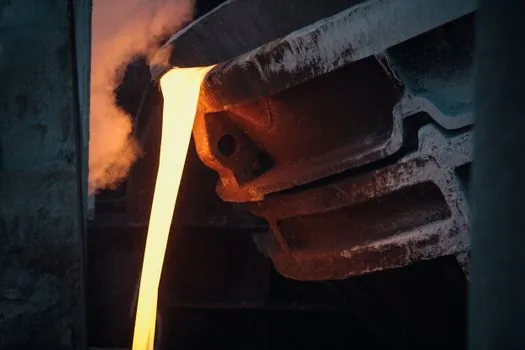
Three furnace families compete for the small-foundry capacity slot, and each has a different cost, control, and fuel profile. The crucible furnace family itself splits into gas/oil-fired and electric resistance-heated versions, with the induction furnace family as the electromagnetic alternative. The cupola furnace is a different beast entirely and is rarely the right answer below 500 kg of iron per hour. [S1]
On four decision criteria that matter to a small foundry buyer: (1) Temperature ceiling, gas-fired crucible units reach roughly 1,649 degrees C versus about 1,316 degrees C for typical electric resistance crucible furnaces, so copper, cast iron, and steel need gas, oil, or induction [S1]. (2) Indoor usability, electric units are workshop-safe with ventilation, gas-fired units are not recommended indoors, and induction is indoor-clean. (3) Capacity granularity, induction vendors sell 18-100 kg steps for ferrous, gas vendors sell coarser 100-250-500-1,000-2,000 kg steps [S3][S4][S6]. (4) Capital cost, hobby electric pots start around $200-$500, while industrial 50-200 kg units sit in the $2,000-$50,000+ range [S1].
Matching capacity to metal and melt rate
Metal compatibility sets the lower temperature bound, which then filters the furnace family before capacity even enters the calculation. Aluminum melts at 660 degrees C, brass and bronze at 900-1,065 degrees C, copper at 1,083 degrees C, cast iron at 1,150-1,200 degrees C, and steel at 1,370-1,480 degrees C, so a furnace rated to 1,316 degrees C handles aluminum and most brasses but not iron or steel [S1]. Graphite or silicon carbide crucibles are the standard recommendation for the 900-1,200 degrees C band.
Melt rate is the second filter, because two 100 kg furnaces can have very different shift throughput. StrikoWestofen specifications cited in the foundry lexicon put electrical-heated crucible melting at approximately 250 kg Al/h and fuel-heated units at up to approximately 400 kg Al/h [S2]. The HORCF-100 gas-fired model from Hormesa lists a 60-90 kg/h melt rate at 45 kW, while the HORCF-250 lists 150-220 kg/h at 100 kW [S6]. For a foundry sizing a 100 kg furnace to an 8-hour shift, the realistic output is 480-720 kg of aluminum per shift, not the 800 kg a naive 100 kg/h calculation would suggest.
Limitations, failure modes, and what the data does not show
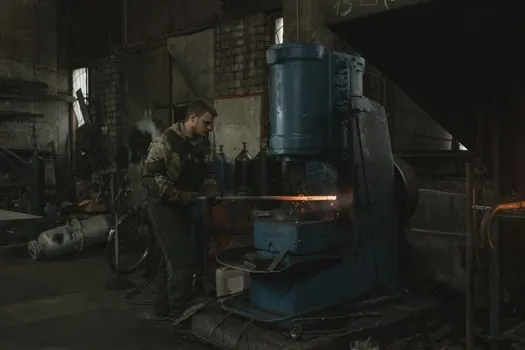
Small-foundry crucible furnaces have real constraints that the marketing material tends to understate. Fixed non-tiltable units should be used exclusively as holding furnaces, because subsequent addition of cold charge metals into a ready-to-cast hot melt will in any case cause a temperature drop, which may have a detrimental effect on casting [S2]. That means a fixed unit is a complement to a tilting melter, not a replacement.
Crucible selection itself is a failure-mode variable. Crucibles are chosen as graphite (with glazing coat and clay binder), silicon carbide, or cast iron / special cast iron / cast steel / sheet steel (the last category particularly for magnesium and zinc alloys) depending on operating temperature and alloy chemistry [S2]. Mixing the wrong crucible with a high-zinc alloy, or running a graphite crucible above its rated temperature, is the most common way a 50-200 kg installation goes down for a week. The research material does not give published MTBF or typical campaign life numbers for any specific model, so those have to be requested from the OEM directly.
Sourcing and specification discipline
For a small foundry writing a purchase spec, the minimum data set to lock down before quoting is: alloy family, hourly melt rate target, maximum pour weight per shift, fuel or power available on site, indoor versus outdoor siting, and crucible material preference. With those five numbers, the capacity band narrows quickly. A 50-200 kg melting furnace for non-ferrous workshop use, indoor, with three-phase power available, points almost exclusively at the 50-100 kg induction or small electric resistance segment, and the spec can be sent out for quotation the same day. [S1]
Trackable signals worth watching over the next quarter: WOLFU and other Asian OEMs are publishing 0.1-2.0 ton crucible furnace catalogs with 80-1,000 kW options and explicit non-ferrous positioning [S4]; CDO is expanding the small induction range with 18-100 kg ferrous and 50-250 kg non-ferrous variants on a single hydraulic-tilting chassis [S3]; and gas-fired vendors are tightening the melt-rate gap to induction by adding recuperative burners in the 25-38% fuel-savings band [S2]. A small foundry evaluating quotes in 2026 should expect each of these to be negotiable down, not up.
This topic is covered further in Particle Counter Count for ISO 7 Cleanrooms: Spec Map and Selection.