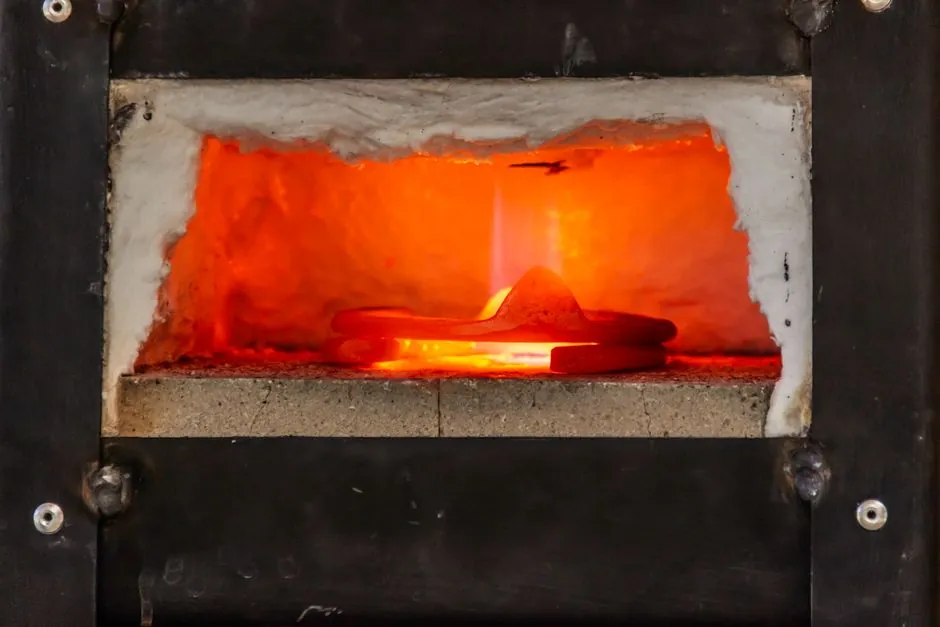
Foseco's catalogue lists crucible model numbers from #16 to #1100 covering approximately 16 kg to 1100 kg of copper charge, with the producer explicitly offering aluminum crucibles above 3 tonnes on request [S1]. A separate model-by-kg table from the same source pairs each rated capacity with outer height, outer diameter, and base diameter, so the kg figure is the entry point and the geometry follows.
For tiltable crucible furnace systems, fixed non-tiltable designs typically cap at 1000 kg aluminum, while tiltable units reach 1500 kg, and dedicated heavy-metal furnaces extend further; melting output runs around 250 kg Al/h on electric heating and up to 400 kg Al/h on fuel firing, per StrikoWestofen specifications cited in the foundry lexicon [S3].
Reading the kg-based size chart: rated capacity vs working capacity
Crucible model numbers encode the rated melt capacity in kilograms of aluminum or copper, so a #16 crucible holds about 16 kg and a #400 holds about 400 kg of those reference metals; the working capacity should stay at 85-90% of that rated value to absorb thermal expansion and allow safe stirring [S2]. For reactive metals such as magnesium, the safe fill drops to roughly 70% of rated capacity [S2].
Because copper and steel have higher densities than aluminum, the same physical crucible holds fewer kilograms of those metals; suppliers recommend derating capacity for higher-density charges [S2]. A ferrous melt above 1600°C also drives thicker-wall crucible grades, which further reduces the effective melt weight per charge [S2].
Dimensions that travel with each kg rating
The Foseco shape-A table pairs rated capacity (kg Cu) with H, D, and d in mm: 16 kg at H 230 / D 185 / d 125 mm, scaling up to 1100 kg at H 890 / D 645 / d 420 mm, with shape-C crucibles also listed at 80 kg and 200 kg [S1]. Special induction-furnace shapes in the same catalogue jump from 120 kg at H 890 / D 560 mm to 265 kg at H 762 / D 445 mm, with the largest 180 kg-class units reaching 1200 mm tall [S1].
Cylindrical induction crucibles with long spouts run 110 L to 410 L, with the 410 L unit at H 1575 / D 525 / d 480 mm and a B dimension of 815 mm [S1]. A second grade listing for Diamant-class crucibles extends to 2025 mm height at 1025 mm outer diameter, indicating 1350-2025 kg class units for high-power induction service [S1].
Selection rules that turn kg ratings into a real installation
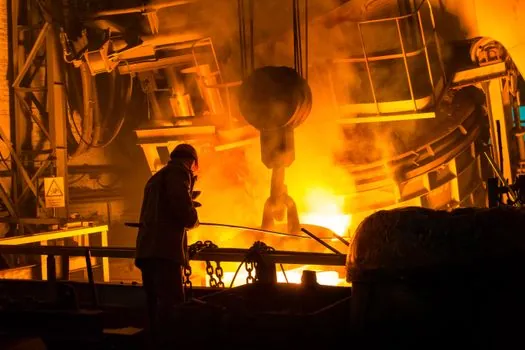
Match the rated kg to the furnace chamber: the crucible outer diameter must sit 20-30 mm below the furnace inside diameter to allow combustion-gas flow and clean extraction [S2]. Higher furnace power widens the choice of crucible volume, so a 100 kW-class induction furnace can melt substantially more per cycle than a 30 kW unit before the crucible becomes the bottleneck [S5].
Choose shape to match the furnace type: A-shape (tapered) suits pit furnaces, B-shape (straight wall) suits tilting furnaces, and bilge shapes cover transfer and special pouring duties [S2]. For a melt held in a holding furnace, the kg rating should match the holding bay's hourly throughput, not the melting furnace's peak output, to keep residence time predictable [S3].
Comparison of common size classes by decision criteria
Three kg bands cover most foundry jobs, and the decision criteria are batch size, furnace class, and handling method. A No. 16 to No. 100 crucible (16-100 kg Cu, H 230-400 mm) fits small benchtop and laboratory furnaces and is hand-liftable; a No. 200 to No. 500 unit (200-500 kg Cu, H 480-590 mm) suits mid-size gas-fired aluminum melting furnaces with mechanical bailers; a No. 600 to No. 1500 unit (600-1500 kg, H 600-890 mm) demands a tilting frame and a dedicated cupola furnace or large crucible furnace, with lifting by hoist only [S1][S3].
On energy and cycle time, smaller crucibles melt faster per kg but require more batches; larger crucibles reduce oxidation losses per kg of melt because the surface-to-volume ratio drops, and a single 1500 kg tilt pour replaces ten 150 kg hand pours for the same throughput [S2]. Safety margin, however, stays at 80-90% regardless of class, so a 1500 kg rated crucible should never carry more than about 1350 kg of liquid aluminum in service [S2].
What the chart does not tell you
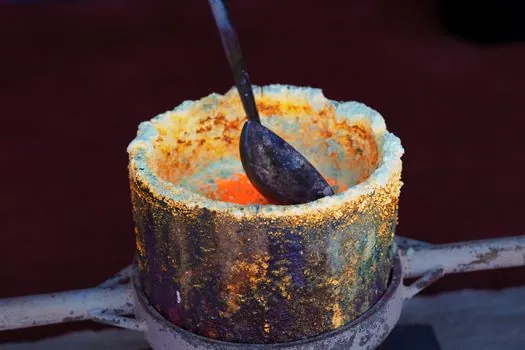
Model-number capacity assumes a reference metal; switching from aluminum to copper at the same kg rating means the crucible wall sees roughly twice the mass per unit volume, with corresponding changes in heat flux and erosion rate [S2]. Chart values also assume the standard Foseco clay-graphite or isostatically pressed silicon-carbide grades; a high-frequency induction application typically requires a special "Diamant Top" grade with very high electrical resistivity, which has its own kg-and-dimension table rather than inheriting clay-graphite numbers [S1].
Custom sizes and capacities above the published table are routinely quoted on request, and Foseco's catalogue explicitly states that "customised shapes and sizes are available on request" alongside the off-the-shelf sizes that stop around 1100-1500 kg for most copper-rated shapes [S1]. For the largest 3-tonne aluminum crucibles, the kg-class size chart transitions from off-the-shelf stock items to engineered supply.
Trackable signals: the next edition of major crucible catalogues (Foseco / Vesuvius, Morgan, Superior Graphite) typically revises only dimensional tolerances and grade splits, not the kg-class model-number ladder, so spec work built on the 16-1500 kg chart remains stable. For process engineers planning a new pour schedule, cross-check the kg rating against the planned alloy density and the furnace chamber's inside diameter before locking a crucible furnace capacity sizing decision, since 20-30 mm of wall clearance and 10-20% headroom for thermal expansion are the two numbers that most often get misread off the size chart.