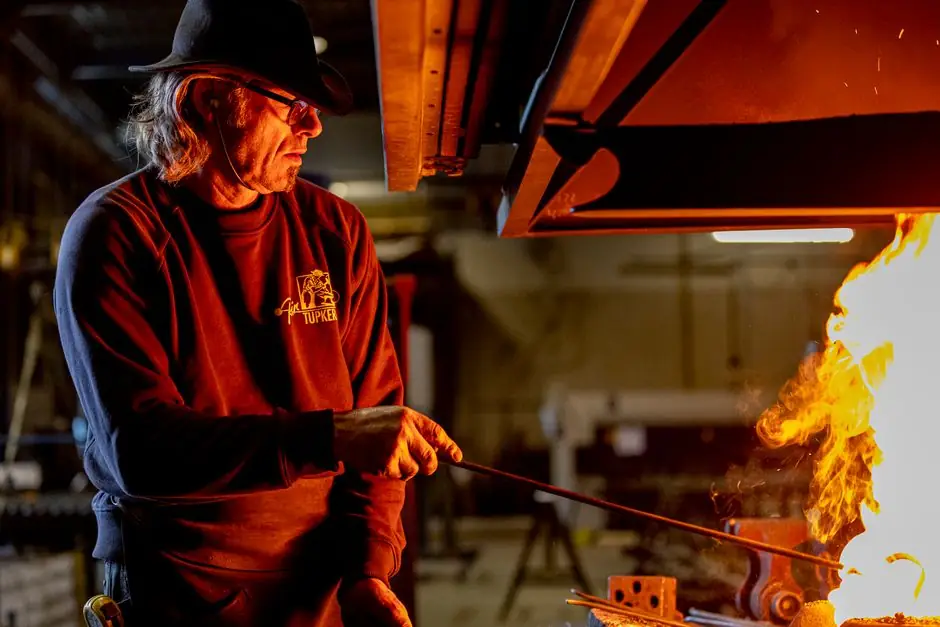
Crucible handling tongs and crucible pouring shanks perform two different jobs in a foundry: tongs grip the bilge of a hot crucible to extract it from a crucible furnace, while shanks cradle the same crucible during the pour into the mold [S2][S5].
MIFCO explicitly states its tongs and shanks are "designed and manufactured according to recommendations of the Crucible Manufacturers Association" and are sized for bilge-shaped crucibles only, with custom fitting available by sending the actual crucible in [S2]. Angele-shop in Germany prices its crucible tong from €93, the scissor two-man version from €259, the shank for crucibles up to 8 kg from €59, and the heavy two-part shank from €175 (as listed on 2026-10-22) [S5].
Crucible Tongs: Geometry, Build, and Operating Range
Crucible tongs are welded steel tools that close on a crucible bilge and rely on a locking latch to prevent drop events during transfer, with a built-in adjustable stop that limits gripper pressure so a molten-metal-filled crucible is not crushed [S1][S2].
MIFCO's design uses die-formed claw grippers matched to the bilge contour, steel webs for rigidity, and an adjustable stop: starting at the #40B size, every tong carries links and rings, with the locking latch able to hold the tong open or closed so the crucible cannot fall once captured [S2]. Angele-shop offers three tong variants: a top-loading compact tong drop-forged from C35 steel at €93, a scissor two-man tong at €259 for heavy top-loading furnaces, and a front-loading forging-furnace tong at €70, with all gripper claws specifically matched to individual crucible sizes [S5]. For a two-man transfer, MIFCO fits bent-handle 90° tongs in size 40 and larger with hoist rings, and the same maker warns explicitly that the bent-handle configuration "cannot use with a T-80 furnace" [S2].
Crucible Shanks: Single-Operator vs Two-Man Designs
Crucible shanks are foundry tools that hold the crucible of molten metal while pouring the molds, made in two standard configurations: a one-man Hand Shank and a two-man Single End Shank, both built around a die-formed ring sized to the bilge below the maximum diameter [S2].
MIFCO's Adjustable Safety Single End Pouring Shank uses a bail and four-point suspension pads inside the ring, with deliberate air space between the crucible and the band to block heat transfer from the crucible to the operator-side steel [S2]. The MIFCO Safety Shank was developed "at the request of school administrators" to remove the hazard of accidentally dropping a crucible of molten metal, and is now required by safety regulations in school shops and commercial foundries [S2]. Angele-shop draws a hard weight line: its standard one-piece shank is rated for crucibles up to 8 kg, with the maker explicitly stating "heavier crucibles should be removed from the furnace using crucible tongs and then handled with a fork by two people" [S5]. The two-part Angele shank (€175) and the matching stand (€120, for forks at 180/220/270 mm diameter and 15/25/50 kg capacity) handle the heavier range, and the stand provides "stable base even on uneven surfaces" [S5].
Decision Matrix: When to Specify a Tong, a Shank, or Both
The two tools overlap only at the lift-out step; the cleanest spec is tongs for furnace extraction, shanks for the pour station, and an optional stand for the heavier two-man shank [S2][S5].
For a hobby A6/A8 setup (roughly 5–10 kg of melt), a single top-loading tong at €70–€93 plus a one-man shank at €59 covers the full workflow, and this is the configuration Black Dragon Forge builds into its A6 and A8 Smelting Starter Kits (March 2026 product line) [S4][S5]. For a 30 lb (≈13.6 kg) aluminum pour in a #40 bent crucible, MIFCO specifies a No. 40 Bent Crucible Tong with two-man handling, which can be locked open or closed and includes links and rings from #40B upward [S2]. For A12, A16, and A20 bilge crucibles (Vesuvius silicon carbide, as discussed in the March 2025 Canadian Hobby Metalworkers thread), neither a hobby lift-out tong nor a home-made shank is adequate, and operators must match a dedicated shank ring to the exact crucible SKU [S3]. The cross-reference rule from MIFCO: "DUE TO VARYING DIMENSIONS IN CRUCIBLE SIZES, PLEASE SPECIFY THE CRUCIBLE BRAND AND PRODUCT NAME THAT YOU ARE USING" and verify the gripper fit before the first heat [S2].
Use-Case Fit: Studio, School, and Small Foundry
Studio knife-makers and small-batch casters typically run A6–A10 crucibles in the 4–12 kg melt range, where a single-operator tong and a one-man Hand Shank give full control with one pair of hands per pour [S2][S4][S5].
School shops and commercial foundries handling A16+ crucibles should default to the MIFCO Safety Shank in either Hand Shank or two-man Single End configuration, because the safety design has been "tested thoroughly in school shops and commercial foundries, where safety regulations specify its use" [S2]. Larger front-loading forging furnaces pair with Angele's €70 front-loading tong rather than the top-loading pattern, since the geometry of the door opening dictates the gripper orientation [S5]. The hobby-metalworker thread from March 2025 confirms that even experienced operators "do not like" improvised shanks built in 2015 for B12 silicon carbide crucibles, reinforcing that matched, brand-specific shanks are a safety investment rather than an accessory [S3].
Failure Modes and Maintenance Rules
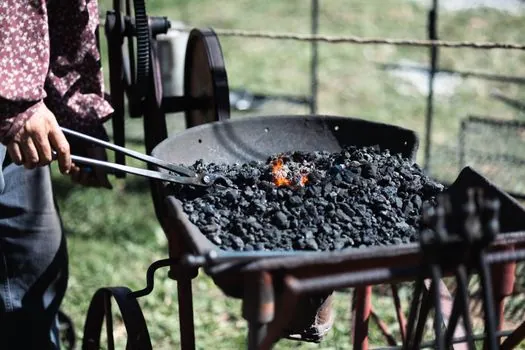
Excess gripper pressure is the second failure path: an adjustable stop on the tong prevents the operator from over-squeezing and crushing a crucible of molten metal, but the stop must be set per crucible SKU and rechecked after every reline [S2]. Shanks should be kept greased, and any slag that accumulates on the ring or gripper must be wire-brushed off before the next heat, per MIFCO's operating notes [S2]. Nuts and bolts on links and rings need a tightness check before every pour because thermal cycling walks fasteners loose over a season [S2]. MIFCO also offers to fit a customer's actual crucible at the shop if a buyer is unsure about the match, which is the cleanest way to eliminate the fit-risk on a non-standard A-clay graphite or B-silicon carbide size [S2].
Standards, Sourcing, and Integration Notes
MIFCO designs follow the Crucible Manufacturers Association (CMA) recommendations for bilge crucibles, which is the only formal industry body referenced in the available maker documentation [S2].
For U.S. school shops, the MIFCO Safety Shank is the documented baseline where safety regulations mandate a positive-locking shank; for European studios, Angele's CE-marked German-made tongs and shanks (drop-forged C35 steel, Owatrol oil finish) integrate with ECOCAST-style top-loading furnaces demonstrated at the Hennef 2013 casting course [S5]. Cross-spec note: a holding furnace or gas aluminum melting furnace does not change the tong or shank geometry, but it does change the ergonomic distance the operator must carry the load, which usually pushes A12+ pours toward the two-man shank regardless of weight [S2][S5]. For matched crucible selection behind these tools, the spec-driven graphite vs clay-graphite tradeoff and the A6 vs A8 starter-kit framing are covered in graphite vs clay-graphite crucible selection and crucible size selection for jewelry vs foundry casting.