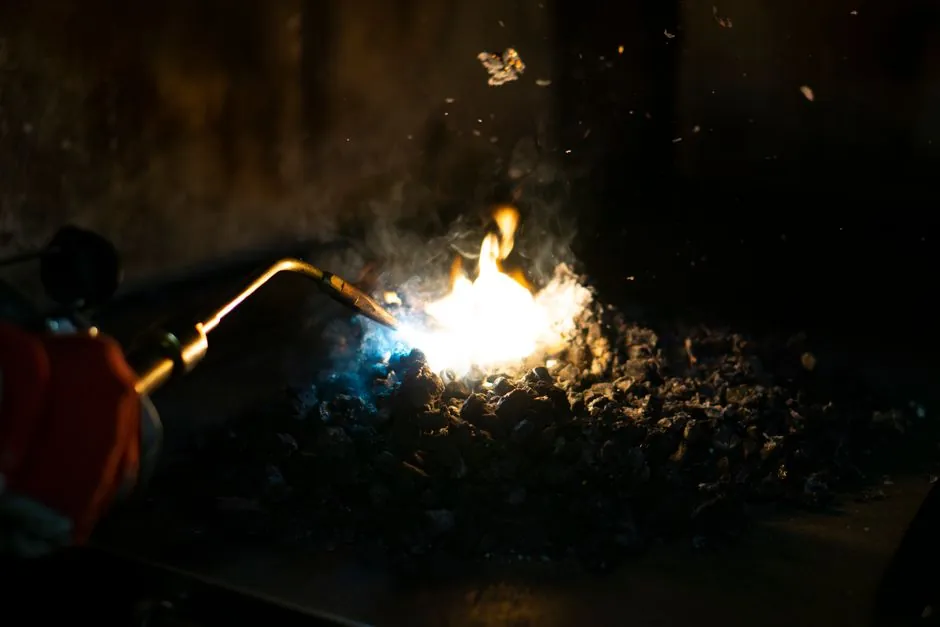
Silicon carbide (SiC) crucibles combine high thermal conductivity with thermal-shock resistance that lets them survive rapid heating cycles, making them a default choice for induction and gas-fired melting of non-ferrous metals up to roughly 1,600-1,800°C [S3][S4]. The shock tolerance comes from the material's low thermal expansion and from the isostatic pressing and sintering route used in production, which yields thick, low-porosity walls and a service life that runs roughly four times longer than generic ceramic crucibles in matched service [S1].
The trade-off is oxidation: above 1,600°C in oxygen-bearing atmospheres SiC begins to decompose, so spec writers treat that number as the practical ceiling and call for inert-gas cover whenever the process climbs into the upper band [S1][S6]. For context on how the SiC body fits inside the broader family of furnace refractories, the silicon carbide overview covers the same chemistry from the refractory-stock angle.
What "Thermal Shock Resistance" Means for a SiC Crucible
Thermal-shock resistance is the ability of a brittle body to absorb a sudden temperature step without cracking, and it is governed by a combination of thermal expansion, thermal conductivity, elastic modulus, and tensile strength [S1]. SiC scores well on that combination because its thermal expansion is low while its conductivity is high, so a thermal gradient inside the wall dissipates quickly instead of building stress at the cold face [S3][S5]. The practical consequence is a crucible that can be charged with cold ingots, or recovered from a holding setpoint, without the preconditioning that alumina or clay-graphite pots demand [S2].
Roller-formed SiC bodies, where the graphite is aligned during forming, sit at the top of the shock-resistance ranking and are the variant Foseco recommends for furnaces with high cyclic loading [S2]. Compared with graphite, which is rated to roughly 3,000°C with near-zero thermal expansion, SiC peaks lower (1,600-1,800°C) but is harder, less brittle in cyclic service, and more resistant to oxidation in air [S4]. Compared with alumina (good to 1,700°C) and clay-graphite (good to 1,800°C), SiC wins on conductivity, which shortens melt time but loses on raw material cost [S3].
Preheat Schedule: The 200°C / 800-900°C Two-Stage Ramp
The single most cited cause of premature SiC crucible failure is skipped or rushed preheating, which traps bound moisture inside the wall and converts it to steam pressure on first heat-up [S1][S5][S9]. The widely published protocol is a two-hour hold at 200°C to drive off moisture, followed by a controlled ramp to 800-900°C before the crucible sees any molten metal or process ramp to working temperature [S1]. A simpler version for lab work calls for 20 minutes at low heat, then a climb to red-hot, then a power-off cool-down, with a visual crack inspection on every cycle [S5].
Charging matters as much as preheating: ingots must go in dry, placed loosely with a crucible tong so the SiC body can expand against the load rather than be point-loaded, and small pieces should cushion the bottom before heavier material is added [S1]. Skipping these steps is the documented path to a cracked pot, not bad material [S9].
SiC vs Graphite vs Alumina: A Spec Comparison
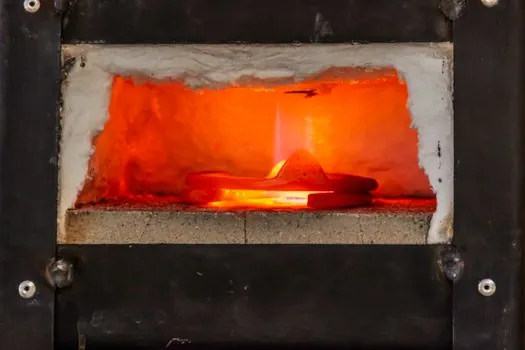
On the four criteria that drive crucible selection, the published numbers line up as follows for typical commercial grades: [S1]
Maximum continuous service temperature: graphite ~3,000°C, SiC 1,600-1,800°C, alumina 1,700°C, clay-graphite 1,800°C [S3][S4]. Thermal-shock resistance: SiC and graphite both rated high, with SiC slightly behind graphite but ahead of alumina in cyclic loading; graphite wins on raw expansion behaviour, SiC wins on hardness and oxidation tolerance in air [S4]. Thermal conductivity: SiC is the leader of the four, which is why it is preferred when melt rate per kW matters; see the crucible furnace reference for the melt-rate context. Atmosphere compatibility: SiC tolerates air at high temperature but needs inert cover above 1,600°C, while graphite needs protective coating or inert/reducing cover to avoid burn-off in open air [S1][S4].
For gold and silver refining at 99.9% purity, SiC is the default because the combination of shock tolerance and oxidation resistance prevents melt loss and preserves purity through repeated remelts [S5]. For processes that have to run above 1,800°C, the comparison flips toward graphite despite its brittleness and coating overhead [S4].
Where SiC Crucibles Fit, and Where They Do Not
SiC crucibles are the right answer for induction melting of copper, aluminium, gold, and silver, for gas-fired and resistance furnaces cycling non-ferrous alloys, and for glass and cathode-material work where conductivity and shock tolerance dominate the spec [S1][S5][S6]. Roller-formed SiC is the variant to specify where the furnace is a gas aluminum melting furnace or a high-cycle induction unit, because the aligned graphite structure reduces the probability of thermal-stress cracking [S2].
They are the wrong answer for sustained operation above 1,800°C, for prolonged exposure to oxidising atmospheres without inert cover, and for processes where raw material cost dominates the budget over service life [S1][S3][S4]. For cupola work, ferrous iron, and very-high-temperature alloying, graphite or clay-graphite crucibles remain the established choice because their upper temperature limit is well above the SiC ceiling [S2][S4]. A silicon nitride bonded SiC grade is a worthwhile upgrade when oxidation resistance is the limiting factor at the high end of the SiC band [S4].
Operating Limits, Failure Modes, and Verification
Three operating limits define the envelope. First, 1,600°C in air is the practical ceiling before measurable oxidation; above that, specify inert cover [S1]. Second, any thermal step larger than the ramp the body was preheated through can crack the wall on the first cycle, so preheat is not optional [S1][S9]. Third, mechanical abuse during charging, tight packing against the base, or impact from cold ingots causes point loading that no material can absorb [S1][S5].
Failure modes to watch in service are surface oxidation scaling in air, cracking from skipped preheat, and bottom-of-crucible wear from flux or dross build-up, all of which are visible on a routine pre-use inspection [S5][S9]. A documented practice of inspecting for cracks before every heat, combined with the two-stage 200°C / 800-900°C preheat, is the consensus maintenance path across manufacturer and foundry guidance [S1][S5][S9].
Sourcing, Standards, and Supplier Signals
Crucible selection is described by suppliers as a nine-parameter match between furnace type, alloy, temperature, ramp rate, charging method, flux, refining, slag handling, and emptying method, and the recommendation is to document all nine before talking to a supplier rather than picking a material off a data sheet [S2]. Industry-accepted test data on thermal-shock performance for SiC follows ASTM C1525 (thermal shock resistance of advanced ceramics by water quenching) conventions, though individual suppliers report their own cycles-to-failure numbers [S9].
Trackable signals when sourcing: ask for the SiC grade (reaction-bonded, sintered, or nitride-bonded), the graphite alignment method (isostatic vs roller-formed), the published maximum service temperature in both inert and oxidising atmospheres, and the supplier's preheat-and-charging procedure in writing. Two reference points to keep in the spec file: the Foseco selection guide for the nine-parameter match [S2] and the GGG Ceramic maintenance procedure for the two-stage 200°C / 800-900°C preheat [S1]. For a deeper look at how SiC tubes behave inside an aluminium holding bath, see Si3N4 vs SiC immersion heater tubes in aluminum holding furnaces.