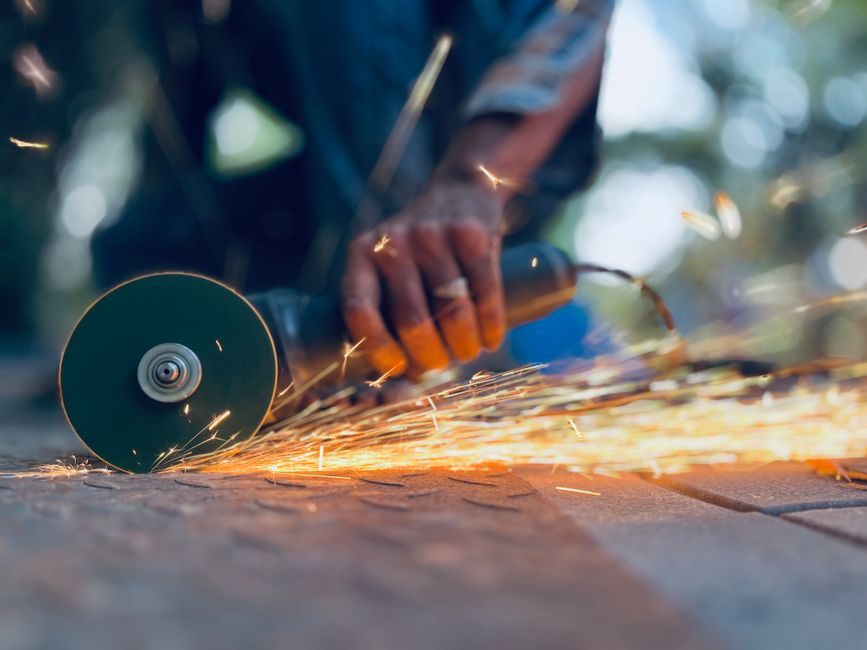
For 2026 procurement, the cut-off machine category converges on two form factors: a handheld 2000–2200 W abrasive saw with a 355 mm wheel and roughly 3800 rpm no-load speed, and a heavier benchtop or floor-standing abrasive cut-off machine for shop use [S6]. The handheld class is the high-volume SKU in industrial supply chains, with Chinese OEM OUDERLI offering a Maktec-MT240-styled J1G-ODL-MT240 at 2000 W rated input, minimum order 300 pieces, and 30–45 day delivery under FOB terms with L/C or T/T settlement [S4].
Buyers specifying a portable steel-cutting saw in 2026 should expect blade diameter 355 mm, no-load speed 3800 r/min, rated input 2200 W, dual-voltage 110/220 V at 50/60 Hz as the default parameter set on mainstream export models [S6]. Priced low enough to sit in the light-industrial maintenance aisle rather than the metal-fabrication capital line, these tools overlap with demolition hammers and power mixers on the corded-power sourcing band — see the 2026 corded-power spec cut for cross-tool cost context.
Handheld abrasive cut-off machine: standard 2026 spec window
The dominant 2026 export SKU is a 355 mm portable steel-cutting saw with rated input power 2200 W, no-load speed 3800 r/min, rated voltage 110/220 V, and rated frequency 50/60 Hz — values that hold across the standard parameter set quoted by Chinese OEM Chuanben on Made-in-China [S6]. Lighter 2000 W models copy the Maktec MT240 form factor, marketed as "high power, copy Maktec 240, new structure design, stable quality, low sound, easy to operate" with model code J1G-ODL-MT240 and brand OUDERLI out of Zhejiang [S4].
MOQ on the 2000 W MT240-styled unit sits at 300 pieces with a 30–45 day delivery window from Chinese mainland suppliers, payment in L/C or T/T [S4]. For context on the corded-power tier that includes this tool, the 2026 sander price bands and demolition hammer FOB bands sit in the same landed-cost range, useful for total-spend benchmarking.
Benchtop and floor-standing abrasive cut-off machines
Stepping up from handheld, the RIDGID 14 inch abrasive cut-off machine (model R41422, orange) is a recognized 355 mm-class floor saw, originally distributed through US retail channels and resold in the secondary market around US $14.49 plus freight [S5]. The 14 inch (≈355 mm) wheel class is the hinge between portable and stationary cut-off machines and the practical ceiling for a single-phase 220 V shop outlet.
Above this size, three-phase 380 V floor saws with abrasive wheels up to 400–500 mm dominate metal-cutting shops. Buyers sourcing these should plan for a vibration-isolated base, a coolant tray for ferrous cutting, and an emergency-stop circuit that meets the same IEC 60204-1 / EN 60204-1 machine-safety expectations applied to other shop tools — a requirement generic to powered industrial machinery, not unique to cut-off machines. In 2026, mainstream Chinese OEM 2200 W portable steel-cutting machines are still quoted at 3800 r/min no-load [S6], which is a useful speed baseline when qualifying alternate suppliers.
Selection criteria: wheel size, motor power, no-load speed
Three parameters decide almost every 2026 cut-off machine purchase. Wheel diameter sets the maximum section thickness: 355 mm wheels routinely cut solid bar up to ~100–120 mm in one pass depending on blade thickness. Rated input power separates the consumer-tier 1400–1800 W units from the industrial 2000–2200 W class — the latter is the workhorse range quoted on both the OUDERLI J1G-ODL-MT240 (2000 W) and the Chuanben 355 mm portable steel cutter (2200 W) [S4][S6].
No-load speed is the third lever: 3800 r/min is the common 2026 spec for 355 mm abrasive saws, and cutting capacity scales with the wheel diameter × speed product [S6]. Voltage flexibility (110/220 V, 50/60 Hz) is now standard on export-grade Chinese OEM units, eliminating the need for region-specific SKUs in most cases [S6].
A quick spec cross-check for buyers comparing 2026 handheld abrasive saws: OUDERLI J1G-ODL-MT240 lists 2000 W, 355 mm-class wheel, MOQ 300, 30–45 day delivery [S4]; the Chuanben portable steel-cutting machine lists 2200 W, 355 mm wheel, 3800 r/min no-load, 110/220 V 50/60 Hz [S6]. Both are 355 mm-class 2000–2200 W units, differing mainly in rated power and supplier terms rather than mechanical envelope. For air pick procurement running in parallel on a similar corded-power line, the same MOQ and FOB cost bands apply.
Who a 355 mm cut-off machine is for — and who it is not
A 355 mm handheld abrasive saw is the right tool for: rebar and pipe fitters, on-site steel erectors, maintenance crews cutting solid bar up to ~50 mm, light fabrication shops, and rental fleets. It is the wrong tool for: precision sheet-metal blanking (use a cold saw or band saw), stainless structural with strict cosmetic requirements (use a cold saw with dedicated blade), and high-volume production cutting (use an automated CNC abrasive or band saw system). The 3800 r/min no-load spec [S6] is also too fast for thin-wall tube work where a lower-rpm cold saw preserves burr-free edges.
Buyers shopping for the 14 inch RIDGID R41422 at roughly US $14.49 on the secondary market [S5] are typically buying spare or replacement units for an installed base, not a primary procurement. New 2026 procurement should go to OEM channels with declared no-load speed, rated power, and dual-voltage capability [S6].
Sourcing signals, standards and limits to track in 2026
Three 2026 sourcing signals matter. First, Chinese OEM MOQs on the 2000 W MT240-class saw are anchored at 300 pieces with 30–45 day delivery from Zhejiang — the structural cost floor for the 2000 W class [S4]. Second, 2200 W / 3800 r/min / 110–220 V / 50–60 Hz is the 2026 reference parameter set for 355 mm export saws [S6]. Third, used RIDGID 14 in R41422 units surface in the US $14–25 secondary band [S5], useful for benchmarking the depreciation curve against new-unit FOB prices.
Standard and regulatory items a 2026 buyer should pin down (without inventing clauses): the cut-off machine must satisfy the EMC and low-voltage directives that apply to all powered hand tools in the destination market, and a Declaration of Conformity referencing the relevant EN 60745 / IEC 60745 series is the usual proof for handheld motor-operated tools. Wheel selection should follow the abrasive-product standard appropriate to the workpiece (resin-bonded reinforced wheels for steel, dedicated wheels for masonry or stone). For procurement lead-time and landed-cost discipline on adjacent corded-power categories, the aluminum ladder 6-spec gate and the oxy-fuel cutting torch price guide offer useful cross-tool benchmarks.
Track three nodes through the second half of 2026: (1) MOQ movement on the J1G-ODL-MT240 and similar 2000 W 355 mm SKUs away from the 300-piece floor [S4]; (2) the spread between FOB China prices on 2200 W / 3800 r/min export units and landed US/EU prices on the same spec [S6]; (3) secondary-market depth on the RIDGID R41422 around the US $14–25 band, which signals the installed base turnover for the 14 inch class [S5].
For component-level specifications, see linear guide, and crossed roller guide.