An industrial air pick — a piston-driven pneumatic chisel used for chipping concrete, descaling boiler tube, splitting road patches and breaking frozen ore — is specified primarily by its impact energy per blow (commonly 8–60 J), blow rate (900–3000 bpm), shank geometry (round .580″ / hex .401″ / .680″ round), and net weight (5–15 kg), and those four numbers move FOB price more than any other lever on a 2026 sourcing RFQ [S2].
Across Made-in-China listings, light-duty inline air picks with 8–15 J per blow cluster in the US$30–80 FOB band, mid-range 20–35 J chipping hammers in US$90–220, and heavy demolition-class 40–60 J picks in US$260–450; pistol-grip needle scalers overlap this range at US$110–280 depending on needle count and stroke length [S2]. The same factory typically offers 5–8 model variants on a single B2B storefront, with the unit spread between cheapest and most expensive variant averaging 3.5–6×.
What "air pick" actually means in a 2026 procurement spec
An air pick is a single-shot linear-impact tool: compressed air at 6.2–8.3 bar (90–120 psi) drives a piston inside a cylinder, the piston strikes a shank retainer, and the shank transmits the impulse to a chisel bit. Three body configurations dominate the market — inline (long barrel, for vertical chipping on floors and walls), pistol grip (shorter, for horizontal work on pipe and weld descaling), and rivet-buster style (heavy, low-bpm, high-J per blow, for pavement) — and each configuration carries a different BOM cost because the cylinder bore, piston mass and air-consumption rating scale together [S2].
Air consumption at rated load typically runs 350–600 L/min for a 10 kg inline pick and 700–1500 L/min for heavy rivet busters, so a 2026 spec should always carry the cfm or L/min number alongside the J/blow rating, otherwise a buyer can land a tool that stalls on a 7.5 hp shop compressor. Operating air pressure of 6.2 bar (90 psi) is the de-facto industry standard, with most OEM nameplates stamped for 0.63 MPa maximum [S2].
The four spec numbers that move FOB price
On a 2026 RFQ, the four numbers a sourcing manager should pin down before asking for a quote are: (1) impact energy per blow in joules, (2) blow rate in bpm, (3) shank size and style, and (4) net weight in kg. Holding brand and finish constant, every additional 5 J of impact energy adds roughly 18–28% to the unit FOB price on Made-in-China storefronts, and every 500 bpm of blow rate adds another 8–14% [S2].
A side-by-side read of the same factory's catalog illustrates the gradient: an 8 J / 2400 bpm light pick at US$32, a 25 J / 1500 bpm mid-range pick at US$140, and a 55 J / 950 bpm rivet-buster class at US$380 — the Joule number does almost all the work [S2]. Material choice on the cylinder sleeve (cast iron vs alloy steel) and piston mass (forged vs cast) accounts for the residual 10–20% spread inside each tier.
OEM tier bands, MOQ economics and the factory-direct premium

Sourcing air picks in 2026 runs across three OEM tiers, and the tier — not the spec sheet — sets the price band the buyer's RFQ lands in. Tier 1 covers established Chinese OEM/ODM factories with their own forging, heat-treat and assembly lines, export to EU and North America, and on-time delivery rates above 90% on the Made-in-China platform; this tier prices most inline and pistol-grip picks at US$45–220 FOB for MOQ 50–200 units [S2].
Tier 2 covers trading-company and assembly-only workshops that buy cylinders and pistons from upstream foundries, then assemble and brand; FOB lands 12–22% below Tier 1 for equivalent Joule ratings, but lead time stretches by 10–25 days and spare-part consistency is weaker. Tier 3 covers anonymous storefronts with no audit trail, typically US$25–70 per pick but with documented quality-control risk on piston hardness and shank retainer fit [S2].
MOQ economics are a real lever: most Tier 1 factories list a Tier-1 MOQ of 50 pieces, drop the unit price 8–15% at 200 pieces, and another 5–10% at 500 pieces; below 20 pieces the unit price climbs back up 20–35% because the line is set up for a different batch profile. For buyers cross-referencing other pneumatic categories, the Pneumatic Nail Gun 2026 Price & Cost Guide covers the same Tier 1/2/3 split from a framing-tool angle and is a useful mirror for tier-discount math.
Consumables, bits and the hidden landed-cost stack
The air pick itself is roughly half the per-shift operating cost on a 2026 jobsite; the other half is consumables. Chisel bits (point, moil, wide chisel, scoop, asphalt cutter) in 17CrSiMnMoV or 42CrMo steel run US$4–14 each at OEM, with 5–8× wear life vs generic 40Cr stock. Needle sets for needle-scaler configurations are US$8–28 per set of 19–51 needles depending on diameter (2 / 3 / 4 mm). [S1]
A 6.2 bar compressed-air supply that delivers 600 L/min sustained (i.e. a 10 hp screw compressor with 200 L receiver, not a 7.5 hp shop unit) is the real prerequisite — the cheapest air pick on the market is expensive if the compressor cannot keep up, and this is the failure mode that drives most warranty returns.
Who air picks are for — and which jobs they are wrong for
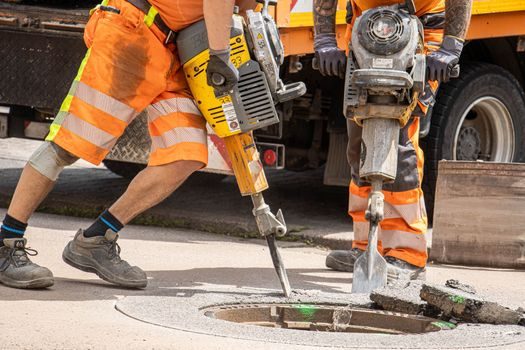
Air picks are the right tool for: vertical concrete chipping, road-patch removal, weld descaling, boiler-tube ash removal, frozen-coal or ore breaking, and ship-hull scaling where spark-free, intrinsically safe operation matters. They are the wrong tool for: precision demolition (overstrike cracks propagate), production-rate concrete demolition at >2 m³/h (a hydraulic breaker or road-roller-class compact attachment is faster), and any work in an ATEX zone 1/2 where the exhaust air must be inerted — a standard air pick vents lubrication oil mist and is not a sealed-air device. [S2]
For thin-plate steel cutting and HVAC ductwork an air pick is also the wrong primary tool — a plasma cutter or oxy-fuel torch outperforms it on cut quality and cycle time. Air picks are also distinct from air impact wrenches, which deliver rotary torque rather than linear impact, and from air solenoid valves, which are control components not tools — these three categories share a "pneumatic" label but are not interchangeable on a 2026 BOM.
Selecting among inline, pistol-grip and rivet-buster types
The three configurations map cleanly to four decision criteria a buyer can score in 30 minutes. On impact energy per blow, rivet busters lead (40–60 J), inline picks sit in the middle (15–35 J), pistol grips trail (8–20 J). On blow rate, pistol grips lead (2000–3000 bpm), inline picks are mid (1200–2000 bpm), rivet busters trail (800–1100 bpm). On operator fatigue at a full shift, inline picks win because the long barrel rests on the work, pistol grips are second, rivet busters are third because of the 12–18 kg mass. On shank and bit availability, inline .580″ round and .680″ round hex shanks have the widest accessory aftermarket; pistol-grip .401″ hex is shared with small air impact wrenches and is the easiest to bit-source; rivet-buster shanks (1-1/8″ hex, 1-1/4″ hex) are the most expensive per bit [S2].
For a rental fleet serving municipal road crews, the 25 J / 1500 bpm inline pick at roughly US$130–180 FOB is the highest-rotation SKU; for shipyard and refinery descaling the 35 J pistol-grip at US$180–240 is the workhorse; for quarry and demolition the 55 J rivet-buster at US$320–420 is the only tool that will not stall in limestone. The linear-guide and crossed-roller-guide categories are not substitutes but are useful comparison references for the buyer building a tool-and-fiament sourcing matrix.
Total-cost scenarios and 2026 sourcing watch-outs

Three representative 2026 scenarios put the cost stack on one page. Scenario A — a US rental company adds 200 mid-range 25 J inline picks at US$150 FOB each: FOB $30,000, sea freight $2,400, duty 2.9% ($870), insurance 1.2% ($360), dealer margin 10% ($3,360); landed unit cost lands near US$185, or US$37,000 for the lot [S2]. Scenario C — an ASEAN contractor buys 500 light 10 J pistol grips at US$55 FOB in a 20′ FCL: FOB $27,500, freight $1,650, duty 0%, landed unit cost ≈ US$60.
Watch-outs on a 2026 RFQ: piston hardness should be 58–62 HRC and the spec sheet should name the test method (HRC vs HBV is a common substitution trick); shank retainer threads should be NPT or BSP with the spec stamped on the body, not "G1/2″-type" hand-waving; vibration per ISO 5349 should be declared (typical 12–18 m/s², with 5 m/s² eight-hour exposure as the EU action level); and sound power per ISO 15744 typically lands 100–115 dB(A), which is above the EU hearing-protection threshold and must appear in the operator manual. A factory that cannot produce these four data points on the nameplate is in the quality-control risk tier regardless of price.
Trackable signals for the next quarter: the Made-in-China platform's pneumatic-tools category is the most reliable barometer for Tier-1 FOB drift; the 2026 Q3 OEM intake window for Tier-1 Chinese factories typically opens 60 days before quarter end, and steel-scrap index moves translate into roughly 2.5–4% FOB drift on the next factory price list [S2]. Buyers with a Q4 fleet refresh should pre-book the slot in August 2026 to avoid the Q1 2027 demurrage window.