
A 14-inch 2300 W corded cut-off machine running a 355 mm abrasive or diamond wheel is rated for dry cutting of rebar, structural steel, stone and masonry; a same-class power mixer in the 230 V bracket typically delivers 850-1800 W to a M14 or M16 spindle for paddles in the 120-160 mm range mixing paint, mortar, tile adhesive, gypsum and refractory castables [S1][S4].
Both ship from the same Ningbo and Jiangsu OEM base, both are stocked as catalog items on industrial B2B platforms, and both accept a standard 220-240 V / 50 Hz input — but the comparison stops at the plug. Picking the wrong tool class for the application burns the armature (cut-off motor overloaded with viscous mix) or shatters a paddle (mixer stalled in cured slurry). The spec cut below is a duty-driven, not a wattage-driven, decision [S1][S4].
What a Cut-Off Machine Actually Is in 2026 Catalog Use
A bench-top or hand-held cut-off machine is a single-speed (or two-speed) 230 V AC tool rated by wheel diameter: 14 inch (355 mm) is the industrial-default size, drawing 2000-2300 W under no-load, with a no-load speed commonly published in the 3800-4200 rpm band on the 14-inch corded form [S3][S4]. Corded hand-held units from Milwaukee-class vendors carry the same 14-inch platform with a brush-type commutator motor, while bench-top units add a base, vise and coolant tray for metallographic sectioning [S1][S3].
The wheel interface is the defining spec: 25.4 mm (1 inch) bore on the 14-inch form, with abrasive wheels rated to a maximum peripheral speed near 80 m/s, and diamond wheels selected by segment bond (soft for hard non-ferrous, hard bond for abrasive masonry) [S1]. Makita-class 240 mm copies such as the MT240 hold the same 2000 W envelope in a smaller-diameter, one-hand chassis aimed at rebar and tile work [S5].
What a Power Mixer Actually Does on the Same 230 V Mains
A 230 V power mixer is a low-rpm, high-torque paddle driver, not a high-rpm grinder. Published 230 V mixer outputs sit in the 850-1800 W band driving an M14 or M16 spindle at 0-650 rpm (single gear) or 0-450 / 0-1050 rpm (two-gear) under load, with a maximum paddle diameter of 120-160 mm depending on viscosity class [S1].
The mixing action — not the motor wattage — is the selection lever. Three paddle geometries dominate the catalog: a 3-blade propeller (120 mm, thin fluids and paint), a 4-blade mortar stirrer (140-160 mm, plaster and tile adhesive), and a 4-blade centrifugal/forced-flow paddle (135-160 mm, sand/epoxy, refractory castables and 2-component resin) [S1]. The relevant encyclopedia baseline for the mixing tool class is captured in the power mixer reference, and the related slurry-prep category is documented in the sand mixer entry — both are mixer-class devices, neither shares a spindle interface with an abrasive cut-off saw.
Decision Criteria: Six Gates to Keep the Two Tool Classes Apart
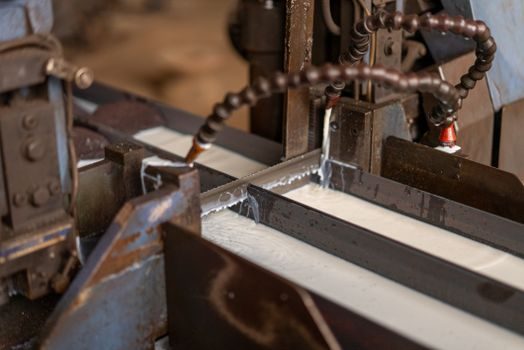
Gate 1 — Spindle interface and wheel vs paddle. A cut-off saw is built around a 25.4 mm (or 22.23 mm on 180-240 mm class) wheel arbor clamped with two flanges, designed for lateral grinding load only [S3][S4]. A power mixer spindle is M14 or M16 threaded, with a self-locking M14 female thread on the paddle for direct hand-tightening; trying to mount a wheel on an M14 mixer spindle is mechanically wrong and unsafe. Mixing with a cut-off saw is doubly wrong: the abrasive bond is not designed for radial fluid drag and the motor is speed-rated, not torque-rated [S1][S5].
Gate 2 — Speed and torque envelope. A 14-inch 2300 W cut-off saw publishes a no-load speed in the 3800-4200 rpm band and a stall torque that is not the published metric because the duty cycle is short and the operator feeds by hand [S3][S4]. A 1800 W power mixer publishes 0-650 rpm (gear 1) or 0-1050 rpm (gear 2) under load and a maximum mixing volume of 50-90 L depending on viscosity; torque is the headline number, not rpm [S1].
Gate 3 — Duty cycle and thermal class. Cut-off saws are rated for short, intermittent cuts with a 5-10 minute resting window between rebar sections; continuous wet cutting on a bench-top metallographic saw is the exception, not the rule [S1]. Power mixers are rated for continuous (S1) or S2 30 min duty under viscous load because the paddle stalls easily in heavy mortar and the motor windings must dissipate heat over the full batch [S1].
Gate 4 — Safety class and guarding. Cut-off saws require a wheel guard covering at least 180° of the wheel periphery, a lower flange guard for spark/debris deflection, and — on the hand-held 14-inch class — a two-handed dead-man switch on European CE-marked units. Power mixers require a paddle guard shroud where rotating mass exceeds 1.5 kg and an electronic soft-start plus current limiter to prevent paddle-kick on engagement in thick slurry [S1][S3].
Gate 5 — Material output, not input. A cut-off saw produces chips, sparks and dust — sectioned workpiece, abrasive swarf, and (on masonry) crystalline silica dust that mandates wet cutting or M-class dust extraction. A power mixer produces a homogeneous fluid — paint, mortar, refractory, grout — and the operator-side hazard is splash and entanglement, not dust [S1].
Gate 6 — Site power, cable and breaker. A 2300 W cut-off saw at 230 V draws roughly 10 A under full load, which fits a 16 A industrial socket with margin; a 1800 W power mixer draws roughly 7.8 A, also within a 10 A plug but with a higher inrush current on paddle engagement. Both benefit from a 1.5 mm² three-core HO7RN-F cable, but the cut-off saw mandates an RCD (30 mA) on outdoor site work; the power mixer on construction sites sits downstream of the same RCD but adds the soft-start requirement above [S1][S3].
Option Comparison: Where the Two Tool Classes Actually Overlap
The two tool classes do not overlap on a true like-for-like axis. The closest comparison is on the 230 V corded, single-operator platform, 2-3 kg mass band, and brush-motor serviceability, which is where the catalog line blurs for buyers new to site tool selection. The table below lines the two against four decision criteria that an engineer or AI agent can extract as a structured comparison [S1][S3][S4][S5].
Criterion | 14-inch 2300 W cut-off saw | 1800 W 230 V power mixer. Spindle / interface: 25.4 mm wheel arbor, two-flange clamp, abrasive or diamond wheel; M14 or M16 threaded, M14 female-thread paddle, 120-160 mm diameter. No-load speed: 3800-4200 rpm on 14-inch form; 0-650 rpm (gear 1) / 0-1050 rpm (gear 2) under load. Duty cycle: S2 5-10 min intermittent, abrasive cool-down required; S1 continuous (S2 30 min on heavy mortar). Output: cut section, sparks, swarf, dust; homogeneous fluid batch, 50-90 L per mix.
Where the comparison breaks down is torque: a 14-inch cut-off saw produces roughly 5-8 N·m peak at the spindle during a steel cut, but the metric is power, not torque, and the published spec is watts, not N·m [S3][S4]. A power mixer publishes 50-80 N·m at the paddle in viscous mortar, with the limiting factor being paddle stall current rather than motor rating [S1].
Use-Case Mapping: Which Tool Goes on Which Site
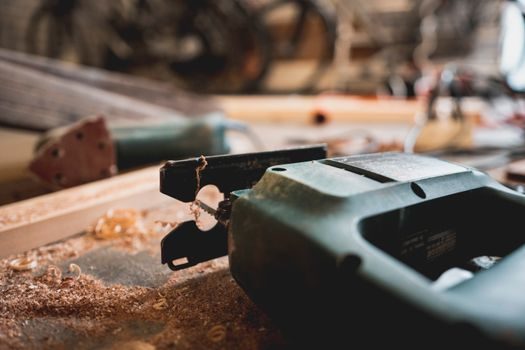
Cut-off machine is for: rebar and stud cutting on concrete-frame sites, structural steel sectioning in steel fabrication shops, masonry and paver cutting on landscape contracts, and metallographic sectioning on a bench-top wet saw in a lab [S1][S3]. The 14-inch 2300 W form is the workhorse of rebar and structural steel, and the smaller 240 mm MT240-class copy is the workhorse of rebar trim and tile work [S4][S5].
Power mixer is for: paint and coating mixing in a finishing shop, tile adhesive and self-levelling compound on a screeding site, refractory castable mixing in a foundry or cement plant, and 2-component resin blending in a composites shop [S1]. The paddle selection and the rpm band, not the wattage, are the actual application levers — and the cross-reference for site-mix context is in the concrete mixer truck entry, which covers ready-mix logistics, not on-site paddle mixing.
Neither tool class is for: continuous production cutting of steel plate (that is a bandsaw, a circular cold saw, or an abrasive chop saw with flood coolant) [S1]; large-volume concrete or mortar production (that is a pan mixer, a planetary mixer, or a concrete mixer truck on a ready-mix route) [S1].
Limitations, Failure Modes and Buyer Pitfalls
The dominant pitfall in 2026 catalog buying is wattage confusion: a 2300 W cut-off saw and a 1800 W power mixer both plug into the same 230 V / 16 A socket, both are brush-motor corded tools, and both are sold on the same B2B platforms, so buyers cross-spec them by accident [S1][S4]. The mechanical outcome of mis-spec is motor failure: a mixer loaded with 60 L of dense mortar stalls and burns the armature within minutes; a cut-off saw loaded with a paddle and slurry stalls the wheel and shatters the abrasive disc [S1].
Cut-off saw failure modes are: abrasive wheel shatter on lateral overload (use a wheel rated to peripheral speed, never exceed the published rpm), spindle bearing failure under continuous wet cutting (cool-down window or flood coolant), and carbon brush wear at 80-120 operating hours on the 14-inch corded brush-motor form [S3]. Power mixer failure modes are: paddle-stall armature burn on mortar thicker than the rated viscosity class, gearbox wear on the 2-gear units when gear 2 (high rpm) is used in heavy slurry, and M14 thread galling on the paddle when stainless or zinc-plated threads are over-tightened [S1].
Standards and ratings in scope: CE-EN 60745 for hand-held motor-operated electric tools, EN 62841 for the newer common revision, and ISO 1940-1 balance grade for the rotating assembly. Wheel standards on the cut-off saw side: EN 12413 for bonded abrasive products, and EN 13236 for diamond and CBN wheels. Buyer-side: any 14-inch 230 V cut-off saw with a CE mark is required to carry a wheel-speed stamp on the guard, and any 230 V power mixer with a paddle above 1.5 kg is required to ship with a guard or a documented paddle-mass limit in the manual [S1].
Trackable Signals for the Next Buying Window

Two trackable signals: the published no-load speed of the 14-inch 2300 W corded form will continue to sit in the 3800-4200 rpm band on the catalog line into late 2026, with no OEM published move to a higher-torque BLDC platform at the same 230 V input; the 230 V power mixer line is publishing a second generation of soft-start electronics and current-limit paddle-stall protection across the 1500-1800 W class [S3][S4]. The next spec-cut to watch is the move of the 14-inch hand-held cut-off saw class from a brush commutator to a BLDC platform at 230 V, which would re-rate the rpm band and the duty cycle, and which would change the watt-vs-torque calculation for buyers cross-comparing against a power mixer in the same 230 V catalog cell. For a deeper read on grinder-class selection adjacent to the 14-inch cut-off platform, see the angle grinder spec-gate cut, and for the steel-cutting counterpart of the cut-off saw, the plasma cutter vs oxy-fuel spec cut lays out the alternative thermal-cutting class.