
Cut-off accuracy on steel bar is dominated by machine features that suppress deflection, lock length repeatability, and minimise kerf loss, with the saw head, work-holding, and feed control doing more work than the blade alone.
On production lines reviewed in 2024-2025, precision abrasive cutoff platforms hold ±0.001 in length tolerance with 0.025–0.045 in kerf, while precision cold saws run ±0.008 in across 0.625–6.00 in diameter stock, and CNC-servo bar cutters replace manual measurement with encoder positioning for large-diameter bar [S1][S4][S6].
Rigid Saw Head and Work-Holding Architecture
Saw head deflection is the single largest source of angular error and burr on bar stock, and rigid head construction that eliminates deflection during the cut is the foundational accuracy feature in modern ferrous cold saws [S2].
On the Tridex CS1-A precision abrasive cutoff platform, that rigidity is paired with water-based coolant and an enclosed stainless work area, holding ±0.001 in length tolerance on most cuts with 0.4–0.8 Ra surface finish, while the machine stays below 80 dB during the cycle [S1]. For the materials routinely routed through these machines, the relevant stock family is stainless steel and the high-strength grades common in fastener and aerospace builds, where deflection control is non-negotiable.
On the C42-type rebar cutter used in rebar processing, the same principle shows up as a heavy-duty frame, a hydraulic clamping system, and a high-torque electric motor, all built so the blade does not walk under load and so the cut face stays perpendicular to the bar axis [S7]. For general carbon steel round bar, a rigid head combined with a proper vise is what separates a usable cut from a secondary-op cut.
Length Control: CNC Servo, Encoders, and HMI Set-Up
CNC servo and encoder positioning systems replace manual measurement on modern bar cutters, eliminating the human-induced dimensional variation that dominates low-volume rebar and round-bar work [S6].
On automated lines, length accuracy is a closed-loop problem: a servo-driven carriage moves the bar past a stop or under a flying blade, an encoder reads position, and the HMI stores recipes for repeat orders. The CS1-A uses a colour touch-screen HMI to set up, load, and operate, which directly supports ±0.001 in length control on production runs of multiple bars cut in one cycle [S1].
For reinforcing bar processing, the C42 family uses an automatic feeding system and adjustable cutting length settings on the operator panel, which is the rebar-grade equivalent of the same closed-loop idea, and is the reason these machines can hold consistent cut length on long rebar campaigns [S7]. Where a buyer is comparing feature lists on a steel bar cutting machine, the real differentiator is whether length is set by a hand-cranked stop block or by a digital encoder with a stored program.
Kerf, Burr, and End-Quality Features
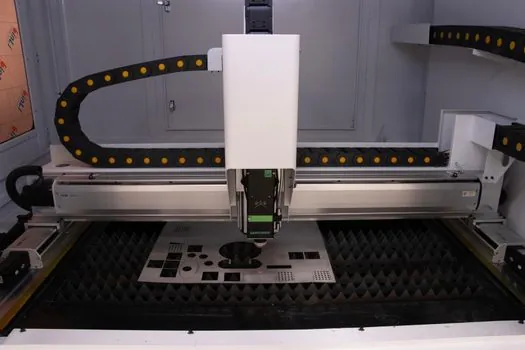
Kerf width and burr level are the two end-quality features most often traded off against cut speed, and on abrasive cutoff platforms they are tied to wheel selection, coolant, and feed ramp rather than to the saw itself [S1].
Cutoff wheels in the 0.025–0.045 in thickness range limit kerf loss and reduce tooling cost per cut; the CS1-A holds this range while producing a smooth 0.4–0.8 Ra surface and a minimal, consistent burr through the life of the blade, removing a deburring pass downstream [S1]. Shear cutting, by contrast, leaves a deformed end and a loud cycle, and is therefore the wrong choice when the cut face has to feed a forging or machining centre without rework [S1].
For non-aerospace bar work, a circular cold saw running at low RPM in a milling-like action gives a fast, burr-free cut without heat or sparks, which is why these saws dominate ferrous production cutting where end quality matters [S2]. When the application is small-diameter rebar or thin bar where heat input must stay low, the same end-quality logic is what pushes buyers toward silicon steel-friendly low-RPM cold sawing rather than abrasive chopping.
Multi-Bar and Bundle Cutting for Throughput
Multi-bar cutting is the throughput feature with the largest impact on per-part accuracy, because it removes the re-clamp error that piles up when bars are indexed one at a time [S1].
The CS1-A is designed to cut multiple bars in a single cycle, which lifts output per shift and, more importantly, locks the length tolerance to a single setup rather than to N individual setups [S1]. On the service side, band saws with a long blade can accurately cut a wide range of diameters and even cut entire bundles of steel in one pass, which is the bundle-cutting equivalent of the same idea on a different machine class [S4].
For high-volume rebar and round-bar production, the takeaway is that a multi-station or bundle-capable saw, paired with automatic feeding, is what lets a shop quote ±0.008 in cold-saw tolerances or ±0.001 in abrasive-cutoff tolerances on a real production schedule rather than on a single demonstration cut [S1][S4].
Safety, Coolant, and Noise Features That Protect Accuracy
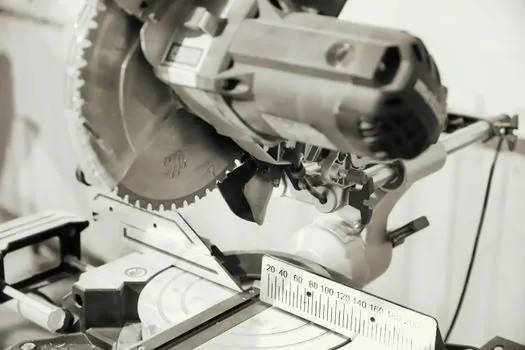
Safety and coolant features are not just compliance checkboxes; they directly protect cut accuracy by keeping the blade temperature, the workpiece, and the operator stable across a shift. [S1]
The CS1-A uses water-based coolant rather than cutting oil, runs below 80 dB, and is built to CE and ISO 13849 machine-safety standards, with an enclosed stainless work area that contains coolant and swarf [S1]. On a cold saw, the equivalent accuracy-protecting features are the rigid head, the clamping, and the low-RPM milling action that keeps the cut zone cold; on the C42 rebar cutter, the equivalent is the overload-protection clutch and the emergency stop that prevent a crash from bending the blade or the bar [S7]. For a working reference on how these guards are mapped to the risk-assessment process, the four-step method in ISO 12100 risk assessment is the upstream document a buyer should expect a CE-marked cutoff machine to satisfy.
The practical point: a machine that overheats the cut zone, throws oil, or exposes the operator is a machine that will not hold its stated tolerance over an 8-hour shift, no matter what the brochure claims.
Feature Comparison Across the Main Cut-Off Classes
Different cut-off classes deliver different accuracy envelopes, and the right choice depends on diameter, material, tolerance target, and volume. [S4]
On a like-for-like spec sheet, abrasive cutoff wins on tolerance and finish, cold saw wins on burr-free production cutting of solid bar, band saw wins on diameter range and bundle work, and CNC servo cutters win on length repeatability for large-diameter stock; rebar cutters sit in their own niche on rebar diameter and throughput [S1][S2][S4][S6][S7].
Selection Criteria and Sourcing Signals
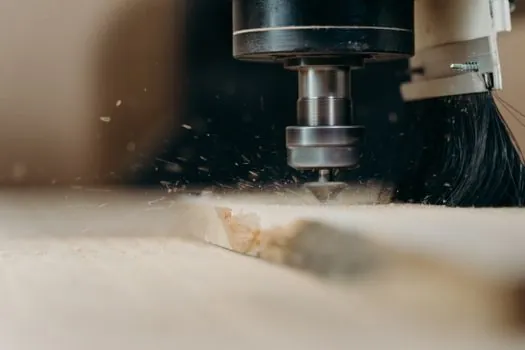
A buyer writing a spec for a cut-off machine should lock four features before talking to a vendor: tolerance target, kerf target, end-quality target, and volume target, and then map each to a machine class. [S1]
If the tolerance target is ±0.001 in with a smooth finish on small-diameter aerospace or medical bar, specify a precision abrasive cutoff with thin-kerf wheels, water-based coolant, and a CE / ISO 13849 build, and verify the length tolerance claim on a multi-bar sample, not a single-piece demo [S1]. If the target is burr-free, heat-free production cutting of solid bar in a fabrication shop, specify a ferrous circular cold saw with a rigid head and low-RPM milling action [S2]. If the target is large-diameter round bar with repeatable cut-to-length, specify CNC servo feeding and encoder positioning, and confirm the closed-loop architecture rather than a stop-block-and-hand-wheel arrangement [S6]. For rebar campaigns, the C42-class machine with hydraulic clamping, automatic feeding, and adjustable length is the baseline, and CE marking plus a documented risk assessment per ISO 12100 risk assessment is the minimum compliance evidence [S7].
Two trackable signals to watch over the next buying cycle: vendor datasheets quoting tolerance under multi-bar cutting rather than single-bar demo cuts, and CNC-servo bar cutters showing encoder-closed-loop positioning as a standard feature rather than an option, both of which are the leading indicators that a machine will hold its stated accuracy on a real shift [S1][S6].