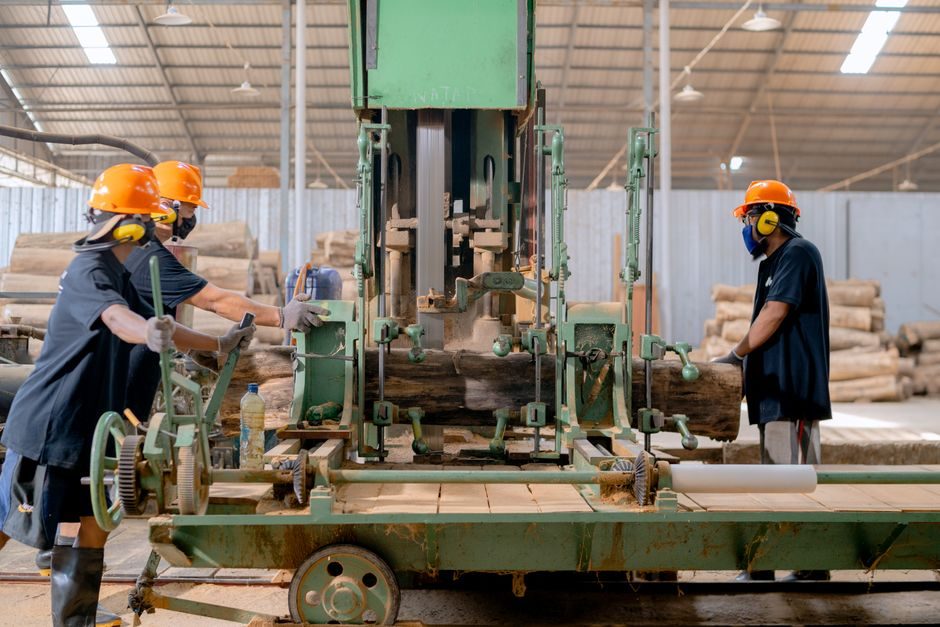
A 2026-07 spec snapshot shows cut-off machines spanning 355 mm handheld abrasive wheels at 4000 r/min, 200 mm automated metallographic wheels with 0.1 mm-class axis repeatability, and 60–80 m/s swing-frame foundry heads — three distinct machines grouped under one name [S1][S2][S3].
Interior finishing covers everything from trimming automotive interior trim and PU/EVA foam to slicing decorative metal trim, cutting stone tile reveals, and sectioning coated panels for QA — so the same label "cut-off machine" hides a wide tolerance and duty gap. The right pick is set by four decisions: stationary vs portable, dry vs wet cut, tolerance band, and what happens to the swarf.
Three Duty Classes the Spec Sheet Hides
Handheld electric cut-off saws in the KD4355T-class run 355 mm abrasive blades, 115 mm max cutting capacity, 4000 r/min no-load speed, 2200 W rated input at 220–230 V / 50–60 Hz, and are sold 1-piece per case — this is the bulk of the portable interior trim and metal-stud cutting market [S3]. The Maktec MT240 copy-pattern (J1G-ODL-MT240) out of Zhejiang lists 2000 W, 30–45 day delivery, 300-piece MOQ, and L/C or T/T terms — a sign that mid-power handheld cut-offs are sourced in container volumes, not unit quantities [S7].
Foundry and structural swing-frame cut-off machines — Rema's PS 350/500/600 series — operate at 60 m/s (196.85 ft/s) peripheral wheel speed as standard, with an 80 m/s option, and are described as "swing frame" units with a column-mounted slewing jib crane interface; these are not interior-trim machines in the usual sense, but they show up when an interior project involves heavy cast iron or steel door frames and threshold plates [S1]. Vulcan's Fox 2-C swing frame cuts heavy cross-sections and swings 90° clockwise / 75° counter-clockwise, again pointing at gate/riser removal on castings rather than architectural trim [S4].
At the precision end, QATM's Qcut 200 A metallographic cut-off machine uses cut-off wheels up to 203 mm (8 in), has X / Y / Z travels of 210 / 80 / 80 mm, weighs 82 kg in bench-top form, fits a 725 × 535 mm footprint, and ships with a 7-inch touch display plus joystick axis control — its cooling flow is rated "approx. 25% higher than comparable machines," reducing wheel wear by up to 15% [S2]. The Qcut 200 A is the go-to reference for QA labs that need to section coated panels, anodized aluminum trim, or composite interior skins without burning the cut face.
Wheel Speed, Kerf, and Heat — the Three Numbers that Decide
Peripheral wheel speed (m/s) is the single most important number for cut quality and wheel life: Rema's swing-frame line offers a 60 m/s standard and 80 m/s option, with the higher speed reserved for harder workpieces and finer surface finish [S1]. Drop below the recommended m/s and the wheel glazes; push above it on the wrong bond and the wheel shatters — both failure modes are documented in abrasive-wheel safety guidance.
For handheld work, the equivalent figure is no-load rpm and motor watts: KD4355T-class saws pair a 355 mm blade with 4000 r/min and 2200 W, giving a theoretical peripheral speed near 74 m/s at the rim — a number close to Rema's 80 m/s high-speed option and worth checking against the wheel maker's maximum m/s rating before spec'ing the wheel [S3].
Kerf and heat input matter more for interior finishing than for general fabrication: PU, EVA, PVC, and TPU foams melt at 80–180 °C and a slow, hot cut will seal the cells shut instead of slicing them. The fix is a sharp, fine-tooth blade, high surface speed, and a feather-light feed — which is why high-frequency welding-and-cut machines built for automotive interior trim run dedicated foam-cutting modes rather than repurposed metal abrasive wheels [S6]. A standard bench-top cutting machine used dry on foam will produce a sealed, yellowed kerf that bonds back together within hours.
Matching the Machine to the Interior Substrate

Metal trim, aluminum reveals, and steel door frames: the KD4355T 355 mm / 2200 W / 115 mm cut depth class is the workhorse, and a thin 1.0–1.6 mm abrasive wheel gives the cleanest cut at 4000 r/min [S3]. For heavier steel sections the same spec saw accepts a 3 mm wheel, but feed rate must drop to keep the motor from lugging.
Foam, leather, fabric, and soft trim: high-frequency welding-and-cut platforms designed for automotive interior door panels, fog-screen welding, foam indentation, and PU/EVA/PVC/TPU forming are the only real option — they seal as they cut, which is the desired behavior in trim work [S6]. Abrasive cut-off saws will destroy foam and melt synthetics.
Composites, coated panels, and anodized aluminum: this is where the Qcut 200 A's 25%-higher cooling flow and 0.1 mm-class backlash-free bearings earn their keep — a wet cut at controlled axis speed keeps the cut face below the coating's glass-transition temperature and preserves the anodic layer for QA inspection [S2]. For QA-only cuts, the core machine class of wet abrasive cutters (Brillant 230 / Qcut 150 A in QATM's line) is the second-tier option.
Wood reveals, MDF panels, and decorative trim: semi-optimizing cut-off saws with scoring units are the right tool — single-blade machines chip melamine and tear MDF edges, and a dedicated scoring saw gives a clean top and bottom edge in one pass [S8]. This is one of the few interior-finishing cases where a coding machine / printer integration matters, since the same line usually inks batch codes onto the cut panel.
Throughput Math: How Many Pieces per Hour
Fives' flying cut-off technology for tube mills claims line speeds of 20–50 m/min on stainless steel, with a fiber-laser option that cuts operating cost by 80% versus a traditional orbital cut-off — useful as a reference benchmark even when the interior project is not stainless tube [S5]. The takeaway: at 20 m/min a flying cut can do 200+ cuts/minute on small-bore tube; a handheld KD4355T at a 1 m/min practical feed on 50 mm round bar will do 20 cuts/minute in expert hands and far fewer on a job site.
For metallographic sectioning the throughput is intentionally slow — 1 to 3 cuts/hour is normal on a Qcut 200 A when the wheel is a 203 mm resin-bonded abrasive and the workpiece is a hard coated panel, because the limiting factor is heat at the cut face, not the axes [S2].
Selection Criteria Compared
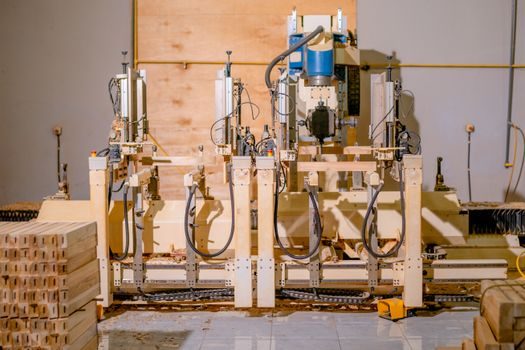
Handheld 355 mm / 2200 W abrasive cut-off saws (KD4355T-class) win on cost, portability, and material range but lose on cut quality, kerf heat, and operator fatigue — expect 1.5–2.5 mm kerf, dry cut only, and a noisy work environment without a vacuum extractor [S3]. Swing-frame foundry cut-off machines (Rema PS 350/500/600, Fox 2-C) win on heavy-section capability and 60–80 m/s peripheral speed but lose on footprint and precision — kerf is wide and the cut face needs a secondary grind [S1][S4]. Metallographic cut-off machines (Qcut 200 A) win on tolerance, repeatability, and surface integrity on coated or heat-sensitive stock but lose on throughput and unit price — 82 kg of bench-top precision is not a job-site tool [S2].
Sourcing, Standards, and What to Verify Before Buying
Three standards cover the bulk of interior-finishing cut-off work: EN 13218 / ISO 16089 for abrasive cut-off machine safety, EN ISO 11843 for laser-cutting fume, and OSHA 29 CFR 1910.215 for abrasive wheel guarding — the 355 mm handheld class must ship with a wheel guard rated to the wheel's max rpm, and the wheel itself must be marked with a peripheral speed that does not exceed the saw's rated m/s [S3]. For laser cut-off, Fives' stainless-steel flying line runs 20–50 m/min with an 80% operating-cost reduction vs orbital cut-off — a hard benchmark to put in any ROI argument [S5].
Suppliers and channels divide cleanly: catalog OEMs (Rema, QATM, Vulcan, Fives) ship factory-direct with full documentation; trade platforms such as Kitairu, Mfrbee, and CENS list mainly Chinese OEM/ODM handheld cut-off saws with MOQs in the 300-piece range and 30–45 day delivery, terms usually L/C or T/T, and rated at 220–230 V / 50–60 Hz for export markets [S3][S7][S8]. Handheld electric saws in this class pair naturally with shop shakeout machine and labeling machine cells when a finished-goods line is being laid out, since the same cut panel usually goes on to be bar-coded or serialized.
Verify before purchase: wheel max peripheral speed in m/s vs machine rating (60, 80, or higher), voltage and frequency match to the destination grid, dust-extraction port size on handheld saws, and on metallographic units the cooling-tank capacity and whether the unit ships with a recirculating filter or needs a chiller. The Qcut 200 A's stated 25% higher cooling flow and 15% lower wheel wear are figures worth confirming with the OEM in writing before treating them as design margin [S2].
Track through 2026 Q3: any 2026 updates to EN 13218 abrasive-machine safety, QATM's 5th-generation Qcut follow-on, and the next round of handheld 355 mm saws at 2300–2500 W that will set the new handheld baseline.
This topic is covered further in Air Circuit Breaker Selection: Frame, Icu, Icw, Trip Unit Map.