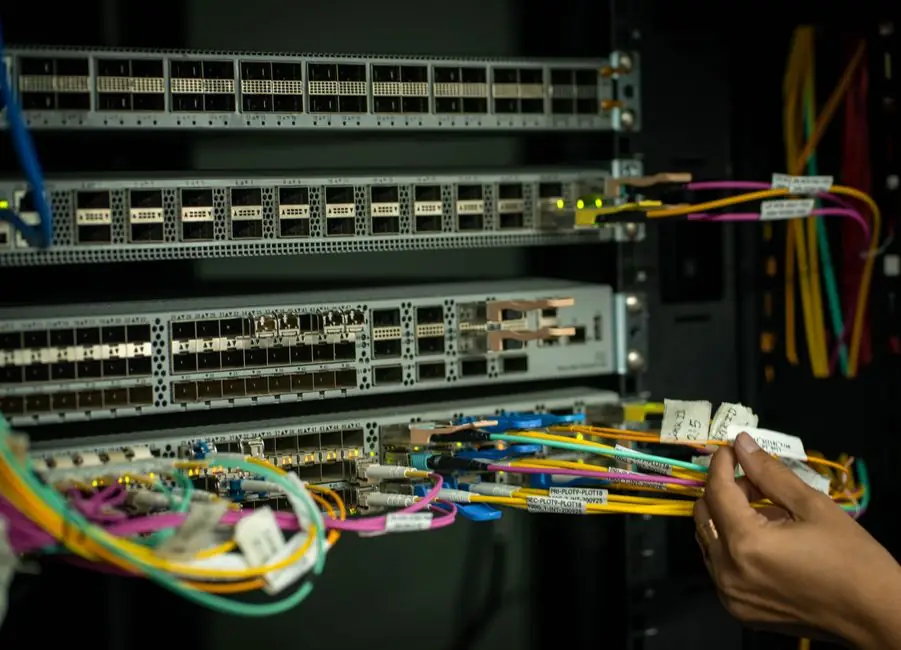
The global data center busways market is projected to grow from USD 3.9 billion in 2026 to USD 8.1 billion by 2032, a 13.1% CAGR, with North America holding 54% of 2025 value and hyperscale operators accounting for 64% [S1].
Across the wider electrical distribution stack, the global busway market reached USD 14.75 billion in 2025 and is expected to hit USD 27.54 billion by 2035 at a 6.4% CAGR, with data center busway flagged as the fastest-growing product line [S2]. Asia-Pacific holds 44.3% of that broader market and is forecast to reach 46.7% by 2035 [S2].
Conductor and rating profile that buyers actually spec
Copper remains the preferred conductor in hyperscale and mission-critical halls because of higher conductivity, compact footprint, and ability to handle very high currents [S1]. Precedence Research pegs copper at 72% of the data center busway conductor mix in 2025, with the 801-1,250 A power-rating band capturing 18% of 2025 share and low-voltage systems at 81% [S3].
Medium ampacity (800 A to 1,000 A) busways held the largest single share of the data center segment at 55% of 2025 value, reflecting the rack-power range that dominates current AI cluster builds [S1]. Sandwich construction is the leading product architecture in the wider market, with lower voltage drop and high short-circuit strength cited as the engineering reason [S2]. By busway type, the sandwich busway segment led the data center busways market with a 41% share in 2025 and is expected to grow at a CAGR of 14.6 through 2035 [S3].
Why AI and hyperscale are rewriting power distribution
NVIDIA's GB200 NVL72 platform surfaced a new per-rack benchmark, 72 GPUs and roughly 120 kW of nominal rack power, and hyperscaler rollouts by Azure and AWS amplified the requirement for advanced busway and busbar architecture [S3]. AI data centers already represented 17.9% of the busway market by value in 2025, a base that is expected to compound as rack densities climb beyond legacy 30-40 kW designs [S1].
Modular busway infrastructure is being substituted for traditional cable-based architectures to cut deployment time and improve operational flexibility for tenant churn in colocation halls [S1]. The engineering case is that busway systems are gaining stronger relevance because users need compact, modular and safer power distribution that can be expanded or reconfigured faster than conventional cable-heavy systems [S2]. Schneider Electric's I-Line Track medium-power busway, launched April 2024, was specifically designed so data center staff can install and reposition tap-off units without full power-down, a direct response to this flexibility demand [S3].
Regional split: US leads value, Asia-Pacific leads volume
The US data center busway market was valued at USD 1,851.8 million in 2026 and is projected to reach USD 3,641.2 million by 2031, an 11.9% CAGR and 96.6% total growth over the five-year window [S4]. Growth will concentrate in Northern California, Virginia, Texas, and the Northeast corridor, where data center density is already highest [S4].
Asia-Pacific is the fastest-growing region in the wider busway market at a 7.2% CAGR through 2035, lifting share from 44.3% in 2025 to a projected 46.7% by 2035 on the back of data center, electronics factory, metro and advanced manufacturing buildouts in China, India, Japan and South Korea [S2]. North America retains the highest value density per project through AI data center construction and manufacturing reshoring [S2].
Supplier landscape and M&A velocity
Schneider Electric, Legrand, Eaton, ABB, and Siemens are the leading participants, supported by extensive product portfolios, global manufacturing footprint, installed base, and direct relationships with hyperscale, colocation, and enterprise operators [S1]. In December 2024 Legrand extended its North American footprint by acquiring the Canadian cable-bus and high-current power distribution specialist Power Bus Way, a move aimed squarely at data center power infrastructure manufacturing [S3].
Legrand Group grew by 13% in 2025, with data center demand and acquisitions cited as primary contributors [S3]. Emerging challengers including USA TrackBusway LLC and Zhenjiang Anyi Electrical Co. have been strengthening their presence by offering specialized power distribution solutions for hyperscale, colocation, and high-density computing environments, with growing participation in AI-focused projects [S1]. For context on adjacent power infrastructure risk that affects busway sourcing, nickel price moves still drive 316 stainless cost per kg in 2026 and BESS container lead times run on a separate factory, ocean, and last-mile timeline, both of which can stretch or compress parallel switchgear and enclosure deliveries on the same hyperscale site.
Selection criteria: copper vs aluminum, AC vs DC, ratings
For hyperscale and AI halls, copper at 800-1,250 A in sandwich low-voltage construction is the current default, and AC remains the dominant power source for tap-off flexibility in North American and European builds [S1][S3]. Aluminum and hybrid conductors are typically selected for cost-driven retrofits and large commercial installations where the higher resistivity can be absorbed in the busway geometry [S2].
Busway systems are judged on short-circuit performance, fire safety, conductor selection, installation speed, digital monitoring, local fabrication capability and service support, which is the same checklist procurement teams use to separate incumbent suppliers from regional fabricators [S2]. For data center projects specifically, the technical decision narrows to installation time, copper exposure, and future load expansion risk, the formal key buying question identified in current market research [S2].
Standards, ratings, and what is not in the data
Published data sets do not specify the governing IEC or UL busway standard revisions applicable to each forecast scenario, so specifiers should verify the current edition of IEC 61439-6 for low-voltage busbar trunking systems and the relevant UL 857 air-handling and feeder busway clauses at the time of order. Short-circuit withstand ratings, IP/IK housing ratings, and tap-off unit coordination curves remain project-specific and outside the scope of the market figures cited here. [S2]
Forecast numbers diverge materially between research houses: MarketsandMarkets sees USD 8.1 billion by 2032 at a 13.1% CAGR [S1], Precedence Research projects USD 10.88 billion by 2035 at a 13.20% CAGR [S3], while Business Research Insights estimates a more conservative USD 1.72 billion by 2035 at a 7.68% CAGR [S5]. Specifiers and procurement teams should treat the upper and lower bounds as a planning range rather than a single point estimate, then reconcile with bill-of-material data from named suppliers before committing to a multi-year capex forecast. For shop-floor and EHS context, emergency stop category selection under IEC 60204-1 still governs the disconnect devices paired with busway tap-offs, and a broader look at modular power distribution product categories puts these busway gains inside the wider low-voltage distribution spend.
Component reference pages worth checking: data logger, and construction machinery and equipment.