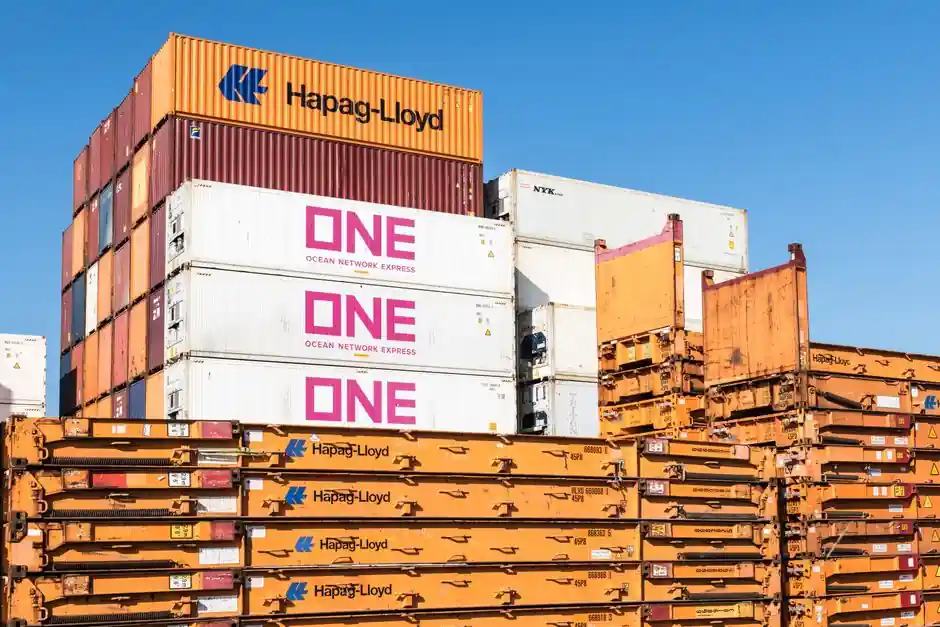
For a 5-7 MWh BESS container ordered in 2026, expect 12-26 weeks of factory build time, 28-65 days of ocean transit from China, and another 4-6 weeks of permitting for inland heavy-haul on the receiving end, for a realistic 5-8 month door-to-pad window [S2][S6].
Each 5 MWh unit lands at 40-45 tons; a fully optioned 7 MWh liquid-cooled container with integrated fire suppression pushes 48-55 tons, and these weights are 40-80% over standard public road limits before a trailer is even bolted on [S2]. That single fact cascades into vessel selection, axle count, bridge rating, and crane sizing.
Factory Lead Time and Configuration Split
Build slots for ISO-format LFP containers run roughly 12-18 weeks for a standard 5 MWh air-cooled unit and 18-26 weeks for a 5-7 MWh liquid-cooled plug-and-play configuration, based on current China-OEM scheduling visibility [S2]. The longer window reflects liquid-cooling manifold fabrication, integrated fire-suppression loop certification, and the factory acceptance test (FAT) cycle on the EMS/PCS pair.
Two products labelled "BESS container" by a vendor can carry very different lead times: a permanently integrated cargo transport unit (UN 3536 classification) versus a cabinet-on-skid arrangement loaded into an ordinary freight box. The integrated version typically takes 4-8 weeks longer because the enclosure, batteries, and powered equipment are wired and tested as one block, not assembled at the destination [S3]. The split also governs dangerous-goods documentation: UN 38.3 test summaries, UN 3536 entry checks, and the new 1 January 2026 maritime rule set all need to be in the file before the booking is confirmed [S3][S6].
Maritime Leg: Vessel Shortage and Routing
Container ships remain the preferred ocean mode, but BESS equipment is classified as overweight dangerous goods, and only a limited number of vessels are properly equipped to accept it [S1]. Real freight from China to the US West Coast runs 28-35 days; to the US East Coast via Panama, 40-50 days; to North Europe 50-65 days; to the UK 45-55 days, with routing sensitivity dominating the spread [S1][S6].
A single 2024 shipment to the US required 160 non-stackable 30-tonne containers that no regular container ship could load, forcing a heavy-lift reconfiguration with under two weeks of booking lead time [S1]. Shippers should treat the maritime leg as a constrained-resource problem: book the heavy-lift window first, then align the factory, not the other way around. The IMO-style classification update effective 1 January 2026 tightened documentation and packaging rules for lithium-ion containers in ocean service, and carriers now reject bookings missing the UN 38.3 summary or with mismatched cell/module data [S6].
Inland Heavy-Haul and Permitting
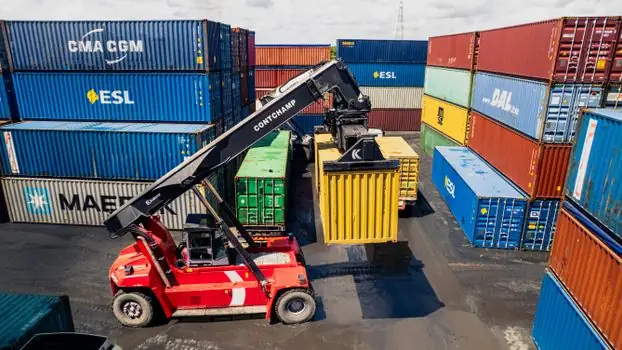
For overland moves, oversize/overweight permits require state-by-state or province-by-state approvals, and typical permit lead time is 4-6 weeks even before a truck rolls [S2]. A 6-axle rig handles 45-50 tons of payload; 55-ton units demand 8-12 axles, and SPMTs (self-propelled modular transporters) on 16+ axles are standard practice for the final mile on soft ground or pad sites [S2].
Bridge ratings, not truck specs, are the hard constraint. A 55-ton container plus 18-ton lowboy trailer equals 73 tons of rolling weight, so every bridge on the route must be rated 80+ tons with a stamped engineer's report on file [S2]. Many US and European rural bridges fail this screen, and a 2026 route survey couples drone LiDAR with ground-penetrating radar to find buried culverts, gas lines, and storm drains that collapse under that axle load [S2]. For related heavy-transport engineering trade-offs, this 20-ton AGV spec map for die and mold handling covers indoor equivalents of the same weight-distribution problem. Travel windows are similarly tight: many jurisdictions restrict heavy loads to 10 PM-6 AM and ban weekend moves, so a 300-mile leg can consume three working days even with permits in hand [S2].
Crane Pick, Set, and Commissioning Buffer
Site lifts require crane capacity rated at 1.5-2x the container's gross weight to cover dynamic load, wind, and pick-radius penalties; a 55-ton container at a 12-metre radius needs a 100-110 ton mobile crane minimum, with outrigger matting on verified bearing capacity [S2]. After the pick, EMS/PCS commissioning and utility interconnection add another 2-4 weeks depending on grid-code review (IEEE 1547, UL 1741 in the US; country-specific grid codes elsewhere) and on whether the AHJ requires a witnessed UL 9540A fire-propagation test before energisation [S5].
For comparison, the on-site scope for a 1 MWh behind-the-meter pilot is typically 4-6 weeks end-to-end, while a 100 MWh utility-scale cluster adds another 8-12 weeks for staged commissioning and grid-sync; the same scaling applies to BESS, where the last 10% of commissioning time eats more calendar days than the first 90% of construction [S4]. Buyers should therefore build a 15-20% time buffer into every manufacturer spec sheet, covering fire-suppression fluid, internal cabling, and palletised spares that the factory paperwork routinely underweights [S2].
What Drives the Lead-Time Spread
Four levers explain the gap between a 5-month and an 8-month door-to-pad schedule: cell chemistry (LFP default, 6000+ cycles to 80% is the common 2026 warranty basis; NMC rare and not advised for stationary use), certification depth (UL 9540 system listing, UL 9540A fire-propagation data, UL 1973 rack safety, NFPA 855 siting compliance in the US; IEC 62619 and IEC 62933 plus CE marking in Europe), liquid-versus-air cooling (liquid extends cycle life by 20-30% and adds 4-8 weeks of build), and destination port congestion (North Europe routings have widened by 7-10 days versus 2024 baselines) [S2][S5].
Certification alone can swing a project by 2-4 months: a system without UL 9540A test data stalls at the fire marshal, while one with a complete data package typically clears in 2-3 weeks [S5]. For broader machinery-safety documentation context that also drives BESS enclosure compliance, this breakdown of what Annex VII actually requires in 2026 covers the EU technical-file discipline that parallels the CE marking path for European BESS deployments. The containerized BESS market itself is forecast to grow at 24.1% CAGR through 2035, which means factory slots will keep tightening, and lead times will likely drift longer, not shorter, through 2027 [S4].
Risk Levers Buyers Actually Control
Three controls cut lead time reliably. First, lock the heavy-lift ocean window before signing the factory PO; carriers reject bookings without complete UN 38.3 and UN 3536 documentation, and a missed window pushes the schedule 4-6 weeks [S1][S3]. Second, standardise on LFP liquid-cooled configurations that the factory already builds in volume, avoiding custom PCS or non-standard 45-ft enclosures that add 6-10 weeks of NRE [S2][S5]. Third, run the route survey in parallel with the factory build, not in series; permit lead times of 4-6 weeks can be fully absorbed inside the 18-26 week factory window if started on day one [S2].
For data-centre and behind-the-meter buyers evaluating parallel power options, this 2026 spec map on behind-the-meter power equipment frames how BESS slots against gas turbines and fuel cells on commissioning time, a useful cross-check when storage is one of several sources under consideration. Watch for two trackable signals over the next two quarters: cell-pricing reset announcements from the major Chinese LFP cell makers (which historically move factory booking behaviour 6-8 weeks later), and any update to the 1 January 2026 maritime classification ruleset that the major carriers apply to overweight container bookings [S3][S6].
For the relevant spec sheets and selection criteria, see lead screw, tank container, and time relay.