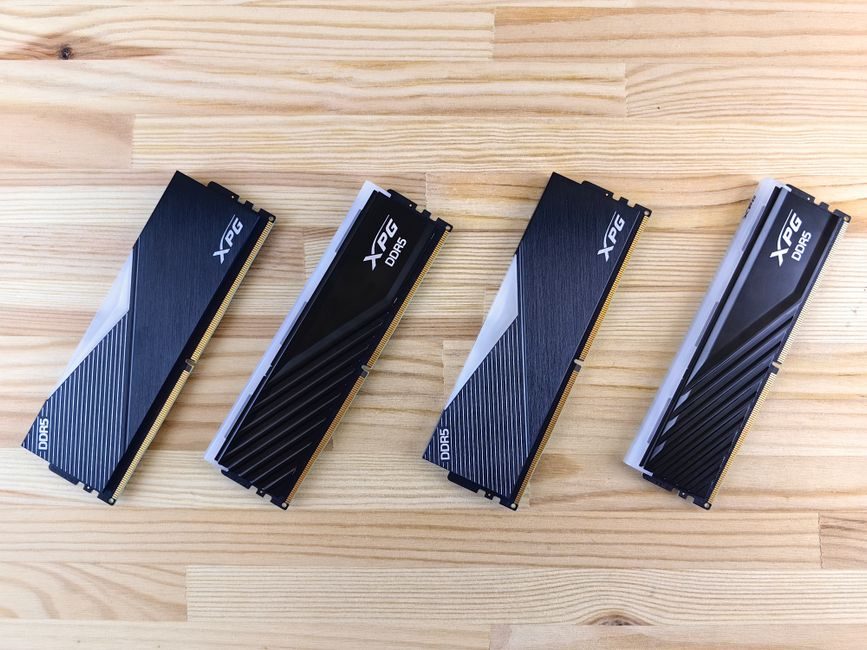
DDR5 is the JEDEC baseline for new industrial memory module designs as of mid-2026, with Samsung, Kingston, and ATP all cataloguing DDR5 SODIMM/UDIMM alongside shrinking DDR4 SKU counts [S2][S5][S8].
The shift carries real spec consequences: DDR5 moves the register clock device (RCD) and a 12 V-input PMIC onto the DIMM itself, drops module voltage to 1.1 V, and doubles burst length to 16 — changes that break legacy DIMM sockets and force a board re-spin rather than a drop-in upgrade [S2].
DDR5 vs DDR4 vs LPDDR5x: Decision Criteria for Industrial Modules
For an industrial control PC or edge-AI box, three DRAM families now compete for the same socket. DDR5 UDIMM/SODIMM runs at 1.1 V with on-module PMIC and ECC-capable variants, DDR4 UDIMM/SODIMM remains stocked at 1.2 V for legacy IPC retrofits, and LPDDR5x is targeted at soldered-down edge inference where power-per-GB matters more than socket replaceability [S2][S5].
On a four-axis comparison the ranking inverts depending on what is being optimised: DDR5 wins on bandwidth (4800–6400 MT/s data rate, BL16) and on error-correction granularity via on-die ECC, LPDDR5x wins on JEDEC power (sub-1 V VDDQ) and channel width up to 16-bit per die, while DDR4 still wins on cost-per-bit and on socket availability for plants running 5–10-year-old IPCs [S2][S5][S8]. ATP's 2026 industrial catalogue still lists DDR3, DDR4, and DDR5 DRAM modules side by side — a deliberate hedge because many IIoT gateways cannot yet migrate to the 1.1 V rail [S8].
Spec Sheet Must-Haves: PMIC, Thermal Sensor, and Rank Configuration
Three line items on a 2026 DDR5 datasheet separate a usable industrial module from a consumer-grade part: an integrated PMIC accepting 5 V or 12 V auxiliary rail, an on-module thermal sensor (TS) reporting via the I3C/I2C sideband, and a rank/x72 organisation for ECC SODIMM [S2][S8].
Kingston's DDR5 technical brief specifies that the on-module PMIC replaces the motherboard VR phases previously required for DDR4, drawing from a 5 V or 12 V rail; omitting this stage on a carrier board will prevent POST regardless of how clean the 1.1 V rail looks [S2]. The brief also calls out that DDR5 SODIMMs expose temperature per rank, which lets a chassis designer close the loop on a sealed IP65 box without bolting on a discrete thermistor [S2]. Alliance Memory, in parallel, ships legacy DDR3/DDR4 densities in 96-ball FBGA and TSOP for medical and industrial customers that have not yet qualified DDR5 [S7].
Legacy Footprint: DDR3/DDR4 Long-Tail in Medical and Industrial
Despite the DDR5 push, DDR3 and DDR4 remain ordered for the long tail of medical, IIoT, and brownfield IPC platforms, with Alliance Memory and ATP both stocking legacy densities in wide-temperature grades [S7][S8].
Alliance Memory's medical product line documents use of SRAM and DRAM in life-support ventilators, defibrillators, diagnostic imaging, and patient monitors — applications where a platform re-validation under a new memory standard can cost more than the parts saved [S7]. For comparison, an industrial DDR4 module such as the Samsung M471A1K43BB1-CTD SODIMM still ships in the catalogue as a drop-in for legacy 1.2 V designs that have not migrated to PMIC-equipped DIMMs [S5]. Buyers specifying 2026 BOMs should therefore confirm JEDEC temperature grade (commercial 0–85 °C vs industrial -40–85 °C) and whether the SPD is locked to a specific JEDEC timing table before assuming pin-compatibility across vendors [S3][S8].
Industrial vs Enterprise: Same Silicon, Different Burn-In
DRAM silicon is largely fungible between industrial and enterprise, but the bill of materials around the die — SPD, PMIC, heatspreader, conformal coating, and burn-in — is where industrial pricing diverges from consumer DRAM [S5][S7][S8].
Samsung's industrial-temp DDR module page markets the same die family used in data-centre DIMMs but adds a wider operating envelope and documentation for thermal cycling, vibration, and long-life programmes — the cost drivers being test time and traceability rather than wafer cost [S5]. ATP's industrial blog frames the choice around IIoT use cases that demand solder-down or ruggedised SO-DIMM with -40 to 85 °C support, often populated with wide-temp NAND for the boot partition but wide-temp DRAM for runtime working memory [S8]. The practical procurement lesson: when a vendor quotes "industrial-grade" DRAM, the [S#] should be the burn-in report, not the JEDEC part number — same die, different reliability data.
Reference Datasheet Pattern: Nanya NT5CC64M16DP-CF
For a concrete 2026 datasheet anchor, the Nanya NT5CC64M16DP-CF specifies a 1 Gbit DDR DRAM in 64M × 16 organisation, 1.35 V supply, commercial 0–85 °C operating temperature, halogen-free PBGA-96, and RoHS compliance — typical of the legacy DDR generation still being sourced for industrial adapters [S3].
The Nanya part illustrates three procurement points that recur across 2026 industrial DDR sources: density is expressed in words × bits-per-word rather than bytes, the 1.35 V rail is a low-voltage DDR (DDR3L) variant, and 96-ball FBGA is the dominant package for embedded applications where socketed DIMMs are not an option [S3]. When these same 64M × 16 dies are stacked into an 8 Gbit module, they end up on a UDIMM or SODIMM whose datasheet is closer to Kingston's KHX8500D2/1G reference — 128M × 64-bit, 240-pin, JEDEC-standard timing at 1.8 V, with the SPD programming the speed bin [S4]. Buyers comparing 2026 quotes should normalise to the JEDEC base timing (5-5-5-18 at 1.8 V in the Kingston example) and ignore the XMP/overclocked numbers unless the carrier board is rated for them [S4].
Sourcing Signals to Track Through Q4 2026
Two verifiable indicators will tell an industrial buyer whether the DDR4–DDR5 crossover is complete: the number of new SKU releases in the DDR4 industrial-temperature category at ATP, Alliance Memory, and Samsung, and the published lead-time on JEDEC-standard DDR5 SODIMM 16 GB and 32 GB densities from at least two independent distributors [S5][S7][S8].
Until those numbers move, a prudent 2026 spec keeps one DDR4 industrial SKU qualified for legacy retrofit and qualifies a DDR5 module with on-module PMIC, TS, and ECC for new builds — with the on-module PMIC and TS verified against the JEDEC DDR5 spec sheet rather than marketing collateral [S2][S8]. For edge-AI inference that can solder the memory, the [S2] technical brief recommends trialling LPDDR5x in parallel, on the understanding that moving from a socketed DIMM to a BGA is a board re-spin, not a memory upgrade.
Spec-level background on the components involved: pressure transmitter, flow meter, and industrial valve.
Background reading: Hydraulic Cylinder Buying Guide: Spec Match, Mounting Type, and 2026 Cost Levers.