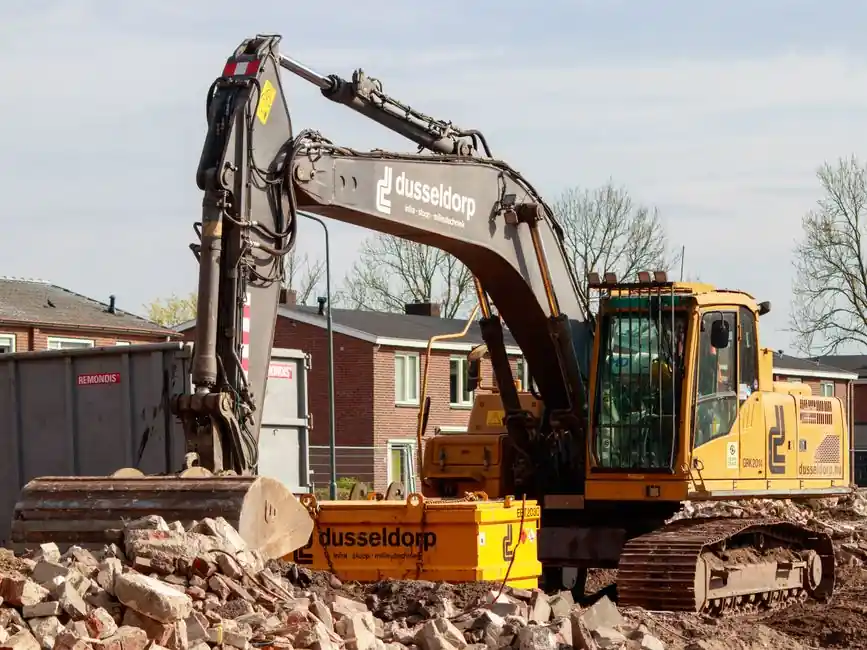
A truck-mounted crane in demolition service is a carrier-mounted loader crane (knuckle or telescopic) selected to lift, sort, and feed debris while the chassis shuttles between cuts, with a separate demolition hammer sized by carrier GVW handling the breaking work.
Working capacity for the segment typically sits in the 3-25 tonne range, matching the boom models on offer from Xuzhou-based manufacturers such as BOB-LIFT, BAOWO, and MJSL, who list knuckle and telescopic lines alongside marine and pickup variants [S1][S2][S4].
Knuckle vs Telescopic: Geometry Decides the Call
Knuckle-boom cranes fold through an articulated knuckle and stow tight against the headboard, freeing deck space for a grapple, clamshell bucket, or a slab-carrying pallet on a short-wheelbase carrier [S1][S4]. That geometry suits low-rise strip-outs where the boom works below roofline and where the operator needs to reach over a partially cut wall without extending a long boom tip.
Telescopic-boom cranes use a straight multi-stage ram to push reach and height, paying for it in stow length and tail swing. They win on open sites where a 2-3 storey structure is being dropped and the crane has to lift sections clear of standing walls, or feed a dump truck positioned at stand-off distance [S1][S4]. BAOWO's published range covers both architectures with matched control valves and slewing bases, so a demolition buyer is choosing kinematics, not brand [S2].
Demolition Crane Selection Gates and Working Capacity
Selection on a demolition contract is driven by four numbers: maximum lift moment (tonne-metre) at full reach, weight of the heaviest single component being lifted, chassis payload after subframe and stabiliser deductions, and the number of lifting cycles per shift the carrier can sustain without overheating the hydraulic cooler. [S2]
For interior strip-out, the 3-8 tonne class (SQS80, SQS200, SQK250-class units) is the common working window, fitted on 4x2 or 6x2 carriers from 8-18 tonne GVW [S4]. For structural demolition where reinforced concrete columns, steel beams, or masonry panels are removed in one piece, the 10-25 tonne class is mandatory, and the boom's load chart at the working radius used on site, not the headline maximum, is the binding number [S2][S4].
Distributors such as 600CT in the Western Cape market Fassi knuckle units into waste, recycling, and construction fleets, treating the truck-mounted crane as a material-handling tool that doubles for demolition support, with waste and recycling listed alongside construction as primary end-uses [S3].
Attachment Pairing: Grapple, Bucket, and the Demolition Hammer Question

A demolition hammer is rarely mounted directly on the truck crane's boom: the carrier's hydraulic flow is sized for the loader crane's slewing and winch circuits, not for a 1,500-3,000 bpm breaker. The standard site configuration is a dedicated carrier-mounted breaker (or a mini-excavator-mounted breaker) for the breaking pass, with the truck-mounted crane doing the sort-and-load pass, lifting cut sections into a dump truck or hook-lift body [S1][S3].
For lower-intensity demolition (timber frames, lightweight masonry, internal fittings), 600CT and similar distributors pair the truck crane with a clamshell or a hydraulic grapple from the same OEM family, keeping all motion on one hydraulic bank and one operator [S3]. Buyers should confirm the loader crane's auxiliary hydraulic flow in L/min and pressure in bar before promising grapple work, and should not assume a knuckle-boom unit rated for 10 tonne lift at 2 m will deliver 10 tonne at 8 m, the published load chart, not the nameplate, is binding.
Chassis and Outrigger Constraints on Demolition Sites
Demolition sites are uneven, soft-edged, and crowded, which puts the outrigger pad load on a par with the boom's lift capacity as a selection gate. Stabiliser spread, pad size, and the maximum permitted ground bearing pressure (typically 80-200 kPa depending on soil class) determine the radius at which the crane can work at full chart, and a crane specced from the brochure at 20 m reach may only be usable to 14 m on a crushed-concrete slab. [S2]
Short-wheelbase carriers with wide hydraulic outriggers give better site access on inner-city strip-outs; longer-wheelbase carriers with narrower outriggers suit open greenfield demolition where reach matters more than pad footprint [S2][S4]. MJSL publishes a 98,000 m² production base in China with right-hand-drive and varied emission-standard options, reflecting the cross-region flexibility demolition buyers ask for [S4].
Standards, Safety, and Sourcing Caveats
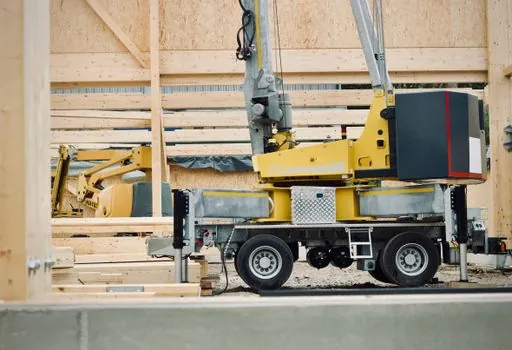
Loader cranes sold into the EU are governed by the Machinery Directive (2006/42/EC) as transposed, with EN 12999 the harmonised standard for loader cranes covering stability, slewing, and load-chart derivation. Operators on UK and EU sites need a CPCS A60 or ALLMI/ENPO qualification, and lifting accessories (slings, shackles) carry separate LOLER inspection cycles. Buyers outside the EU should still demand load charts derived to EN 12999 or an equivalent national standard; a nameplate lift without a documented chart is not a spec, it is a marketing number. [S2]
Manufacturer pages reviewed for this piece (BOB-LIFT, BAOWO, MJSL, 600CT as a Fassi distributor) confirm the segment's product taxonomy but do not publish independent test data, fatigue-cycle ratings, or specific EN 12999 clauses, so the buyer must request the Declaration of Conformity and the full load chart at the planned radii before purchase [S1][S2][S3][S4].
Comparison: Knuckle vs Telescopic for Demolition Work
On a head-to-head for a typical 10-25 tonne demolition truck crane, knuckle units win on stow length, low-building reach-over, and lower cost per tonne-metre, while telescopic units win on raw vertical reach, simpler load-chart reading, and faster hook-in on open sites where the boom can be fully extended without folding. [S1]
For interior strip-out and waste/recycling crossover, the knuckle-boom architecture is the better default; for structural demolition on open plots, the telescopic boom's reach and direct radial lift path usually justify the stow penalty. In both cases, the binding spec is the load chart at the working radius, the stabiliser pad load on the actual ground, and the carrier's residual payload after the subframe, tank, and stabilisers are fitted [S1][S2][S4].
Buyers comparing across the BAOWO, BOB-LIFT, and MJSL ranges should request the same load chart, the same EN 12999 or equivalent DoC, and the same outrigger pad-load drawing for each candidate, then make the call on price, lead time, and local dealer support, because the published model line-ups cover the same kinematic options with broadly comparable 3-25 tonne capacity brackets [S1][S2][S4].
For related site-vehicle spec work, the crawler-crane selection logic for restricted-access sites follows a similar load-chart-first discipline as covered in Crawler Crane Selection for Snow Removal: 2026 Spec Gates, and the carrier-side questions on payload, axle load, and body choice overlap with dump truck selection for muck-away fleets. Track two signals next: a specific EN 12999 load chart at the working radius for the shortlisted crane, and a confirmed outrigger pad-load figure on the actual demolition-site soil class.
For the relevant spec sheets and selection criteria, see truck mounted crane.