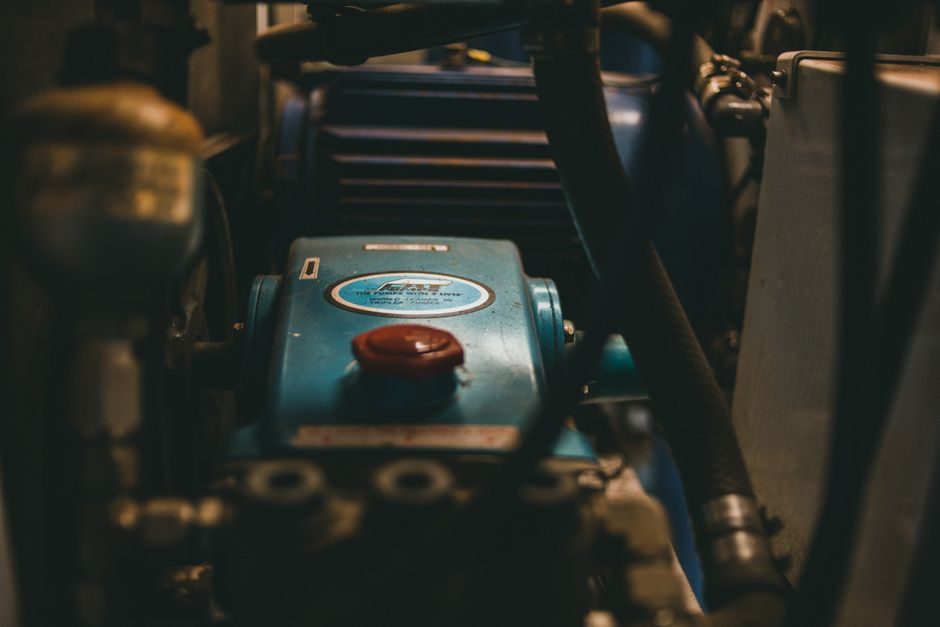
Food-grade diaphragm pump selection for a validation line is driven by four engineering decisions: wetted-material certification, clean-in-place (CIP) / sterilize-in-place (SIP) thermal tolerance, pulsation control, and hazardous-area classification for alcohol- or solvent-based cleaning chemistries [S1][S2].
Air-operated double-diaphragm (AODD) pumps dominate this segment because their sealed diaphragm isolates the product from lubricants and the drive mechanism, which simplifies validation documentation versus a packed plunger or lobe pump [S2].
Hygienic Material Certification and Surface Finish
FDA 21 CFR 177 (food-contact elastomers) and 3-A Sanitary Standards 02-09 / 73-01 (sanitary fittings) are the baseline specifications called out on most food-grade diaphragm pump datasheets; wetted elastomers in PTFE, EPDM, or Santoprene variants are the common selections, with PTFE preferred for high-acid and high-temperature product streams [S2].
Stainless 316L wetted hardware is the default for sanitary service; surface finishes on product-contact surfaces must be specified at Ra ≤ 0.8 µm (32 µin) for sanitary tubing and Ra ≤ 0.5 µm (20 µin) where membrane filtration or final-product transfer is the service [S2].
CIP and SIP Thermal and Chemical Compatibility
Stainless-body AODD pumps with PTFE diaphragms are rated for repeated SIP exposure at 121 °C saturated steam for 30-minute cycles, the typical validation protocol for aseptic and ESL dairy or beverage lines [S2].
Verification steps during validation normally include three consecutive CIP/SIP cycles with final rinse conductivity below 1 µS/cm and endotoxin rinse samples, with the pump's diaphragm acting as the only true dynamic seal in the train [S2].
Pulsation, Shear, and Flow-Quality Metrics
Diaphragm pump discharge is inherently pulsed; pulse amplitudes of 10–30 % of line pressure are typical for an AODD at 60–100 cycles/min, which is unacceptable for positive-displacement flow meters or HPLC sample loops downstream [S1].
A side-by-side comparison of the three common discharge-control options:
- No dampener: simple, lowest cost, pulses of 10–30 %; suited only for transfer or feed-tank loading.<br/>- Pneumatic-charged bladder surge suppressor: adjustable to 5 % pulse amplitude or less, broad chemical compatibility; adds 1–2 pipe diameters of dead volume [S1].<br/>- Electric- or servo-driven metering diaphragm pump: constant low-pulse output, ±1 % flow accuracy, but needs a separate power and control signal, raising explosion-classification scope [S2].
ATEX and Hazardous-Area Zoning for CIP Fluids
When the cleaning chemistry includes alcohol, MEK, or a low-flashpoint solvent, the surrounding space must be classified ATEX 2014/34/EU Zone 1 (Group IIB/IIC) for the pump enclosure and any solenoid / level-switch on the suction leg, per IEC 60079 series guidance [S2].
AODD pumps are intrinsically safe for flammable atmospheres because the drive is pneumatic with no hot surfaces or electrical components in the wetted area, which is the principal reason food plants running ethanol-based sanitizers still specify AODD over centrifugal for line-dedicated CIP skids [S2].
Vendor Selection Tools and Sizing Discipline

Manufacturer selector tools, e.g. the Husky AODD selector, let engineers input flow (L/min), suction lift (m), particle size (mm), and material code to receive a shortlist of body sizes and diaphragm materials, which compresses the 8–12 week vendor-evaluation cycle typical of a brownfield dairy expansion to under two weeks [S3].
Standard aluminum-body AODD pumps are not acceptable in sanitary service; specifying a stainless 316L body with a PTFE diaphragm, tri-clamp connections, and a CSA-certified motor / grounding path on any electric overpump option is the minimum technical envelope for a validated food line [S2].
Trackable signals to watch before issuing a PO: (a) the vendor's 3-A / EHEDG certificate number and last audit date, (b) the OEM's published CIP/SIP cycle-count endurance figure, and (c) a documented pulse-amplitude curve with the chosen surge suppressor at your line's actual operating pressure.
Related: pressure transmitter, flow meter, industrial valve.