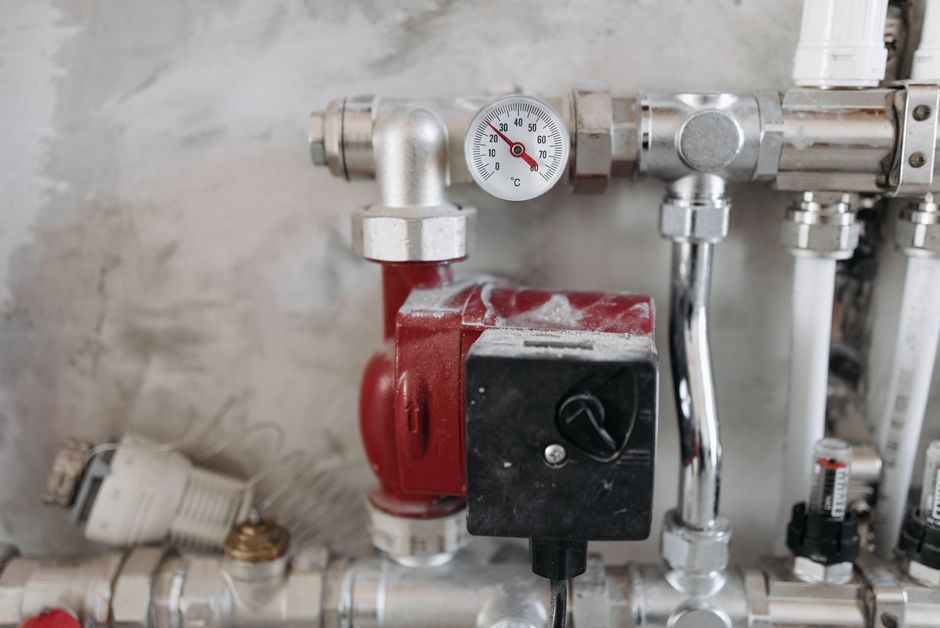
Diaphragm pumps (AODD, mechanically actuated, and PTFE-lined) are positive-displacement machines: each stroke moves a fixed chamber volume, so flow is set by stroke length × cycles per minute, not by impeller speed [S5]. Multistage centrifugal pumps stack 2–12 impellers in series; head is summed across stages, producing 50–1,500 m lift per casing on industrial builds from manufacturers such as Galleon, HNYB, and Kenshine [S2][S6][S7].
Operating envelopes diverge sharply: a typical 1.5-inch AODD sits at 0–50 m³/h and 0–8 bar, while a horizontal multistage D-type frame spans 3.75–1,360 m³/h at 50–1,500 m head and 3–4,000 kW [S6]. The selection question is therefore not "which is better" but "which duty window — flow, head, fluid — matches which mechanism".
Flow, Head, and Efficiency Windows Compared
Galleon's second-generation multistage line (DP/DFP/DYP/MDP) publishes 3.75–1,360 m³/h flow, 81–1,384 m head, and 7.5–4,000 kW motor power across the range [S6]. The first-generation D/DF/DY/MD series and DK single-/double-inlet frames cover 55–1,360 m³/h at 60–1,500 m head [S6]. Kenshine's DY horizontal multistage oil pump — the same family used as boiler-feed or hydrocarbon-transfer skid — is offered on FOB terms of 600–15,000 USD/set from Shanghai, with monthly capacity of 200 sets [S2].
On the diaphragm side, the SLD/SLDG/SLMD horizontal multistage reference (Q=12.6–1,260 m³/h, H=13–232.8 m, 0–105 °C, inlet 50–150 mm) is the bridging case: a multistage machine is still in centrifugal territory even at 12.6 m³/h [S1]. Vane-angle CFD studies on 12°/14°/18° radial impellers (stainless steel, AMMC, Kevlar 49) confirm that centrifugal output is governed by blade geometry and rotational speed, with mass-flow rate rising as a function of fluid velocity at the impeller eye [S3]. AODD units, by contrast, cap practical flow near 50 m³/h before frame cost and air consumption become uneconomic.
Fluid Compatibility: Solids, Shear, and Corrosion
Diaphragm pumps pass solids up to the ball-valve clearances (commonly 10–65 mm depending on port size) and tolerate slurries with particles that would erode a centrifugal impeller in days [S5]. The SLMD wear-resistant multistage variant tolerates only ≤1.5% solids by volume with particle diameter <0.5 mm, and the medium must stay below 80 °C — limits written into the product specification itself [S1]. For abrasive or fibrous service, the diaphragm mechanism is the only safe option; for clean, low-viscosity water, glycol, or light hydrocarbon, the multistage centrifugal is mechanically more efficient.
Fluoroplastics-lined magnetic centrifugal pumps (PTFE wetted path) address a different corrosion niche — strong acids at modest solids loading — and are listed by Anhui-based OEMs at 3,500–35,000 USD/set for 1-set MOQ, separate from the diaphragm comparison [S8]. Material options on multistage casings span cast iron, SS304/316, and duplex; diaphragms span Santoprene, EPDM, Viton, PTFE, and bonded PTFE/Neoprene for chemical resistance. Pump diaphragm pump selection therefore turns on the chemical compatibility matrix of the elastomer, not on metallurgy alone.
Pulsation, Suction Lift, and Run-Dry Behavior

Multistage centrifugal pumps require flooded suction or a minimum NPSH margin; the SLDG boiler-feed variant specifies inlet pressure must be positive for stable head delivery above 100 m [S1]. Diaphragm pumps are self-priming to 5–9 m dry lift on standard 1–2 inch AODD frames and tolerate dry running indefinitely because the working fluid never contacts moving seals — only the diaphragm flexes.
Pulsation is the reverse trade-off. For instrumentation, dosing, or HPLC feed, that pulsation gap often forces a dampener or a switching to a peristaltic or diaphragm-metering pump instead. multistage centrifugal pump installations on boiler-feed service use the smoother discharge to protect downstream control valves and economizer tubes.
Selection Matrix: Four Decision Criteria
Temperature: AODD diaphragms (PTFE-rated) cap near 150 °C wet, 200 °C dry; SLD/SLDG multistage frames are specified 0–105 °C with the wear model limited to 80 °C [S1]. Solids tolerance: diaphragm ports pass 10–65 mm, multistage tolerates <0.5 mm particles and <1.5% by volume [S1]. Maintenance interval: AODD diaphragm and ball sets are field-replaceable in 30–60 minutes; multistage stage repair requires impeller, shaft, and bearing teardown.
Use the comparison passage as the decision anchor. If the duty is clean, continuous, high-head (boiler feed, RO feed, mine dewatering beyond 100 m), specify a horizontal multistage D/DP frame at 3.75–1,360 m³/h [S6]. If the duty is dirty, intermittent, shear-sensitive, or run-dry-prone (slurry transfer, chemical dosing, pigment, ceramic slip, drum unloading), specify a diaphragm pump sized to stroke volume × cycles. Sliding the same comparison down a row — e.g. a chemical plant metering sodium hypochlorite at 5 m³/h against 30 m head — collapses both candidates: a small AODD is cheaper, a horizontal multistage is more efficient, and a metering diaphragm pump wins on accuracy.
Integration, Standards, and Sourcing Footprint
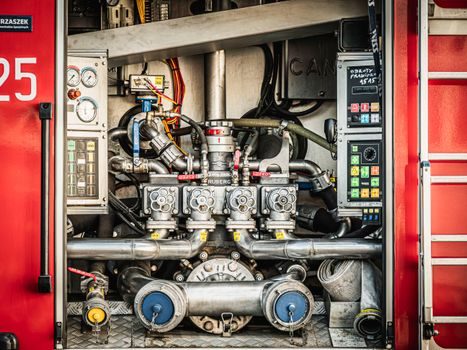
SLD/SLDG/SLMD horizontal multistage pumps from the cited OEM are documented to GB/T 5657-95 centrifugal-pump technical-conditions Class III [S1]. HNYB (Henan) lists 30 years of pump production with own casting foundry and posts supply lines for self-balancing multistage, medium-open, chemical, condensate, sewage, diaphragm pump, pipeline, single-stage, self-priming, oil, vacuum, slurry, deep-well, and mud pumps — a useful single-supplier view of the full displacement-vs-centrifugal portfolio [S7]. Galleon's SINCE-1983 catalogue lays the D/DF/DY/MD and DP/DFP/DYP/MDP families side by side, with DK single-inlet and DKS double-inlet frames closing the high-flow gap up to 1,500 m head [S6].
On air-operated diaphragm units, the cross-listed catalogue shows 1/4-inch to 3-inch AODD frames from suppliers including Dongguan Vinsome and Shanghai Suoto, with AODD price bands 1,000–5,000 USD/set MOQ 1 [S5]. multistage pump FOB bands from Kenshine on the DY oil-pump line are 600–15,000 USD/set with 200-set/month supply ability [S2]. For comparison sourcing — e.g. a diaphragm vs inline pipeline pump decision on a clean-water skid — use the same OEM dossier to confirm duty-point overlap before locking the spec.
Limits, Failure Modes, and Verification Signals
Failure modes are mechanistically distinct. Diaphragm pumps fail by diaphragm rupture (cycle-life limited, often 10–50 million cycles for PTFE), air-valve stalling on dirty compressed air, or ball-seat wear. Multistage centrifugal pumps fail by impeller erosion, mechanical-seal face wear, bearing fatigue, and shaft deflection at off-design flow. The published SLD/SLDG/SLMD parameters cap temperature at 105 °C and solids at <0.5 mm, so any service that pushes past those limits is automatically outside the centrifugal envelope and inside the diaphragm envelope [S1].
Trackable signals for spec verification: published head-rise efficiency curves from the multistage OEM (D/DP family, Galleon) and cycle-life curves from the AODD diaphragm supplier. Confirm GB/T 5657-95 Class III documentation on the centrifugal side and the elastomer compatibility chart on the diaphragm side. Both Kenshine (Shanghai, 200 sets/month capacity) and HNYB (Henan, own foundry) are currently listed as active suppliers with the product lines cited [S2][S7].
Closing spec anchor: lock the fluid-window first (clean vs solids-laden, viscosity, temperature, run-dry risk), then map the duty point to either the SLD/SLDG/SLMD envelope (12.6–1,260 m³/h, 13–232.8 m, 0–105 °C) [S1] or the AODD envelope (≤50 m³/h, ≤8 bar, slurry-tolerant). Two trackable signals for 2026-07-19: Galleon's DP/DFP/DYP/MDP second-generation range at 7.5–4,000 kW remains listed as the high-power multistage reference [S6], and HNYB's 30-year production line including self-balancing multistage and diaphragm pump is published with own-casting sourcing [S7].
For the relevant spec sheets and selection criteria, see centrifugal pump.