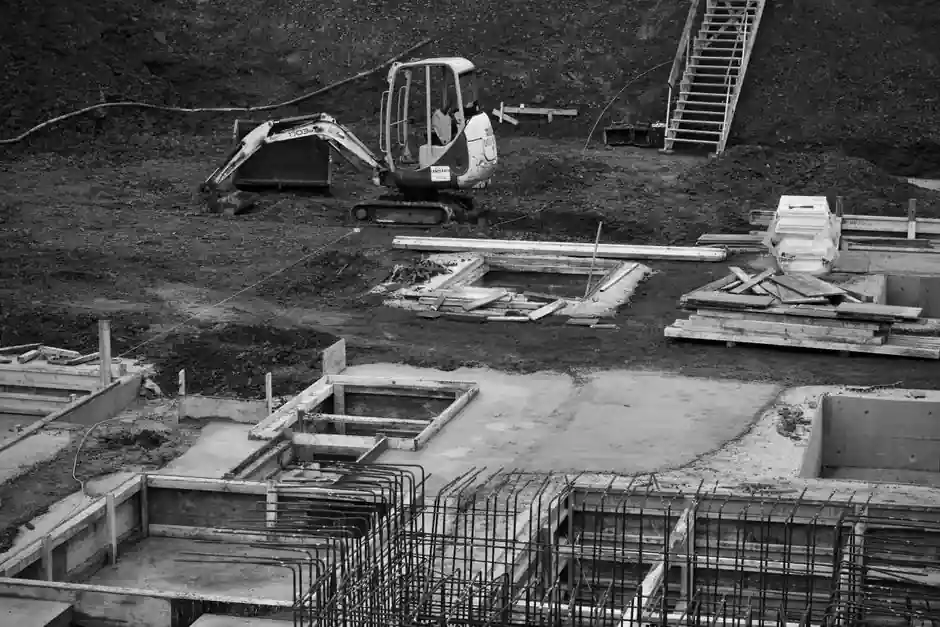
BAUER states that selection between a trench cutter and a diaphragm wall grab depends primarily on soil conditions and trench depth.
Both systems construct slurry-supported diaphragm walls, but they suit different soils, depths, operating envelopes and supply arrangements; a trench cutter becomes necessary where the selected grab cannot break the ground efficiently [S1][S2].
Difference in excavation mechanism and output
A diaphragm wall grab excavates in repeated cycles: the tool is inserted into the slurry-supported trench, loosens material at the base, and removes the soil before reinforcement and concrete are placed [S1].
A clamshell grab performs a comparable panel-excavation function, but the hydraulic grab used for diaphragm walls is a more specialized machine with a high load capacity and remote hydraulic control [S2][S4]. Heritage Infra Space identifies clamshell grabs and chisels as conventional equipment used in diaphragm wall construction.
BAUER lists trench cutters as especially suitable for hard or very hard soil conditions and large trench depths.
Decision comparison across four criteria
Depth is the first separator: the DHG V specification reaches 3,800 mm trench length and 1,500 mm trench width, whereas the research provides no equivalent depth capacity for a conventional clamshell [S1].
Site access and equipment integration form the fourth criterion. SENNEBOGEN identifies the 6140 HD as a 140 t duty-cycle crane with a diaphragm wall grab.
Correct application for foundation excavation
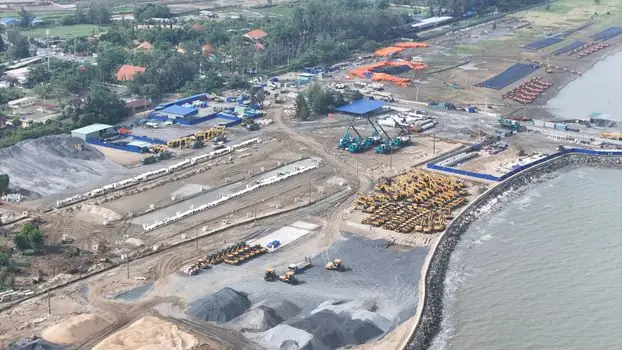
Specify a diaphragm wall grab for basement and foundation pits where the excavation requires panel-by-panel removal of dense sand, stiff clay or variable fill, provided the panel geometry fits the published tool envelope and the crane-leader system has the required capacity [S1][S3]. The pile driver is a separate foundation method, so it should not be substituted for wall-panel excavation merely because both are foundation construction equipment.
The wall remains a structural or earth-retaining element rather than merely a trench: diaphragm walls can enclose excavation pits, seal dams, or act as foundation elements with structural function [S1].
Neither grab removes the need for slurry management. Support slurry stabilizes the open trench, while displaced slurry passes through desanding equipment before returning to the circuit for reuse [S1]. If hard soil or trench depth exceeds the grab’s working range, a trench cutter becomes the defensible alternative; cutting wheels loosen the material, and a mud pump removes the loaded slurry through a desanding plant [S1].
Geometry, handling and machine-selection constraints
Panel width must therefore match the grab specification rather than an assumed nominal range. This is especially important when comparing a dedicated diaphragm wall carrier with a crawler crane or other lifting base because attachment, leader and hydraulic requirements can dominate productivity.
The crane must also satisfy the complete working load, not merely lift the grab in isolation. SENNEBOGEN identifies the 6140 HD as a 140 t duty-cycle crane with a diaphragm wall grab, while the supplied product listings show maximum load capacities up to 40 t and maximum hook heights up to 24 m. Those figures describe specific crane models, not universal grab requirements, so the final selection must use the manufacturer’s duty chart for the configured leader, grab, block, rope system and working radius.
For commercial planning, the operating-cost calculation should include trench cycles, slurry treatment, cleaning time, panel width and realized production rather than acquisition cost alone. The related analysis of diaphragm wall grab operating cost per square meter provides a useful framework for comparing those variables with a clamshell option.
Failure modes and quality controls
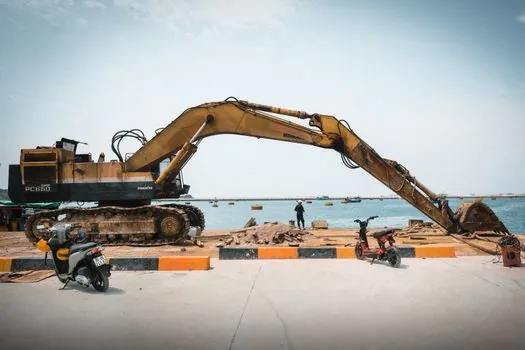
These risks increase when the clamshell is asked to perform outside its practical soil range, particularly where dense sand or stiff clay reduces bite efficiency [S3].
Hydraulic grabs reduce some traditional limitations through greater load capacity, remote control, and more controlled excavation, but they do not remove geotechnical risk [S4]. A panel can still be affected by inadequate slurry support, poor desanding, unsuitable tool geometry, or a mismatch between soil and grab. Control records should therefore cover trench dimensions, slurry condition, excavation cycle behavior, panel volume or yield, reinforcement placement, and concrete placement.
Selection also needs an explicit stop condition. If the grab repeatedly stalls, produces irregular trench geometry, or cannot meet panel dimensions, the contractor should compare a cutter against the ground rather than continuing inefficient grab cycles [S1]. This prevents a nominal schedule from overriding a clear production limit.
Practical recommendation by project case
For a deep basement or cut-off wall in dense sand, stiff clay or mixed urban ground, choose a hydraulic diaphragm wall grab, subject to confirming the 3,800 mm by 1,500 mm maximum DHG V geometry against the design panel and checking crane and leader capacity [S1][S3]. For a shallow wall in soft-to-medium soil with constrained access, a conventional clamshell may deliver a simpler package [S4].
For very hard soil or depths beyond the grab range, select a trench cutter rather than forcing either grab [S1]. For a mixed fleet, classify each wall panel by formation level, expected bite resistance, required panel width and access route, then assign grabs or cutters accordingly. That panel-level approach is more defensible than specifying one machine for an entire excavation without soil variation.
Track production in panels per shift, excavation minutes per panel, slurry volume treated, cleaning time and realized wall area per operating hour; compare these records with the planned panel schedule and the contractual excavation completion date.