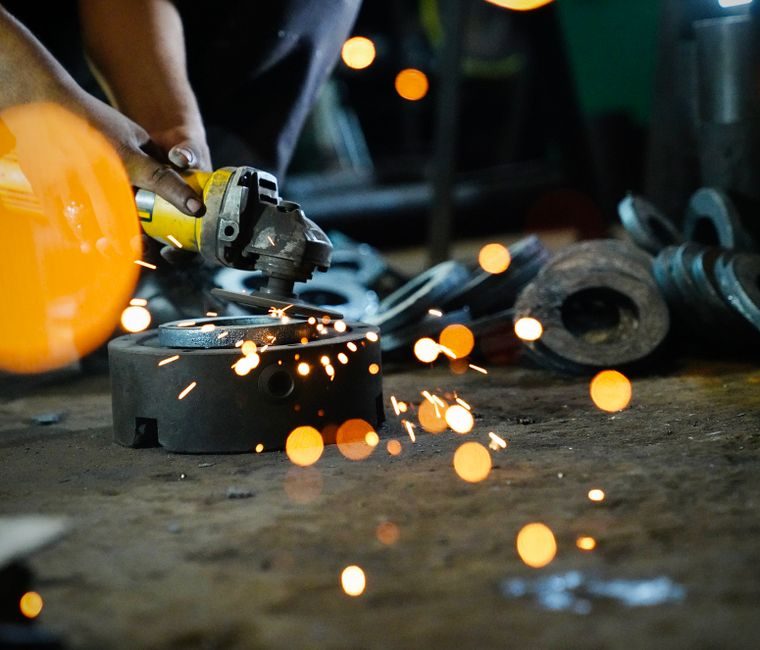
A die casting die is a hardened steel (typically H13 / DIN 1.2343) tool machined to accept molten aluminum, zinc or magnesium injected at clamping forces commonly from 300 to 3,500 tonnes, producing thin-wall, high-tolerance parts in cycles of seconds [S1][S5]. A sand casting mold is a one-piece bonded silica shape (green sand, resin no-bake, or shell) consumed after a single pour, tolerating a far wider alloy range including cast iron, carbon steel, bronze and large aluminum pours [S2][S3][S6].
For buyers comparing the two, the practical cutoff is volume × alloy × tolerance × part size: die casting wins for runs of 1,000+ pieces in Al/Zn/Mg with ±0.05 mm tolerances and walls as thin as 1.5 mm; sand casting wins for prototypes, runs under a few hundred, large housings above ~50 kg, ferrous alloys, or any job where tooling lead-time and NRE must stay low [S2][S3][S6][S9].
Tooling Material, Lead Time, and Cost Structure
A die casting die is machined from pre-hardened or through-hardened tool steel, water-cooled internally, and trimmed with ejector pins, slides, and runner systems sized to the projected area × injection pressure [S1]. Lead time for a new single-cavity die is commonly 4-8 weeks, with tool costs of USD 5,000-50,000 per cavity depending on size and slide count, and a service life rated in tens of thousands to hundreds of thousands of shots before welding or refurbishment [S1][S5].
A sand casting mold is built around a wood, resin, or aluminum pattern and bonded silica aggregate; the pattern is reusable but the mold is consumed each pour [S2][S3]. Lead time on the first part is typically 2-4 weeks because pattern fabrication dominates, but per-unit piece cost drops slowly with volume because each part still requires new mold assembly, sand reclamation, and pouring labor [S3][S6]. Tooling NRE for a sand pattern is often 10× lower than a comparable die, while per-part cost at 10,000+ pieces is several times higher once labor, sand, and yield losses are summed [S2][S6].
Process Physics: Pressure, Temperature, Cycle Time
Die casting forces molten metal into the cavity at 10-100+ MPa using a cold-chamber (aluminum, magnesium, brass) or hot-chamber (zinc, lead-free zinc alloys) machine; shot-to-shot cycle time for small aluminum parts lands in the 30-90 second range, dominated by injection, solidification, and water-cooled die open/close [S1][S4]. For reference, a 3,500-tonne clamp pressure is offered as the upper end of mainstream aluminum cold-chamber production lines [S5].
Sand casting pours metal by gravity at near-atmospheric pressure (or under a few hundred kPa in vacuum-assist variants), so fill velocity is far lower and minimum section thickness is typically 4-6 mm for aluminum and 6-10 mm for iron to avoid misruns [S2][S3][S6]. Cycle time per mold is measured in hours, not seconds, because the mold must be made, poured, cooled, shaken out, and the sand reclaimed; published product-line data from contract shops explicitly separates the two processes so a buyer can request a quote on either [S2][S9].
Surface Finish, Tolerance, and Post-Machining
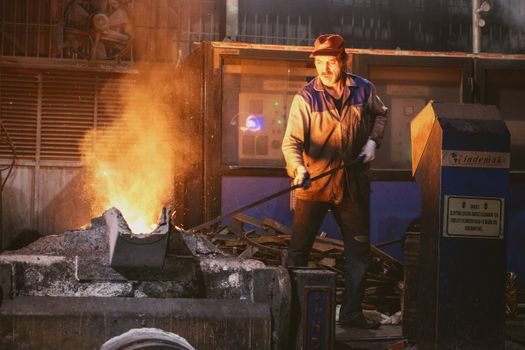
Die cast surfaces come off the die at 3.2-6.3 µm Ra as-cast on machined faces and 1.6-3.2 µm Ra on polished die surfaces, holding ±0.05 mm on critical dimensions and ±0.1-0.2 mm on non-critical ones; draft angles of 0.5-1° per side are mandatory for part ejection [S1][S9]. Most die cast parts still receive CNC machining on bolt holes, bearing bores, and sealing faces to hit the final tolerance, and shops routinely bundle in-house CNC into the same cell as the casting cell [S2][S9].
Sand castings land at 6.3-12.5 µm Ra as-cast and ±0.5-1.5 mm typical tolerance (CT 8-10 per ISO 8062-3 is the common shop range for resin-bonded sand), with draft angles of 1-3° per side required to release the pattern from the mold or the part from the sand [S2][S3][S6]. Because of the loose surface and the larger stock allowance, sand castings almost always need more machining stock and longer machining times per part than a die cast equivalent [S2][S6].
Alloy Range and Part Geometry
Die casting is limited almost entirely to non-ferrous alloys: aluminum (A380, A383, ADC12), zinc (Zamak 3, 5), magnesium (AZ91D), and select brasses [S1][S4][S9]. Magnesium has emerged as a focal alloy, with the China Diecasting Congress 2026 highlighting thixomolding and ultra-large magnesium die castings as one of six key forming processes under industry development [S7].
Sand casting accepts a much wider alloy set: gray iron, ductile iron, carbon and alloy steel, stainless steel, bronze, brass, copper, and aluminum (often as large sand molds or as an alternative to permanent mold for prototype runs) [S3][S6]. A single foundry can list aluminum sand castings, aluminum permanent mold castings, and aluminum die castings on the same capability sheet, signaling that sand is the default for sizes or alloys that fall outside the die's envelope [S6].
Decision Criteria: When to Pick Which
Pick a die casting die when the program is 1,000+ parts/year, the alloy is Al/Zn/Mg, walls are ≤3 mm, tolerances are ≤±0.1 mm, and surface finish must look acceptable with minimal machining; expect 4-8 weeks of tool build, USD 5,000-50,000 NRE per cavity, and per-part piece prices in the low single-digit USD range at scale [S1][S5][S9]. Pick a sand casting mold when the alloy must be ferrous (iron/steel), the part is large (above roughly 25-50 kg or above ~600 mm), the run is short, geometry is complex with internal cores, or NRE is capped [S2][S3][S6].
The two are not mutually exclusive: many OEM programs release a sand-cast prototype for design validation, then move to permanent mold or die casting once the geometry stabilizes and volume justifies the die spend; in-house tool rooms supporting both are now standard among mid-tier Chinese suppliers [S2][S3][S5]. The reference die casting die and sand casting mold pages lay out the underlying tool anatomy; for the high-level comparison of the equipment side, see die casting machine and gravity die casting machine, with the broader process families contrasted at casting mold.
Failure Modes and Process Constraints
Die casting's recurring defects are soldering, cold shuts, gas porosity, and flash from worn die parting lines; thermal fatigue cracks in the die steel appear after tens of thousands of cycles and drive scheduled die welding or retirement [S1][S9]. Sand casting's recurring defects are sand inclusions, gas defects from inadequate venting, misruns on thin sections, and dimensional drift as the bonded mold deforms under the metalstatic head; sand reclamation, venting, and pattern wear control are the day-to-day process levers [S2][S3][S6].
Process constraints differ sharply: die casting cannot economically produce parts above roughly 50 kg in aluminum because platen size and clamp tonnage become limiting, and it cannot run ferrous alloys because the molten iron attack on die steel is too aggressive [S1][S5]. Sand casting cannot hit die-cast-class surface or thin-wall geometry, and its per-piece cost curve flattens well above competitive die-cast pricing once volumes cross into the tens of thousands [S2][S3][S6].
Standards, Sourcing, and 2026 Industry Signals
Foundry qualification across both processes typically rests on ISO 9001:2015 quality systems, with NADCA (North American Die Casting Association) and ASTM AFS standards governing die casting and ISO 8062-3 governing casting dimensional tolerance — these are the reference frames shops work to, even when individual shop data sheets quote the values in mm rather than calling out the standard by clause [S6]. The China Diecasting Congress 2026 (Shanghai, July 15-17, 2026) and the parallel China Nonferrous exhibition explicitly list die casting mold exhibitions and magnesium forming process forums as headline tracks, indicating that die-side tooling and magnesium are the active investment areas in mid-2026 [S7].
Trackable signals for the next 6-12 months: (1) magnesium thixomolding and ultra-large magnesium die casting capacity additions out of China, flagged at the July 2026 congress; (2) continued migration of aluminum die casting into structural and EV housing parts, where 3,000-3,500 tonne clamp cells become the practical minimum; and (3) sand casting holding its niche in iron, steel, and large aluminum prototypes where die economics break down [S1][S5][S7]. For background on a similar B2B spec-cut decision in another product family, the Heat Treatment Furnace 2026 Price & Cost Guide applies the same FOB-band and spec-lever logic to a different capital equipment category.