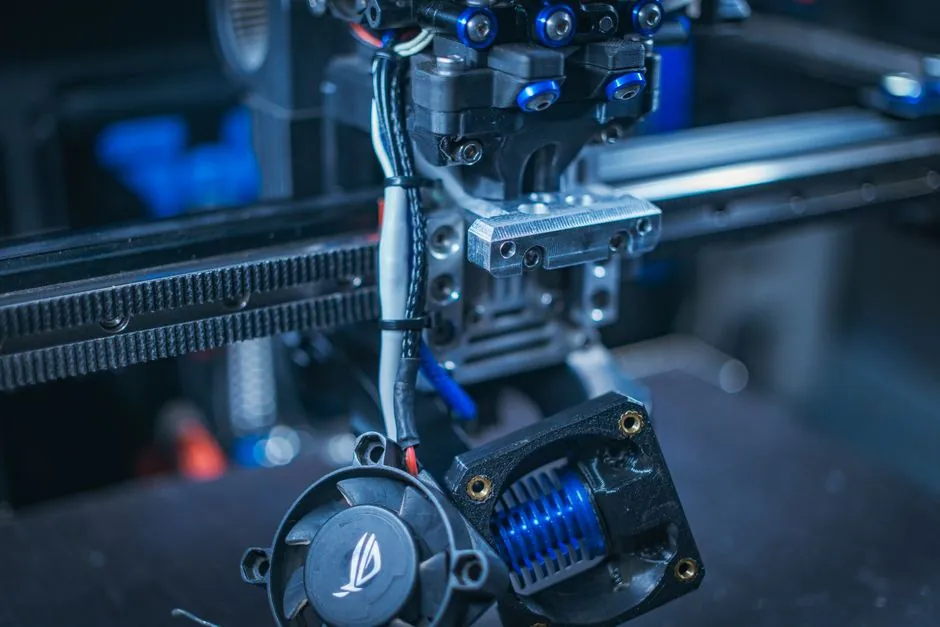
A digital spare parts inventory, consisting of CAD files printed on demand, can replace physical spares for low-volume plastic components, obsolete parts, and legacy brackets, but it cannot yet substitute qualified metal, safety-critical, or oversized hardware [S1][S2][S5].
The case is anchored in two quantitative levers: traditional warehouse carrying cost runs 20-55% of an item's value per year [S1], while a desktop additive build volume of roughly 15-30 cm in any single axis caps the part envelope that can realistically be substituted without splitting assemblies [S2]. Spare-parts logistics demand keeps climbing, with the automotive spare-parts logistics market projected to grow from USD 312.61 billion in 2025 to USD 663.27 billion by 2034 at an 8.67% CAGR [S1].
What "Digital Inventory" Actually Means
Digital inventory is a server-resident library of production-ready CAD or STL files, paired with a printer, filament/powder stock, and a QA workflow, that converts a digital file into a physical part on demand [S3][S5]. Mosaic frames the workflow as four steps: failure detected, file selected, part printed, part installed, replacing the legacy chain of identify, source, ship, wait, install [S3].
BigRep positions large-format industrial FFF as the enabling hardware, with open-material platforms able to print PEEK and ULTEM, alongside engineering-grade ABS, ASA, PA6/66, and TPU 98A [S1]. RS Components adds a complementary path: 3D scanning captures a mesh of an obsolete part, which is then reverse-engineered into a printable CAD model for legacy equipment no longer supported by the OEM [S5]. The shared premise is that a digital file stores the part definition; the printer, not the warehouse, holds the work-in-progress inventory [S1][S3].
Where Digital Inventory Wins on Spec
Digital substitution pays off where unit demand is low, geometries are simple-to-moderate, and qualification is light: jigs, fixtures, covers, brackets, knobs, grommets, housings, and discontinued legacy parts [S1][S2][S4]. For these categories, additive manufacturing avoids amortising injection-mould tooling across small volumes, a cost structure that AMFG identifies as the root reason traditional spare-part pricing inflates for low-volume SKUs [S4].
Obsolescence is the cleanest use case. When an OEM discontinues a part, the digital file preserves manufacturing capability indefinitely; only filament and print time are consumed on demand [S3][S4]. A documented SE Energy deployment illustrates the operating model: a 3D printer was installed locally in Budostan, eliminating the physical stock required to support field equipment [S6]. According to an EY survey reported by AMFG, 33% of companies surveyed believed that 3D printing of spare parts enables a more efficient after-sales market, with an additional 26% stating that the technology can reduce logistics efforts and inventories [S4].
Where Digital Inventory Fails or Costs More

Digital inventory breaks down in four well-defined regimes. First, size: any axis beyond the printer's build envelope, roughly 15-30 cm on desktop and benchtop machines, forces part-splitting into assemblies, adding fasteners, alignment features, and failure modes [S2]. Second, duty cycle: high-stress, fatigue-loaded, or wear-surface parts need engineering-grade SLS or metal DED/SLM processes, and even then, qualification against standards such as ASME or API 6D is unresolved for most installed assets [S2][S5].
Third, material class: most plant-grade 3D printers handle plastics and a narrow set of polymers reliably; metal and high-temperature alloy spares remain a specialism, not a commodity workflow [S2][S3]. Fourth, regulatory and safety-critical parts: pressure-bearing components, dynamic-load couplings, and items traced to pressure transmitter or flow meter service lines carry qualified spares requirements that additive manufacturing has not yet met at scale, and no industry consensus currently permits a printed part to substitute a serial-numbered, traceable spare in those loops [S2][S3]. Stopgap printed parts are an accepted compromise here, used to bridge downtime until a qualified replacement arrives [S2].
Criteria-Based Comparison: Digital vs Physical Spares
Decide between the two models on four measurable criteria. (1) Annual demand: digital inventory is economic at low or unpredictable volumes; physical stock is economic at high, steady consumption. (2) Carrying cost: physical stock consumes 20-55% of item value per year in warehouse overhead, a line item digital inventory largely removes [S1]. (3) MTTR: traditional sourcing chains run days to weeks; on-demand printing can compress that to hours, with Mosaic citing movement from equipment failure to installed part in hours rather than days or weeks [S3]. (4) Qualification risk: physical stock of OEM-sourced spares carries documented traceability; printed parts carry new qualification burden, and the older/lighter the original part, the lower that burden [S2][S5].
Formlabs adds a fifth practical criterion, geometry, captured by a 3D scanner workflow: if the digital file already exists in the OEM's CAD library, the cost of going digital is near zero; if it must be reverse-engineered from a physical sample, budget for scanning, mesh cleanup, and verification prints before the first production part ships [S2][S5].
Operating Model for a 2026 Implementation
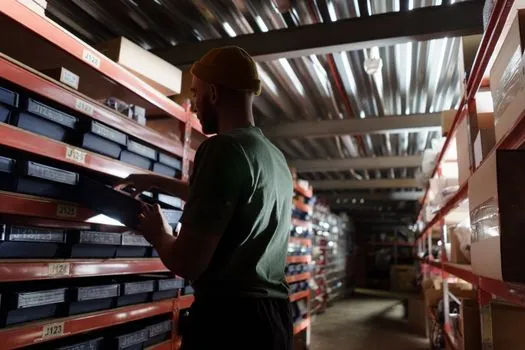
A workable hybrid looks like this: catalog every low-volume, non-safety-critical part in a CMMS-linked digital library, print on demand against a service request, and keep a small physical safety stock of high-criticality spares whose failure would halt a regulated process line [S1][S3][S5]. RS Components notes that 3D printing synchronises cleanly with CMMS workflows, which auto-trigger orders based on demand signals, allowing the digital library to be treated as a virtual warehouse rather than a parallel system [S5].
For measurement and control assets, the rule is conservative: field instruments such as digital panel meters carry OEM calibration and serial traceability that a printed bracket or enclosure does not touch, so digital inventory is restricted to non-functional accessories, not the metrological core. Material selection is the second guardrail: pair engineering-grade polymers (PA6/66, PA12 CF, ABS, ASA) with light-duty indoor spares, reserve fiber-reinforced grades (HI-TEMP CF, PA12 CF) for higher-temperature zones, and confine open-platform PEEK/ULTEM printing to validated industrial cells with controlled atmospheres [S1]. Mosaic's purpose-built industrial systems, with continuous operation, minimal operator involvement, and remote monitoring, are the reference architecture for a 24/7 unattended digital-spares cell [S3].
Limits, Failure Modes, and Sourcing Discipline
Three failure modes recur in published deployments. File rot: a CAD library without a steward goes stale, and the part prints but no longer matches the current equipment revision [S1][S5]. Material drift: switching filament suppliers without re-qualifying mechanical properties silently changes part performance, a risk that matters more for load-bearing spares than for covers [S2]. Printer downtime: a single printer in a digital-inventory cell is a single point of failure; the SE Energy model mitigates this by deploying the printer at the point of need rather than centralising it [S6].
Sourcing discipline means keeping OEM CAD files where the OEM provides them, reverse-engineering via 3D scanner where the OEM does not, and never printing a part whose failure would trigger a safety or environmental incident without an engineering sign-off against the relevant material and load standard [S2][S5]. The 2018-vintage AMFG analysis is still a useful sanity check: digital inventory lowers fixed cost and storage burden, but it does not erase the need to qualify the part, only shifts that work upstream into the file and print process [S4].
Track three signals over the next 12 months: large-format industrial FFF and SLS pricing per kilogram, the emergence of OEM-published CAD libraries for legacy spares, and any expansion of the SE Energy-style local-print deployment model into additional utilities and discrete manufacturers [S3][S6]. Each signal moves the digital-vs-physical crossover point for one more part category, and one more line item off the warehouse balance sheet [S1].
For related coverage, see 3D printed metal parts in aerospace: 2026 process, material and production map.