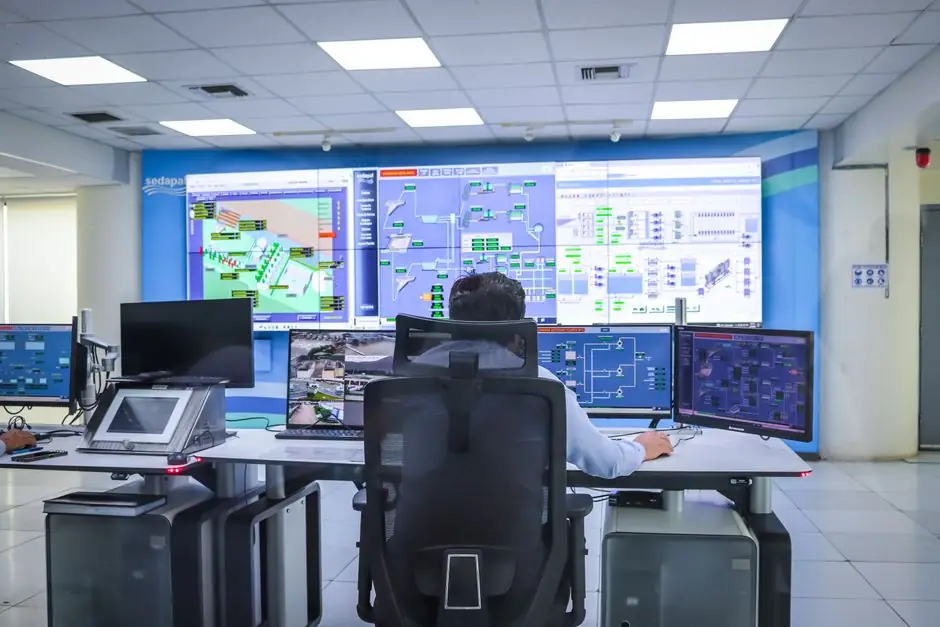
Digital twin simulations applied before facility layout changes can cut development time by up to 50% and yield 15-30% capital-expenditure savings versus committing to physical build first [S2][S4].
The practical threshold is granular: a $5M new line or a $500K equipment relocation is the typical scale where simulation pays for itself, because rework on a poured slab multiplies cost by an order of magnitude once structural and utility tie-ins are fixed [S4].
What the layout-stage digital twin actually is
A layout-stage digital twin operates on three planes: a data plane (sensor readings, historical records, ERP transactions), a model plane (physics-based simulation of equipment and process behavior), and a decision plane (AI-driven recommendations for optimization) [S4]. It is a living, data-driven simulation that mirrors real-time equipment behavior, production-line dynamics, and factory-wide operations, so engineers can run what-if scenarios without touching a physical asset [S4].
NIST Advanced Manufacturing Series 100-61 (October 2024) defines a digital twin as a digital computer model of a physical system that has high accuracy, precision, and flexibility to model various aspects of the system, and estimates the potential annual impact of full digital-twin adoption in U.S. manufacturing at $37.9 billion, with a 90% Monte Carlo confidence interval of $16.1B to $38.6B and a median of $27.2B [S1]. The NIST analysis explicitly lists optimize facility layout, reduced capital expenditures on facilities, and reduced movement of goods among the economic benefits that drive the estimate [S1].
Where the CAPEX savings actually come from
The CAPEX delta is not abstract: lifecycle digital-twin use during early project phases is documented to deliver capital-expenditure savings of as much as 20% and operational savings of 15-30% on carbon-capture and process-plant projects [S2].
For the discrete-factory side, figures behind the 28.1% CAGR manufacturing-digital-twin segment note that digital twins are projected to grow from $3.6 billion in 2024 to $42.6 billion by 2034, while McKinsey research cited in the same source shows digital twins cut development times by up to 50%, deliver 20% improvement in consumer-promise fulfillment, reduce labor costs by 10%, increase revenue by 5%, and reduce carbon emissions by 7%, with payback periods often under 24 months for targeted pilot projects [S4]. The market sizing anchors these claims: the global digital twin market grew from $24.48B in 2025 to $33.97B in 2026, racing toward $384.79B by 2034 at 35.4% CAGR, while the manufacturing-specific slice jumped from $3.6B in 2024 to a projected $42.6B by 2034 [S4].
The savings show up in six independent streams that compound when stacked: 50% faster development, 20% less unplanned downtime, 25% fewer quality incidents, 10% labor cost reduction, 7% carbon-emission cut, and simulation-validated ROI projections on capex itself [S4]. Each line item is independently justifiable, which is why capex committees now request the simulation evidence as a gate, not a nice-to-have.
Three twin flavors and which one a layout study needs

The three digital-twin scopes that matter for a layout review are asset twins (single machine, motor, pump, CNC, predicting failures with 88-97% accuracy and calculating Remaining Useful Life for every monitored component), process twins (entire production line or process flow, simulating throughput, cycle times, bottlenecks, energy consumption, and answering what-if questions such as adding a second press or absorbing a 20% demand increase), and system or factory twins (entire facility, including lines, utilities, logistics, staffing, supporting capex planning with simulation-validated ROI projections) [S4].
For pre-CAPEX layout validation, only the system / factory twin is large enough to compare factory and plant layout variants on measurable outcomes including throughput, travel distance, congestion, and utilization, so the floor is optimized before concrete is poured [S5]. Stochastic discrete-event simulation beats deterministic models here, because the layout must survive variability: stochastic simulations use deviations derived from historical data rather than ideal assumptions to test throughput, bottlenecks, WIP, and lead time before any line change [S5].
Layout-stage criteria: how to compare twin approaches before signing
A pre-CAPEX layout twin should be judged on four decision criteria: fidelity at 1:1 scale, the ability to run stochastic scenarios rather than deterministic ones, the speed of variant comparison, and the data-pipeline maturity required to feed it. Static 2D CAD shows geometry but not flow in motion; a 3D dynamic digital twin adds behavior, scenario variants, and validation in VR/AR, which is the comparison that actually justifies capex [S5].
Data maturity is the gating constraint: a viable twin can be built starting from manual inputs, then calibrated with historical data (e.g. spreadsheets), then connected to live data via APIs or IoT, without a big-bang approach [S5]. A BIM model alone, while powerful during design and construction, has limited usefulness once a building is complete unless it advances into a digital twin with a working data link, because without that link the model quickly becomes obsolete, as seen in a South Carolina manufacturing client where a 3D scan was paid for but no data link was ever established [S3]. The data link is what turns a 3D model into a decision tool, and the link can be bi-directional, meaning the twin can control or manipulate the physical asset [S3].
Who benefits and who should not deploy
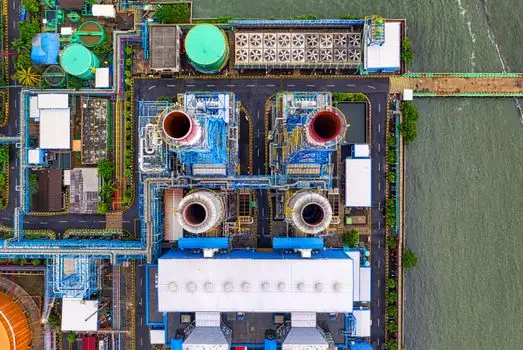
Layout-stage digital twins are for greenfield and brownfield projects where a single layout decision locks 5-20% of facility capex, and for existing plants planning additions of new lines, equipment relocations, or utility reroutes where the cost of rework on poured concrete is severe. They are also a fit for process digital twin tie-ins, because validated flow paths reduce oversized pumping and instrumentation budgets downstream. They are not for: very small shops with fewer than 50 tagged assets (the data-pipeline cost outweighs the layout benefit), single-machine capex under six figures (the simulation overhead exceeds the layout risk), or sites without any historical production data to calibrate a stochastic model. [S4]
For sensing infrastructure on the new layout, the twin should resolve pressure transmitter tap locations and impulse-line runs before procurement, since moving them after installation is a classic hidden capex line. Operators running a layout twin also need to know they are not getting a 3D visualization, they are getting a digital panel meter read-out of capex risk on every variant, and that distinction is what justifies the line item to finance.
Standards, sourcing, and what the NIST number actually covers
The most rigorous public reference is NIST AMS 100-61, approved by the NIST Editorial Review Board on 2024-08-19, which models the economics of digital-twin adoption in U.S. manufacturing and lists optimize facility layout, reduced capital expenditures on facilities, and reduced movement of goods as direct cost-reduction pathways [S1]. That same NIST report estimates the potential impact of full adoption at $37.9B annually, with the 90% confidence interval of the Monte Carlo simulation landing between $16.1B and $38.6B at a median of $27.2B [S1]. The Fortune Business Insights 2025 figure cited by industry references places the global digital twin market at $17.73B in 2024, growing from $24.48B in 2025 toward $259.32B by 2032 at 40.1% CAGR, with manufacturing as the fastest-growing segment [S3].
For engineer-to-engineer sourcing in 2026, the workable path is: start with manual inputs and historical data to validate a layout variant, gate capex release on the simulation evidence, then connect live IoT data only where the decision value is real [S5]. The seven independent references converge on the same operational picture: simulated layout review before pouring concrete is the capex decision the 2026 factory floor finally has the tooling to defend.
For related coverage, see Proximity sensor false triggering from adjacent metal brackets: causes and fixes.