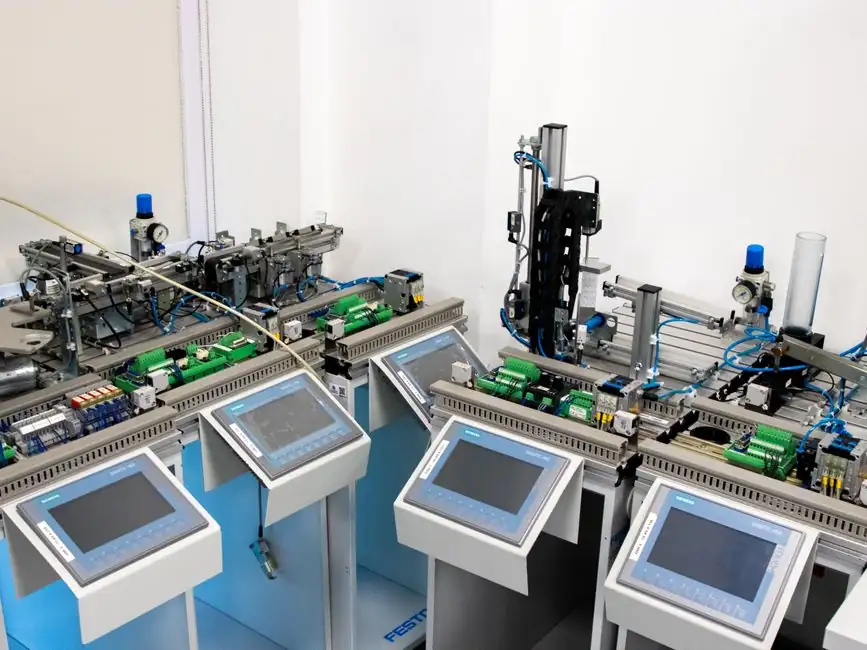
Digital twin projects in discrete manufacturing consistently report throughput gains of 15-25% from validated process changes, per vendor-disclosed case material from 2026 [S2][S9], with at least one documented deployment skipping 98% of end-of-line product tests by predicting quality in real time [S4].
These numbers are framed as ranges from documented deployments, not guarantees, and 2026 build-vs-buy guidance flags aspirational ROI claims as a recurring procurement trap [S9]. A 2024 peer-reviewed review in the journal Big Data and Cognitive Computing consolidates the academic view, identifying high-fidelity modeling, real-time data interaction, and iterative optimization as the three enabling technologies for discrete-line twins [S3].
What the 2026 ROI Range Actually Covers
The 15-25% throughput-improvement figure attaches to discrete-event simulation twins that validate line layout, scheduling, and bottleneck removal before capital is committed, with the range drawn from documented manufacturing deployments rather than controlled studies [S2]. Separately, an industrial-ML case reports a customer skipping 98% of end-of-line product tests after deploying a quality-prediction twin, a metric that ties directly to scrap, labor, and lab-test cost avoidance [S4].
A 2026 NYU/DRI market study places global digital-twin spend at $21-24B in the mid-2020s with forward projections ranging from $40B to $260B by 2030, a spread that reflects definitional disagreement between product-CAD twins, process twins, and full system twins [S6]. The same source notes that the ROI envelope widens as more data sources feed the model, a point also made in the 2018 LNS Research framework paper, which states ROI potential increases as additional data sources are applied to improve twin fidelity and completeness [S5].
Discrete vs Process Twin: Why the Definitions Matter
Discrete manufacturing twins are commonly built around a CAD product model and a PLM-anchored bill of processes, whereas process-industry twins usually replicate a continuous unit operation or plant, a definitional split that drives very different ROI line items [S1][S4]. A 2018 LNS Research paper states that in discrete manufacturing, a Digital Twin is most often an executable virtual model of a physical thing or system, frequently a product, and is best launched from a PLM platform that already integrates design and production [S1].
That definition matters for ROI because product-twin value accrues as engineering change orders, while process-twin value accrues as OEE, throughput, and energy savings [S4]. For a discrete cell that already runs near design capacity, the dominant payback is often faster NPI rather than raw throughput, a distinction that gets blurred in vendor marketing collateral.
Selection Criteria: Build vs Buy, PLM-Anchored vs Standalone

2026 build-vs-buy guidance for plant digital twins recommends evaluating three criteria before vendor selection: data-source coverage, model-update latency, and integration with the existing PLM/MES stack [S9]. Manufacturers already running a mainstream PLM platform are advised to start with their PLM vendor, because most product and process models needed for a first-generation twin already live there [S1].
For greenfield sites or non-PLM-led operations, discrete-event simulation platforms with Python integration and third-party render layers (for example, Omniverse-connected tools) provide a faster path to a working process twin, but require more integration engineering [S2]. LNS Research's 2018 framework remains the canonical reference: ROI potential increases as more data sources feed the twin, so platforms that lock you into a single vendor's telemetry stack limit the long-term fidelity ceiling [S5].
Who Digital Twins Are For, and Where They Fail
Digital twins pay back fastest on lines with high product mix, frequent engineering changes, or bottleneck equipment where a what-if simulation can defer physical trials [S1][S7]. They are not a fit for stable, high-volume single-SKU lines already running above 85% OEE, where the marginal gain rarely justifies the integration cost [S2].
Known failure modes include twin models that drift from the physical asset because update latency exceeds process dynamics, models that ignore multi-variable interactions and produce overconfident quality predictions, and pilots that never escape the PLM sandbox into live MES data [S3][S4]. The 2024 MDPI review highlights fine-grained sculpting, model adaptivity, communication delay, and efficient modeling tools as the four open issues that separate a working twin from a slide-deck twin [S3].
Reference Architecture and Standards Alignment
A typical 2026 discrete-line twin stack layers a PLM-hosted product model, a discrete-event simulation engine, a Python-based optimization layer, and a live data feed from the line's PLCs and flow meter / pressure transmitter instrumentation through an IIoT gateway [S2][S7]. The three enabling technologies called out in the literature are high-fidelity modeling, real-time information interaction, and iterative optimization algorithms, with the latter increasingly handled by AI/ML surrogates rather than first-principles solvers alone [S3].
Process-twin fidelity depends on the quality of the underlying instrument data; a digital panel meter or digital multimeter reference on the bench keeps the calibration chain auditable when the live tags disagree with the model [S7]. Material and process parameters for new product introductions are often validated inside a additive manufacturing material digital twin before any physical build, especially for aerospace and defense work [S1].
2026 Trackable Signals
For related coverage, see In-Cycle Automatic Pattern Change for Flaskless Molding Lines.