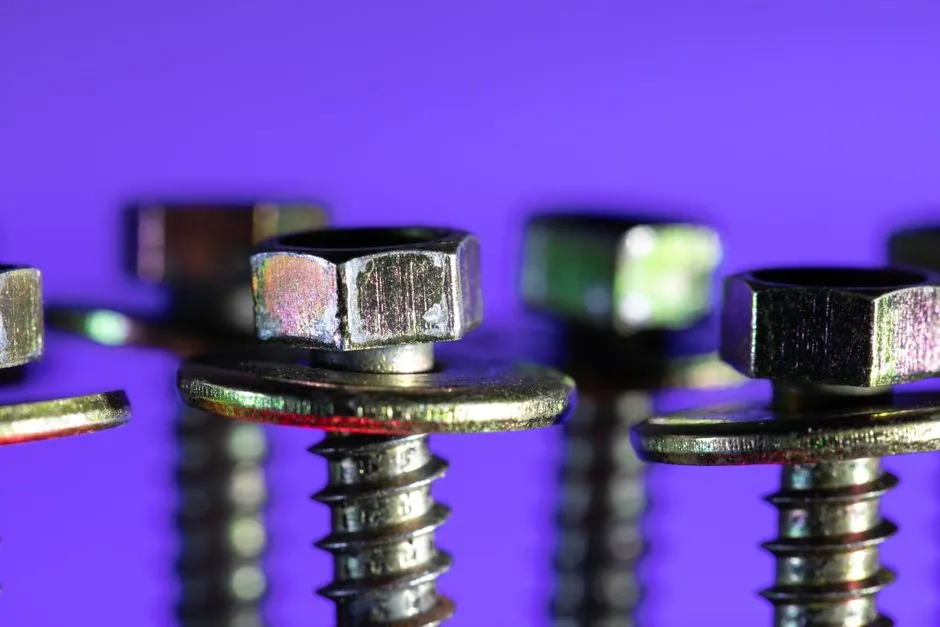
DIN 127, the German standard for split spring lock washers in sizes M2 through M100, was formally withdrawn by the Deutsches Institut für Normung, and the cancellation was driven by repeated test data showing the split-ring geometry fails to keep bolted joints tight under vibration and sustained load [S1][S5].
The original DIN 127 specification, published 10/1987 and superseding the 12/1970 edition, defined two product variants: Type A with tang ends and Type B with square ends, both intended for bolt/nut assemblies of property class 5.8 or lower per ISO 898-1 [S2]. Despite the withdrawal, distributors continue to catalogue DIN 127 B parts across the full metric range because the geometry still fills a generic "spring washer" slot in many OEM drawings [S3][S6].
The Technical Reason DIN 127 Lost Its Standard
The withdrawal rationale, as documented in the Deutsches Institut für Normung notice and echoed by independent engineering commentary, is that a split helical washer does not generate enough residual spring force to compensate for the self-loosening rotation (the Junker effect) that occurs in preloaded bolted joints under transverse vibration [S1][S5]. When a M8 DIN 127 B washer is compressed between a nut face and a steel substrate, the cross-section is only 2 mm thick (S) and 3 mm wide (B), producing a calculated stored spring force in the single-digit newton range, far below the clamp-load loss threshold of a typical M8 grade 8.8 bolt, which sits around 18–22 kN of preload [S2][S3].
The standard was originally scheduled to be withdrawn on 1 January 1992, with DIN 128 (curved spring lock washers) recommended as the interim successor, but subsequent testing of DIN 128 produced the same negative result, and both were eventually removed from the active DIN catalogue [S4][S1]. For a deeper look at the family of washers still considered useful, including load-distributing flat types, see the sealing washer reference page.
What DIN 127 Actually Specified Before Cancellation
The withdrawn 1987 DIN 127 document covered inside diameters (D min.) from 2.1 mm at M2 up to 101 mm at M100, with matching outside diameters (D max. / D1 max.) scaling from 4.4 mm to 131 mm, and section thicknesses (s) of 0.5 mm at the small end up to 8 mm at M30 and above [S2][S3]. Free height (h) ranged from 1.2 mm at M2 to 18.9 mm at M52, with tolerance bands of ±0.1 mm on section thickness up to M5 widening to ±0.25 mm from M24 upward, reflecting the looser geometric control that became one of the criticisms once ISO began reviewing the format [S3].
Weight per 1000 pieces (at ρ = 7.85 kg/dm³, plain carbon steel) ran from 0.033 kg at M2 to 318 kg at M100, and these mass values are still printed on current distributor datasheets, which is why the part survives as a stocking SKU even though the standard document itself is cancelled [S2][S3]. The Type A/B distinction matters in assembly: Type A (tang ends) is meant to bite the substrate to add a small anti-rotation couple, while Type B (square ends) relies purely on spring deflection, and neither behaviour was sufficient under controlled Junker-type transverse-load tests [S7][S5].
Who the Part Still Suits and Who Should Avoid It
DIN 127 B split lock washers still have legitimate use cases in low-vibration, low-consequence assemblies: M3 to M6 sizes in sheet-metal enclosures, terminal blocks, and consumer-grade mechanical fixtures where the primary function is to take up slack in a bolt that may be loosened and re-tightened during service, rather than to resist dynamic loosening [S6][S7]. In these applications the washer acts more as a tension-maintaining spring than a true locking device, and the geometry does that job adequately for property class 5.8 fasteners and below [S2].
For critical joints, the same parts should be avoided. Bolted flange connections on pressure-bearing equipment, structural steel connections governed by EN 1993 (Eurocode 3), and any rotating-machinery mounting should use a positively locking method: DIN 6796 (serrated load-distributing washers) for high-tensile bolted connections, DIN 25201 (nord-lock style wedge-locking washer pairs) for sustained vibration, or simply a properly torqued preload on a clean, lubricated thread without any spring washer at all [S5]. Engineers specifying spring washer hardware for these service classes should match the geometry to a current ISO document, not the withdrawn DIN sheet. For adjacent component decisions in pressure-bearing skids, the pressure transmitter and industrial valve reference pages document the bolt-loading environment these joints live in.
Comparison: Spring Lock Washer vs Flat Washer vs Wedge-Locking Pair
The following comparison lines up the three common washer choices for an M8 grade 8.8 bolted joint in mild-steel plate, so the engineering trade-off behind the DIN 127 withdrawal becomes concrete: [S1]
Split lock washer (DIN 127 B, 14.8 mm OD, 2 mm section): adds 1.6 g of mass per joint, provides a single-digit newton residual spring force, fails DIN 25201 vibration tests after a few thousand transverse-load cycles, and costs roughly 0.5–1.0 cent per piece at distributor pricing [S3][S5].
Wedge-locking washer pair (DIN 25201, 14.8 mm OD, two cam-faced halves): adds roughly 4 g per joint, locks the bolt at the preload value against transverse vibration by generating a cam reaction force proportional to the bolt tension, passes Junker-type tests through 1000+ cycles at full preload, and costs 20–40 cents per pair [S5].
The decision tree is straightforward: use a flat washer for general distribution, use a wedge-locking pair when the joint sees sustained vibration or thermal cycling, and avoid a split spring washer in either role once the joint is anything beyond a cabinet or cover plate.
Where the Industry Has Moved Since the Withdrawal
Of the six DIN washer standards that were withdrawn alongside DIN 127 (DIN 128 curved spring, DIN 137 wave spring, DIN 6796 serrated load-distributing, DIN 6798 serrated, DIN 7980 single-coil spring), only DIN 6797 (conical spring washers) survived the ISO review with a still-valid DIN document, primarily because the conical geometry is a genuine spring element rather than a vibration lock [S1]. ISO 7053 was published as the international counterpart for the plain washer-plus-split-spring combination used in some assembly drawings, which is why the part persists in catalogs under both DIN 127 and ISO 7053 references [S3][S6].
For procurement teams, the practical signal is that a purchase order specifying "DIN 127" without a size or material callout will be filled with whatever the distributor stocks, usually a DIN 127 B in spring steel with a black phosphate or zinc finish, and that part will meet the dimensional table of the cancelled 1987 document but will not carry the certification pedigree of a current ISO or EN standard [S2][S3][S6]. Engineers who still want the spring force of a DIN 127 should pair it with a positive locking method, or replace it entirely with a DIN 25201 wedge-locking pair for any joint where loosening would create a safety, production, or warranty exposure. Related material-grade decisions in this space, especially around case depth versus through-hardening for the bolt itself, are covered in the 8620 case hardening comparison, which matters because the washer only behaves as designed when the bolt substrate is at the hardness the geometry assumes.