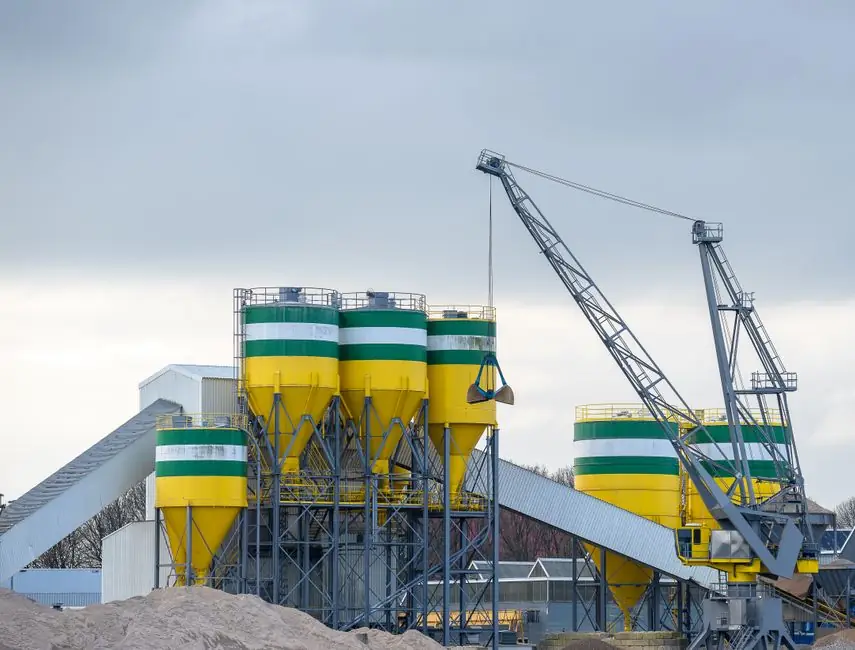
Disc couplings carrying the load between motors and gearboxes in cement plants are now specified around four hard gates: AISI-300-series stainless disc packs, ATEX certification for the relevant dust zone, API-610 balance and anti-flail conformance, and a documented misalignment budget covering angular, parallel, and axial offsets in the same SKU [S1][S3].
The cement industry ranks as a named served market for the major process-motion coupling lines, alongside mining, energy, and marine, which is why cement-specific documentation is treated as a first-class variant rather than a generic industrial build [S5]. For drives above roughly 75 kW, that translates into a near-universal preference for disc coupling designs over elastomeric or gear alternatives on the main mill, kiln, and cooler trains.
Why Disc Couplings Fit Cement Drives
Disc couplings are widely described as the most common flexible-element coupling because of their high misalignment capacity, torsionally rigid response with zero backlash, and compact outside diameter for a given torque rating, three properties that line up with what a cement train demands from the motor to the gearbox [S3]. The torsional rigidity matters when an AC drive or VFD is upstream; backlash-free torque transmission protects gear teeth during shock loads common in mill starts [S1].
Their fully metallic, lubrication-free flex element is the second reason cement plants use them. A dry-running metallic disc pack is preferred where dust ingress, ambient temperature swings, and irregular lubrication are routine; elastomeric elements that swell, harden, or burn in a cement dust cloud are not [S1][S3]. The disc pack itself can be inspected in place with a strobe light while the machine runs, so the maintenance window is reduced to a visual check rather than a teardown [S1].
Construction Styles: Traditional, Drop-In, Floating Shaft
There are two main constructional styles in service across cement plants: the traditional five-piece design, two hubs plus a center spacer with two disc packs, and the drop-in spacer design, where the spacer, disc packs, and guard rings ship as a single assembly that drops between the hubs [S2]. Drop-in designs are favored where the spacer must be removed for service without disturbing hub alignment, while the traditional five-piece layout is generally cheaper and more flexible on custom shaft separations [S2].
A third configuration, the floating-shaft arrangement, uses two single-flex couplings connected by an intermediate shaft; this is the standard answer when shaft separation is too long for a single spacer, and the intermediate shaft can be hollowed to cut weight on long runs [S1]. For close-coupled drives, the SX and SXC variants shrink the overall envelope by turning the hubs inward into the spacer body, with the SXC close-coupled split spacer extending the principle to permit disc-pack service without moving the hubs [S1].
Selection Criteria: Torque, Speed, Misalignment, and Disc Pack Geometry
Selection is governed first by torque per disc pack, with bolt count (4, 6, or 8 bolt designs) defining the per-pack torque ceiling; the 8-bolt pack transmits greater torque than the 6 or 4 bolt pack, but accepts less angular misalignment [S1]. Lovejoy's published disc pack profile handles between 1/2° and 1-1/2° of angular misalignment per flex plane, which is a useful upper bound when calculating the total alignment budget on a mill or kiln drive [S1].
Speed rating is the second gate. Lovejoy publishes API-610 support up to 3,800 RPM, with the API-610 balance and anti-flail requirements satisfied by unitized disc packs that meet the standard's piloting and repeatability rules [S1]. The DI (Drop-In) type explicitly meets API-610 balance and anti-flail requirements and includes piloted hubs as the anti-flail feature, so any cement-plant drive on the API-610 list, principally pump drives and any mill with a defined API auxiliary, should default to the DI family [S1].
For material and corrosion behavior, the working standard in the major product lines is AISI-301 stainless for the disc pack, chosen for high strength, high fatigue endurance, and resistance to most environmental conditions, including cement dust exposure [S1]. A typical comparison the engineer should run: 4-bolt disc pack favors maximum angular misalignment at the cost of torque ceiling; 6-bolt is the common compromise on most cement auxiliaries; 8-bolt delivers the highest torque density but needs tighter alignment; floating-shaft with two single-flex units is the choice for long shaft separations and hot-shaft growth compensation [S1][S2].
Cement-Specific Environmental Requirements
Cement dust is the binding environmental constraint. Combustible cement dust atmospheres place a coupling inside an ATEX zone in most EU installations, which is why ATEX certification of the coupling itself, not just the motor and gearbox, is a hard requirement for any new European cement plant build [S1]. The product lines documented as ATEX-certified for disc coupling families include SU, SX, DI, SXC, SXCS, SXCST, DIR, DILR, DIRA, and DIRLA configurations, which covers the bulk of catalog offerings used on cement auxiliaries [S1].
Heat and ambient temperature on cement drives is the second factor. A coupling sitting next to a preheater or cooler tower sees sustained ambient temperatures well above 40 °C, and the metallic, grease-free disc pack design is rated for that without derating in most published product lines, unlike elastomeric couplings that lose durometer and torque capacity as temperature climbs [S1][S3]. The cement and concrete process environment, with high particulate loading, intermittent water spray, and high ambient temperatures, is a textbook case for stainless disc packs rather than coated carbon-steel elements.
Compatibility with Other Plant Equipment
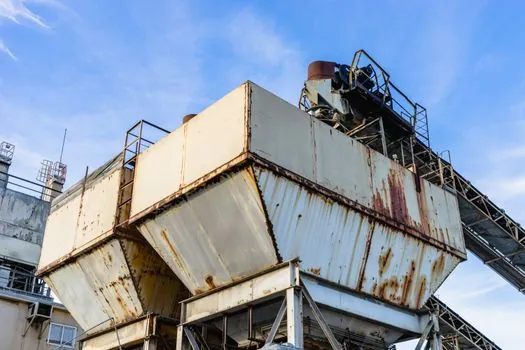
Disc couplings are normally selected as part of a drivetrain stack that includes electric motors, gearboxes, and occasionally fluid couplings upstream of the mill. Where a soft-start requirement exists, a fluid coupling is paired with a disc coupling downstream to transmit torque after the slip ramp, with the disc coupling handling the final alignment and shock-load isolation rather than the start-up slip itself [S3][S5].
On drives where torsionally soft behavior is required for start-up shock, a separate torsionally soft coupling family is used instead of a disc coupling, since disc couplings are by design torsionally rigid with zero backlash, which is a feature for gearbox protection but a limitation for impact damping [S1][S5]. The engineer should therefore route the start-up duty to a fluid or elastomeric coupling and reserve the disc coupling for the rigid torque path on a cement auxiliary.
Sourcing and Specification Signals for 2026
The 2026 sourcing signal on disc couplings for cement plants is product-line breadth under one warranty: Rexnord (Thomas, Addax, Euroflex, Modulflex, CENTADISC) and Lovejoy (SU, SX, DI, SXC, SXCS, SXCST families) are both marketed as multi-line disc coupling portfolios, and that breadth is what allows a procurement team to standardize on a single vendor across API-610 pump drives, fan drives, and mill auxiliaries [S1][S5]. NBK's disc-type Couplicon line is a lower-cost Asian-sourced alternative for non-API, non-ATEX auxiliaries, with single and double disc variants starting around USD 67–78 list price for small bores [S4].
For buyers tracking 2026 cement-plant spend, disc coupling selection intersects directly with clinker-cooler waste-heat recovery and alternative-fuel upgrade work; the 2026 cement industry digest covers those adjacent capex programs that are pulling in coupling orders alongside kiln and preheater rebuilds. The next data point to watch is ATEX recertification renewals on installed disc coupling populations in EU cement plants, since a 2025–2026 recertification cycle would surface replacement demand in the same window as the current waste-heat and alt-fuel capex wave.