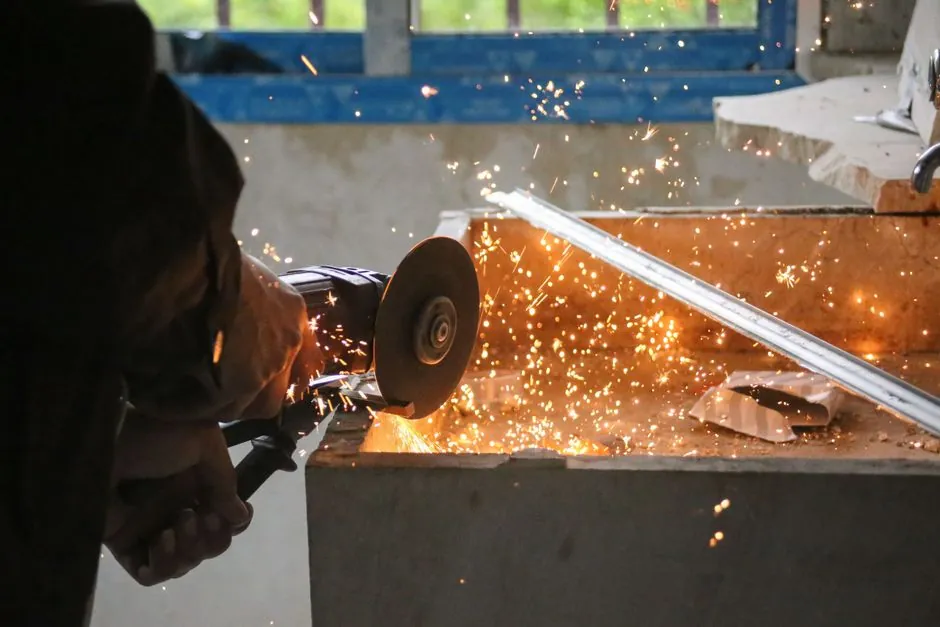
A 230 mm (9 inch) angle grinder paired with a 2.5-3.2 mm cutting wheel is the practical handheld ceiling for plate from roughly 10 mm up to about 25 mm, while 355-400 mm (14-16 inch) carbide-tipped circular saw blades take over from 25 mm to 50 mm (1-2 inch) plate [S1][S5]. Cutting-disc geometry per EN 12413 sets a 22.23 mm bore for both 125 mm and 230 mm wheels, so the same arbour hardware spans the handheld range [S1].
The mistake to avoid is forcing a thin 1.0 mm wheel onto a deep cut: a 1.0 mm disc on a 125 mm grinder cuts cleanly in sheet from 2-5 mm but will jam or shatter in plate above 10 mm because lateral stiffness falls with the cube of thickness [S1][S3]. For steel plate above 10 mm, diameter and thickness must scale together.
Disc-diameter thresholds by plate thickness
ESAB's plate-cutting guide maps thickness to process, not to disc: laser is preferred below 0.080 inch (2.0 mm), plasma or laser below 0.125 inch (3.2 mm), and waterjet, plasma, or oxy-fuel from 0.125 inch upward [S2]. For shops that stay on abrasive wheels, NovoAbrasive's 2026 thickness table anchors the diameter choice: 80% of 125 mm grinder work fits 1.0-1.6 mm wheels, but 2.0-2.5 mm wheels are specified for 16-25 mm fittings and thick-wall pipe, and 3.0-3.2 mm wheels are reserved for stationary machines and gas/rail cutters [S1].
Atlantic Stainless narrows the angle-grinder sweet spot to 2-5 mm stainless plate using a thin cut-off wheel; above 10 mm, the same fabricator moves to plasma at 50-60 amps, with waterjet kept in reserve for any thickness where heat distortion must be avoided [S3]. The pattern is consistent across sources: as plate thickness crosses 6-10 mm, the process shifts away from handheld abrasive cutting toward higher-power thermal or stationary mechanical methods.
Why 230 mm is the handheld ceiling, not 180 mm
A 230 mm wheel has roughly 3.4 times the abrasive volume of a 125 mm wheel at the same thickness, which is what carries it through a 20-25 mm kerf without overheating or grabbing [S1]. On a 125 mm grinder, maximum practical cut depth is about 30-35 mm of plate when the operator flips the workpiece, and the 1.0-1.6 mm wheels that make 125 mm grinders sing on sheet simply lack the beam stiffness to track straight through 20 mm plate [S1][S4].
Field experience backs the rule of thumb. A practical-machinist thread on 1 inch and 2 inch (25-50 mm) plate rated a 14 inch (355 mm) metal-cutting carbide blade at USD 150-200 as the cost-effective answer, with an explicit warning that cheaper blades are not the same product [S5]. The same thread confirmed that a 185 mm cold-cut saw can stretch from its 6 mm rating to 12 mm in two passes with cool-down, but plate above 25 mm demands either a 14 inch carbide circular saw or an oxy-acetylene torch [S4][S5]. The takeaway: diameter has to outrun the kerf depth, and below 355 mm the kerf math stops working past about 25 mm of mild-steel plate.
Comparison: 125 mm vs 230 mm vs 355 mm+ cutting setups
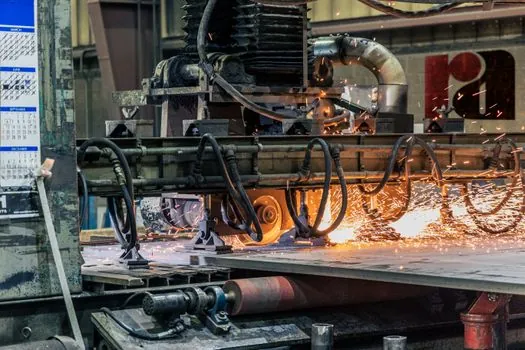
Set against four decision criteria, the diameter ladder sorts cleanly. Cut-depth: 125 mm reaches about 30 mm with flip-cut, 230 mm reaches about 70 mm, 355 mm+ stationary saws reach the full plate thickness in one pass [S1][S5]. Optimum disc thickness: 1.0-1.6 mm on 125 mm, 2.0-2.5 mm on 230 mm, 3.0-3.2 mm or carbide tooth on 355 mm+ [S1]. Material range: 125 mm is for sheet, profile, and 2-5 mm stainless; 230 mm covers 10-25 mm plate and thick-wall pipe; 355 mm+ covers 25-50 mm plate and rail [S1][S3][S5]. Heat management: 125 mm thin wheels run cool enough for stainless, 230 mm wheels need controlled feed to avoid blueing, and 355 mm+ circular saws typically need water-based coolant on sustained cuts above 25 mm to prevent motor overload and tooth burning [S3][S5].
For stainless plate, an extra rule applies: hardness around 200 HBW and tensile strength of 485 MPa mean work-hardening kicks in fast, so even at the right diameter the feed rate has to be slow enough to keep the wheel cutting rather than rubbing [S3]. The same diameter-to-thickness ladder still applies, but the operator trades speed for heat control.
Process substitutions above 25 mm plate
Past about 25 mm (1 inch) of mild-steel plate, abrasive cutting on a handheld grinder stops being competitive on time or cost, regardless of disc diameter [S2][S5]. Oxy-fuel cutting handles any thickness from 6 mm up with a rough, locally hardened edge; plasma takes the 10-25 mm band cleanly; waterjet covers any thickness where no heat-affected zone is acceptable, including stainless [S2][S3]. For repetitive straight cuts on 25-50 mm mild-steel plate, a 355 mm (14 inch) metal-cutting circular saw with a carbide blade is the dedicated tool, and operators should plan on USD 150-200 per blade, intermittent water-mist coolant, and a duty cycle of seconds-on, seconds-off to keep the motor alive [S5].
The diameter decision is therefore a two-step check: confirm the kerf depth requirement, then confirm whether a handheld grinder can physically deliver that depth in one or two flip-cuts. If the answer is no, jump to a stationary circular saw or a thermal process before reaching for a larger abrasive disc on a grinder not rated for it [S1][S5]. Specifiers working through selection logic for adjacent tooling can borrow the same duty-cycle reasoning used in welder output ratings, where short-cycle thermal limits dictate machine class.
Safety and standard constraints that pin the choice
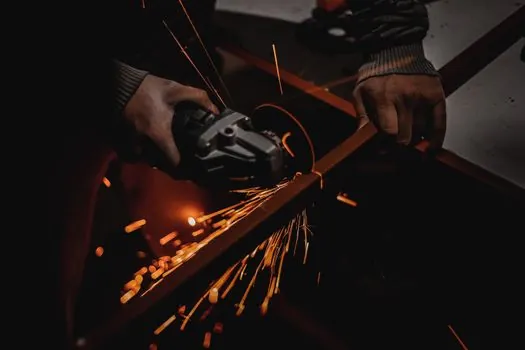
EN 12413 covers bonded-abrasive cutting wheels and is the baseline standard cited for the thickness and bore combinations in the diameter ladder above [S1]. Every wheel carries a maximum rotational speed printed on the blotter, and that rating must be checked against the grinder's no-load rpm before mounting; a 230 mm wheel on a high-rpm 125 mm grinder is a fragmentation risk, while a 125 mm wheel on a low-rpm 230 mm grinder simply will not cut [S1][S4]. Respiratory protection, a full face shield, cut-resistant gloves, ear defenders, flame-resistant clothing, and spark-resistant extraction are baseline PPE for abrasive plate cutting, and the rules tighten, not relax, as diameter grows [S3][S4].
Two failure modes drive the diameter decision more than cut quality does: lateral bind, where a thin wheel snaps sideways in a deep kerf, and thermal overload, where a small motor burns up on a long cut through thick plate [S1][S5]. Both are managed by stepping up diameter and disc thickness together, never by stepping up only one. The 230 mm / 2.5-3.2 mm pair and the 355 mm+ carbide blade exist because those are the combinations that survive the binding and heating loads of plate above 10 mm [S1][S5].
Track the next two signals before re-specifying: abrasive-blade manufacturers continue to push 1.0-1.6 mm thin wheels on larger 180-230 mm arbours to cut stainless plate cooler, and carbide circular-saw blade prices in the 14 inch (355 mm) class are the gating cost for any shop considering stationary plate sawing over oxy-fuel subcontracting. Either shift will redraw the diameter ladder within the next product cycle.
The underlying component specifications are covered under disc coupling, and cutting machine.