
A welder's nameplate duty cycle only makes sense when paired with the amperage next to it: a machine rated 60% at 200A can sustain 200A for 6 minutes of any 10-minute window, then must rest 4 minutes to let internal heat dissipate [S2][S9].
That rating is generated under the IEC 60974-1 standard test condition of 40°C ambient, with a 10-minute cycle as the reference window, so any field derating (hot shop floor, enclosed welding curtain, stacked panels) lowers the effective duty cycle below the nameplate value [S2][S6].
Definition and the 10-Minute Reference Window
Duty cycle is defined as arc-on time divided by a 10-minute test window, expressed as a percentage, and it is always co-stated with a specific output current [S2][S5]. A 30% rating at 200A means 3 minutes of arc-on followed by 7 minutes of cooldown inside every 10-minute window, while a 100% rating means the machine can weld continuously at that current without tripping thermal protection [S2].
The reference window is not arbitrary: it is a standardized test cycle that lets two different welders be compared apples-to-apples, provided both ratings are taken at the same ambient temperature and the same output voltage class [S2][S6]. A common spec-table reading shows 200A at 60% for GMAW, 180A at 60% for SMAW, and 200A at 60% for GTAW on a single multi-process inverter, with each pair representing a different process load profile rather than three separate machines [S5].
How Output Current Reshapes the Duty Cycle Curve
Output current and duty cycle are inversely linked because heat generation scales with I²R losses inside the IGBT module, transformer, and output rectifier, so a higher amperage setting fills the thermal budget faster and forces longer rest periods [S1][S2]. The SSimder SD-4050Pro spec sheet captures this directly: at 220V GMAW the unit delivers 200A at 60% duty cycle but only 154A at 100% duty cycle, a 23% current drop to gain the remaining 40% of arc-on time [S5].
The same machine on its 110V input derates further, posting 155A at 60% and 123A at 100% in GMAW, and 140A/60% versus 123A/100% in SMAW, because lower supply voltage forces higher input current for the same output and the internal losses climb [S5]. For estimation, a square-root scaling rule is widely used in the field: Amps at Desired Duty Cycle = Amps at Rated Duty Cycle x square root of (Rated Duty Cycle / Desired Duty Cycle), giving roughly 282A at 30% from a 200A/60% baseline [S4].
Light, Medium, and Heavy-Duty Classes by Use Case
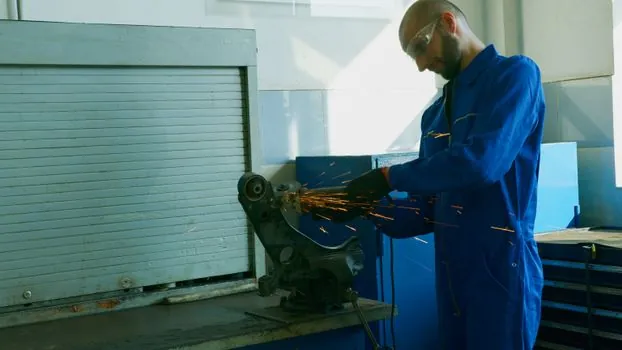
Entry-level hobby machines typically post 20% duty cycle, mid-range workshop units land in the 40% to 60% band, and industrial three-phase or engine-driven welders run 60% to 80% or even 100% at their rated current [S7]. A 130A MIG on a standard 230V supply is a common mid-duty benchmark, often advertised at 20% to 30% duty cycle at the headline 130A figure [S4].
TIG duty cycles are effectively higher than the nameplate suggests because manual filler-rod feeding and foot-pedal arc control produce frequent short pauses, so a 60%-rated TIG machine on thin-gauge stainless typically runs well below its thermal ceiling [S5]. Stick (SMAW) is similar in the sense that electrode changes and slag chipping impose natural rest periods, but long weave beads on thick plate still push the machine against its duty cycle ceiling and force cool-downs [S5].
Reading a Real Spec Sheet Side by Side
Looking at a representative multi-process inverter at 220V input: GMAW delivers 200A at 60% (24V) and 154A at 100% (21.7V), SMAW delivers 180A at 60% (28V) and 154A at 100% (26.1V), and GTAW delivers 200A at 60% (18V) and 154A at 100% (16.1V), while plasma cutting drops to 50A at 60% (100V) and 40A at 100% (96V) because the higher arc voltage and duty push thermal stress to a different regime [S5].
The voltage column matters because output voltage determines real power: 200A at 24V is about 4.8 kW of arc power in GMAW, while 50A at 100V is 5.0 kW in plasma cutting, so a plasma cutter can thermally load a chassis as hard as a much higher-amperage MIG [S5]. When two welders share a nameplate amperage but differ on voltage class, the higher-voltage process is the harder run, which is why process-specific duty cycle numbers are listed separately rather than rolled into a single headline figure [S5][S6].
Limits, Misreads, and When Duty Cycle Alone Misleads
Duty cycle ignores four field variables that change the answer: ambient temperature above the 40°C IEC reference, restricted airflow around the welder, input voltage sag on long extension cords, and the operator's actual arc-on duty versus the rated one [S2][S6]. A 60% rated machine in a 50°C fabrication shop, mounted inside a truck bed box in July, will trip thermal protection well before the nameplate interval, even though the sticker says it can run 6 of every 10 minutes [S6].
Two common misreads drive bad buying decisions. First, a higher duty cycle number at a lower current is not a free upgrade: a 100%/120A machine is delivering about 1.6 kW less arc power at 100% than a 60%/200A machine at 60% over the same window, so productivity on thick plate drops even though the machine never stops [S2][S9]. Second, duty cycle is not a measure of build quality, warranty, or expected service life; a 60% Chinese inverter and a 60% Lincoln or Miller share the same thermal-load percentage on paper, but the cooling fan sizing, IGBT thermal pad, and thermostat trip point differ [S6][S8].
Selection Criteria by Job Profile
For intermittent home-garage work on 1.5–3 mm steel, a 20%–30% rated inverter at 130–200A is generally enough because the operator spends more time fitting and cleaning than welding, and the thermal headroom is rarely approached [S4][S7]. For a production fab shop running 6–8 hour shifts on 6–12 mm plate, a 60% rating at the working amperage is the practical floor, with engine drives at 100% preferred for fieldwork where grid power is unreliable [S7][S8].
For robotic or mechanized MIG cells, a 100% duty cycle rating at the actual setpoint is effectively mandatory, because the machine never pauses and any thermal trip stops the whole cell, which is the same reason plasma tables specify 100% duty at the cutting current rather than the peak current [S5][S6]. When two machines have the same headline amperage, the one with the higher duty cycle at that amperage, or the higher amperage at 100% duty, is the right pick for high-utilization work, and this trade-off is captured in our welding and cutting tool reference for the broader spec picture [S2][S5].
Standards, Test Conditions, and Practical Verification
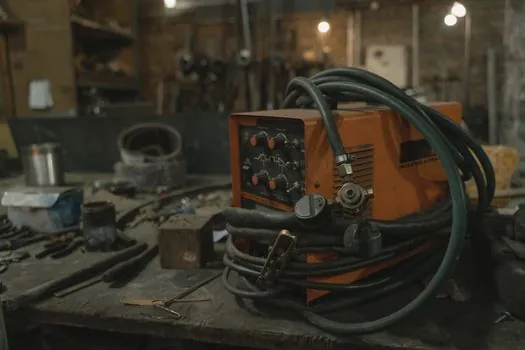
Welding power source duty cycle ratings are produced under IEC 60974-1, which sets the 10-minute test window, the 40°C ambient reference, and the load voltage for each process as the test conditions, so a nameplate value is a lab number rather than a shop-floor guarantee [S2][S6]. In the field, the closest verification is a controlled 10-minute test: weld at the nameplate amperage, time the arc-on interval until the thermal protection trips, and divide by 10 to get the real duty cycle at that shop's actual ambient [S5].
Engine-driven welders from manufacturers such as Lincoln's Ranger series are commonly published at 100% duty cycle at their rated output, which is the baseline that the square-root scaling rule uses to back-calculate lower duty cycle currents, and the same rule has been independently checked against owner-manual curves from Thermal Arc and Miller machines with consistent results [S4]. For more on the thermal cycling logic that drives the protection circuit, the thermal memory behavior in motor protection relays follows an analogous I²R accumulation model that is worth reading alongside a welder spec sheet [S2][S4].
Next signal to watch: as inverter IGBT modules move to higher junction-temperature ratings (175°C class), expect nameplate duty cycles at 200A to climb from the current 60% band toward 80% on new 2026–2027 multi-process machines, with the I²R ceiling and IEC 60974-1 40°C test point unchanged. Track the OEM spec sheets for any 200A GMAW unit published after this date where the 100% current rises above the current 154A benchmark, since that is the leading indicator of a redesigned thermal path [S5][S6].
Component reference pages worth checking: eddy current tester, and vfd duty motor.