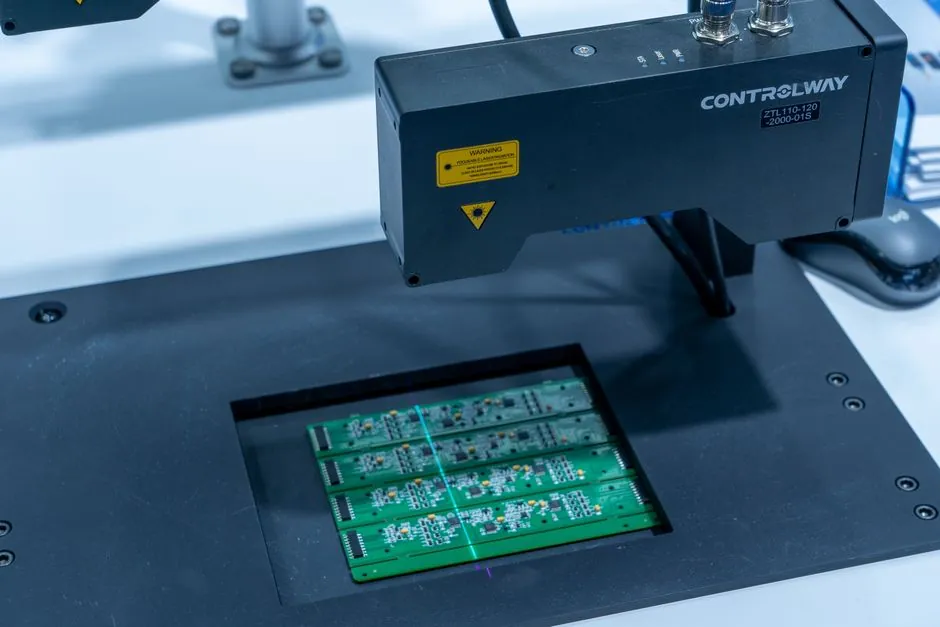
Selection on the fieldbus should be the final step, not the first, when weighing a generic displacement sensor against a laser displacement sensor: the analog and digital ports differ enough that a wrong assumption blocks any PLC swap.
The 2026 catalog from major Japanese, Chinese, and European suppliers confirms the split: Keyence's 1D triangulation line (LK-G, IX, IG series) lists analog plus serial and Ethernet options per datasheet [S1][S2]; OPTEX FA's CD5 multi-unit laser displacement line, rated for highest-in-class repeat accuracy in its 2026-05 family page, ships with analog and serial outputs only, no native EtherCAT or PROFINET [S3]; G-TEK's LF25 laser displacement family uses 4–20 mA plus RS-485, no industrial Ethernet [S4]; attocube's interferometer-class laser displacement sensor for nanometer-accuracy lab work uses a controller-side digital interface rather than a PLC-style industrial bus [S5].
Protocol stack: what each family actually ships
A non-laser displacement sensor covers the analog layer only: 4–20 mA current loop for long cable runs and noise immunity, 0–10 V for short runs into PLC analog cards, and a discrete push-pull or NPN/PNP output for threshold switching [S1]. No serial, no fieldbus, no industrial Ethernet. That maps directly onto a protocol gateway when the plant runs PROFINET, EtherNet/IP, EtherCAT, or Modbus TCP, because the gateway converts the analog mA loop into the chosen industrial Ethernet.
A laser displacement sensor carries a richer stack on the same head: the analog outputs above plus a digital channel that the datasheets identify as RS-232, RS-422, USB, or Ethernet. Keyence's LK-G3000 series, a high-accuracy Li-CCD triangulation head, ships analog 4–20 mA plus ±5 V output alongside RS-232 and a dedicated controller link, with Ethernet available through the LK-G3001P head variant documented on the 2026-07-25 product page [S2]. OPTEX FA's CD5 Series, classified as a high-performance multi-unit laser displacement sensor, exposes 4–20 mA analog and a serial output that is the documented path for 3-channel multi-calculation data, not a native industrial fieldbus [S3]. G-TEK's LF25 family, a 20-year track-record Chinese OEM line, publishes 4–20 mA plus RS-485 as the standard port set, no Ethernet, no EtherCAT, no PROFINET silicon on the head [S4]. attocube's interferometer sensor reaches nanometer resolution by design, with the controller box handling the digital I/O, not the head, and the documented interface is a controller-side signal, not a PLC bus [S5].
Selection criteria, ranked
1. Range and standoff. Triangulation laser heads work at 10–1000 mm typical standoff, 1 µm to 200 µm resolution, and are non-contact, so they sit well above the target on a moving line. attocube's interferometer, the high-end of the laser family, hits sub-nm resolution but only in a controlled lab environment and over limited range [S5].
2. Target material. Laser triangulation needs a diffuse or specular reflection; shiny metal, transparent glass, and black rubber all require different optics and firmware. If the line mixes materials, a non-laser displacement sensor is more forgiving.
3. Update rate. Laser heads on the 2026-05 OPTEX CD5 page cite high sampling suitable for inline inspection; the LK-G3000 family markets 1 kHz-class sampling for high-speed profile work [S2][S3]. Generic displacement sensors top out in the 100 Hz to 1 kHz band, which is fine for hydraulic cylinder feedback but borderline for high-speed scanning.
4. Environment. IP67 heads exist in both families. Laser heads fail on heavy steam, condensation on the lens, and ambient light interference; eddy-current and LVDT heads ignore those. For outdoor tank farms and washdown lines, see the manometer selection spec map for 2026 for the parallel logic on rugged process instruments.
5. Cabling and fieldbus. This is the protocol question. A laser head with RS-232 hits a 15 m cable limit, RS-422 stretches to 1200 m, RS-485 to 1200 m multi-drop, and industrial Ethernet is whatever the head silicon supports. Most triangulation heads do not embed PROFINET or EtherCAT silicon, so the user adds a protocol gateway or a vendor controller. Generic displacement sensors with only 4–20 mA always need a gateway to talk to any modern PLC.
Use-case map and decision matrix
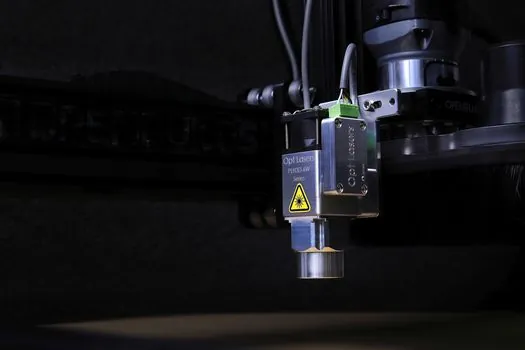
Generic displacement sensor is the right pick when the target is conductive or ferromagnetic, the line is hydraulically driven, the cable run is long, the fieldbus is industrial Ethernet over a gateway, and the cycle rate is below 1 kHz. Laser displacement sensor is the right pick when the target is non-conductive, the measurement is non-contact by necessity, standoff is 30–500 mm, and the application needs profile, thickness, or vibration data, even if the fieldbus needs a protocol gateway to land on PROFINET or EtherCAT [S1][S3].
Concrete comparison: eddy-current displacement sensor with 4–20 mA output runs on a 2-wire loop, ignores dust, oil, and water, costs low, and connects to PROFINET only through a 4–20 mA-to-PROFINET gateway. LVDT displacement sensor with 0–10 V or 4–20 mA gives sub-µm accuracy, needs an LVDT amplifier, and again reaches PROFINET through a gateway. Triangulation laser displacement sensor with 4–20 mA plus RS-422 gives 1–10 µm accuracy, 1 kHz sampling, and reaches PROFINET through a vendor controller or RS-422-to-PROFINET gateway. Interferometer laser displacement sensor (attocube) gives sub-nm accuracy, but the output is a controller-side signal, not a PLC fieldbus, so it belongs on a metrology bench, not on a shop-floor PLC [S5].
Cross-industry pattern: spec the sensor for range, accuracy, target, and environment first, then choose a head with the analog output the PLC analog card accepts, then add a protocol gateway for the industrial Ethernet. Specifying the fieldbus first forces compromises on optics, cable, and update rate. The 2026 catalogues of the four suppliers above support that ordering, because every head advertises its analog and digital ports separately, and none of them bundles a native PROFINET or EtherCAT silicon option on the head [S1][S2][S3][S4].
Limitations, failure modes, and integration risk
RS-232 on a laser head is a single-drop, 15 m cable, point-to-point link. RS-422 is a single-drop, 1200 m differential link. RS-485 is multi-drop, 1200 m, but only with vendor firmware that supports polling, which is not always the case. Industrial Ethernet variants (EtherCAT, PROFINET, EtherNet/IP) are not interchangeable, because the silicon, the protocol stack, and the conformance class differ; a PROFINET gateway will not talk to an EtherCAT master. Generic 4–20 mA loops are polarity-sensitive, need a 24 V supply, and ground-loop at long cable runs unless isolated. Vendor controller boxes that bundle serial-to-Ethernet conversion lock the user into that vendor's firmware for parameter setting, which complicates spares stocking [S2][S4].
Laser-class optical failure modes include false readings on transparent or polished surfaces, lens contamination in washdown environments, and ambient-light interference on photoelectric cells. Generic-class electrical failure modes include target-decalibration on eddy-current heads (the target must stay conductive, not coated in plastic), and LVDT core stroke going out of the linear range, which clips the output. For hazardous-area deployment the analog loops of both families route through intrinsic-barrier stages, not the head itself, and the gateway sits in the safe area. For dosing-skid chemistry, the rules on chemical compatibility and dead-leg avoidance echo those in pressure sensor selection for chemical dosing skids, though the wetted-material logic there does not apply to non-contact laser heads.
Sourcing, standards, and what to verify on the datasheet
No single IEC or ISO standard governs "protocol compatibility" for displacement sensors; the fieldbus layer falls under industrial-ethernet or fieldbus conformance (PROFINET conformance class A/B/C, EtherCAT conformance, EtherNet/IP CIP conformance), while the measurement layer is handled by the vendor's own spec sheet and the plant's calibration procedure. ISO 9001 governs vendor QA, and CE/UKCA covers EMC and low-voltage compliance for the head and controller; ATEX and IECEx govern hazardous-area deployment, but only when the datasheet explicitly lists the certification, which most laser heads do not [S1][S2][S3][S4].
On the datasheet, verify: the analog output type and load impedance; the digital port list and protocol (RS-232, RS-422, RS-485, USB, Ethernet); the fieldbus silicon on the head or only on the controller; the cable length limit per port; the IP rating; the operating temperature; the warm-up time; and whether the vendor's parameter-setting software is Windows-only, which blocks headless PLC integration. For the 2026-08 update cycle, watch for laser heads shipping with native single-pair Ethernet (SPE) and 10BASE-T1L, because that collapses the analog and digital layers into one cable, removes the gateway, and is the most likely protocol-side change to land in the next supplier catalog refresh.
Trackable signals for the next node: Keyence, OPTEX FA, and G-TEK publishing PROFINET or EtherCAT silicon on a triangulation head (none of the four sources above show that today); interferometer-class heads with built-in OPC UA over MQTT; and any move to IO-Link on the analog channel, which would give the same gateway-bypass result at the sensor layer.