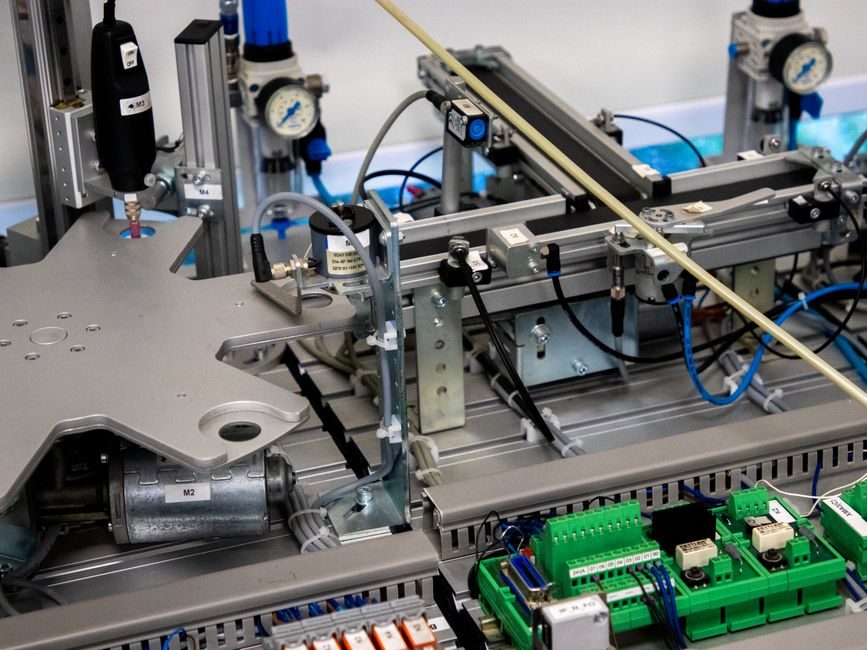
A draw-wire sensor retrofit into an existing control panel is governed by what the wiring, I/O card, and mechanical envelope already are — not by what the new sensor's datasheet promises. Across documented retrofit projects, the recurring failure points are 24 VDC voltage drop on legacy conductors, analog-input type mismatch (4-20 mA vs. 0-10 V vs. encoder), and insufficient linearity budget for the full stroke length.
Draw-wire transducers measure linear position by spooling a flexible steel wire onto a spring-loaded drum coupled to a position element; commercial units span measurement lengths up to 50,000 mm with wire speeds to 10 m/s and accelerations to 5 g [S4]. Linearity is specified as ±0.05% to ±1% of full scale [S4], so a 5 m sensor at ±0.1% will drift up to ±5 mm end-to-end — a number procurement must compare against the application's required repeatability.
Confirm the existing power budget before choosing a sensor
Legacy brownfield cabinets are commonly wired for 120/230 VAC distribution rather than 24 VDC, and the gauge of the existing run may be too small to carry 24 VDC over the distance required [S1]. Voltage drop on 24 VDC scales with current and conductor length, so a sensor that draws 100 mA at the far end of a 50 m run on 0.5 mm² copper can lose more than 2 V, pushing the excitation below the sensor's specified minimum and producing unstable readings [S1]. The retrofit team should measure open-circuit voltage at the sensor terminals under load before final sensor selection; if it falls outside the manufacturer's excitation window, either the cable must be upsized, a local power supply added, or a sensor with a lower minimum excitation chosen.
For strain-gage and potentiometric draw-wire units, the PLC or DAQ system must supply a stable excitation voltage because the output is ratiometric to the input [S5]. An unstable excitation source translates directly into output noise, regardless of how good the sensor's linearity is. In practice, brownfield retrofits that mix older 24 VDC supplies with new analog I/O cards are the most common source of this drift.
Match output type to the available I/O card
Draw-wire sensors are offered in potentiometric (voltage divider), 4-20 mA, 0-10 V, incremental encoder (quadrature), and absolute encoder outputs, and the chosen unit must match an input channel that already exists or is being added to the PLC. Potentiometric outputs are inexpensive and accept a wide range of excitation voltages but suffer from wear over millions of cycles and produce a ratiometric signal that drifts if the excitation drifts. Current-loop (4-20 mA) outputs are immune to voltage drop on the loop itself, which is one of the main reasons they are favored in long-cable brownfield retrofits. [S1]
Incremental encoder-output draw-wire sensors, such as quadrature models with index pulses, deliver higher resolution (10 µm on the ENC4118_0, 1 m stroke, 300 mm/s max speed) and digital noise immunity but require a high-speed counter input rather than a standard analog channel. The selection decision therefore collapses to a single question: does the existing or planned I/O card expose an analog input, a high-speed counter, or a serial absolute encoder interface — and does the application need the long-term stability of a 4-20 mA loop or the resolution of an encoder?
Size the measurement range and linearity to the application
Stroke length is the most visible spec on a datasheet, but linearity scales with full scale, so a sensor with a 10 m range at ±0.1% linearity is ±10 mm end-to-end while the same sensor at 1 m range is ±1 mm [S4]. Brownfield retrofits frequently oversize the stroke to cover the full mechanical envelope, then discover that the absolute accuracy at the operating point is poor. The draw-wire sensor's measurement range should be selected to be as close to the actual operating stroke as possible, with margin only for overtravel and mounting tolerance.
Mounting geometry matters as much as electrical specs. Compact series such as the wireSENSOR MK are designed for restricted installation space and are typically chosen where the existing machine envelope limits sensor footprint, while heavy-duty P-series units cover large measuring ranges in rough environments. Misalignment between the wire exit direction and the actual motion axis introduces side-load on the drum, which shortens service life and degrades repeatability. Spring-loaded retraction force, wire exit angle, and the radius over which the wire must bend at the attachment point should be verified against the machine's motion path before the model is locked in.
Environmental derating versus the existing cabinet
Draw-wire sensors are commonly specified for industrial environments with wide temperature ranges, dust, and vibration, but the cable gland, IP rating, and housing material of the unit must be matched to the local conditions [S2]. Outdoor draw-wire retrofits in crane and port machinery see salt spray, UV, and temperature swings that indoor cabinet-mounted units do not. Power-plant synchronized-lifting applications have used draw-wire sensors in groups of eight or more to track heavy load position precisely under continuous duty [S6]; those installations require sensors rated for the full ambient range and for vibration spectra specific to the lift mechanism.
For dynamic load monitoring and synchronized lifting, the draw-wire sensor is paired with a force or load cell, and the combined system accuracy is dominated by the worse of the two. Wire tension, mounting alignment, environmental conditions, and sensor resolution are the four documented factors that affect draw-wire accuracy [S3]. Holding any of those four unaddressed negates the benefit of a higher-accuracy class sensor.
Comparison: output types against typical brownfield constraints
The four dominant output options for a draw-wire sensor retrofit each trade off against different brownfield constraints. A 4-20 mA output tolerates long cable runs and is the natural fit for installations where the pressure transmitter style analog loop is already in use. A 0-10 V output is simple but loses accuracy with cable length and is the worst choice for runs over roughly 10 m. A potentiometric output is the lowest-cost option, but its wiper wear limits it to slower, lower-cycle applications. An incremental encoder output offers the best resolution and digital noise immunity, but it requires a high-speed counter or a dedicated encoder input module on the PLC and a homing routine on power-up because it is not absolute. [S2]
Linear displacement is one of several measurement categories the plant may need to retrofit alongside the flow meter and industrial valve work; standardizing on 4-20 mA where possible reduces spare-parts variety and lets the same analog input card serve multiple instrument types. Where the application is a valve-travel indicator on a modulating industrial valve, the draw-wire sensor is often mounted directly to the actuator, and the existing valve positioner wiring duct becomes the routing path — another reason to match the new sensor's cable diameter and jacket to the existing conduit fill.
Installation and commissioning checks specific to brownfield
Commissioning a draw-wire sensor in a brownfield site should begin with a wire-pull test across the full mechanical stroke to confirm smooth retraction, no slippage at the attachment, and no binding at the wire exit. With the sensor electrically connected to the new I/O card, the excitation voltage at the sensor terminals should be measured under operating conditions and recorded; this is the baseline value for future troubleshooting. The output at four calibrated points (typically 0%, 25%, 75%, 100% of stroke) should be captured and compared to the sensor's linearity specification; deviations larger than the spec indicate either a mounting error or a damaged wire drum. [S3]
Documentation should record the sensor model, serial number, full-scale output, excitation voltage at the terminals, cable type and length, and the I/O card channel used. That record is what allows the next retrofit — or the next failure — to be diagnosed without re-tearing the machine apart. For multi-sensor installations such as synchronized lift systems [S6], the same commissioning procedure should be repeated on every unit and the inter-sensor deviation logged as a baseline; synchronization accuracy degrades if any one sensor has a hidden linearity error.
Selection criteria to lock in before ordering
For a brownfield PLC upgrade, the binding selection list is short: confirmed excitation voltage at the sensor terminals with the existing wiring in place, an output type that matches an I/O card already in the panel, a measurement range as close to the actual stroke as practical, an IP and temperature rating that matches the local environment, and a linearity specification that meets the application's required accuracy at the operating point. Each of those five items can be checked against the existing site conditions without involving the sensor vendor. [S4]
Track these signals: published case studies of draw-wire retrofits on legacy PLCs (Allen-Bradley SLC 500 to CompactLogix, Siemens S5 to S7, Modicon 984 to M340 or M580) typically appear in integrator technical notes within 60-90 days of the install; the next 12 months will see more 4-20 mA draw-wire models qualified for hazardous-area use as the existing installed base of 4-20 mA pressure sensor and pressure transmitter loops is reused.