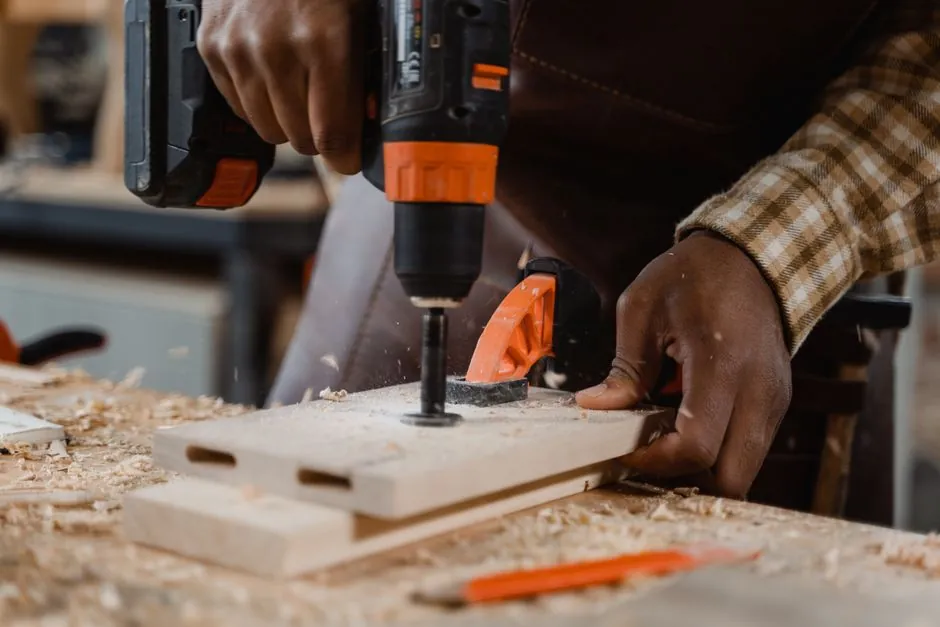
A drill-driven concrete vibrator with a 5/16-inch shaft reaches about 6,500 vibrations per minute and is most practical for small, accessible pours where owning one impact drill is more economical than buying separate compaction equipment [S3].
A dedicated poker vibrator, also called an internal, immersion, or needle vibrator, compacts fresh concrete from the inside using a vibrating steel head on the end of a flexible hose immersed in the pour [S4].
Choose by Compaction Duty, Not Tool Label
The term “concrete poker,” “vibrating poker,” “poker vibrator,” “internal vibrator,” and “immersion vibrator” describes the same working principle: an eccentric mechanism vibrates a steel head immersed in fresh concrete to remove trapped air and consolidate the mix [S4].
Fresh concrete can contain about 5–20% trapped air by volume. Unremoved air forms voids and honeycombing that weaken the placed concrete and can facilitate water and chloride ingress toward reinforcement [S4]. This makes tool selection a production decision rather than a simple accessory purchase.
A drill-driven pencil vibrator is an attachment that converts drill rotation into vibration. One documented version has a 5/16-inch shaft, a 5-foot length, and an operating speed of about 6,500 vpm, with speed varying according to the drill [S3]. A dedicated poker vibrator comprises a vibrating steel head attached to a flexible hose and is used to compact fresh concrete from inside the pour [S4].
Decision Criteria: Reach, Control, and Production Capacity
For small residential or patch pours, a 5-foot drill-driven attachment can provide useful reach without a separate machine. The same 5-foot format is also offered for slabs, footings, and formwork of varying sizes [S1]. A typical dedicated site poker also works through a flexible shaft, so reach alone does not distinguish the two systems [S4].
Frequency and amplitude provide the stronger technical separation. The TEMCo drill-driven unit operates at about 6,500 vibrations per minute, although the rate can vary with the drill used [S3]. Higher frequency alone does not establish better compaction, because the drill-driven product is also described as having greater amplitude than some faster vibrators, an advantage in moving concrete [S3].
For structural pours, choose the dedicated poker when its specified frequency, head diameter, cable length, power supply, and motor duty are documented and matched to the placement plan. For isolated pours below the reach or output of the dedicated system, the drill-driven attachment is a reasonable low-capital option, provided drill speed and battery capacity are adequate.
Comparison of the Two Tool Classes
Cost and portability favor the drill-driven option because one attachment can serve multiple compatible corded or cordless drills. Its documented shaft is 5/16 inches, and the manufacturer states that it works with both cordless and corded drills [S3]. By comparison, a dedicated poker requires the complete powered tool, including its motor or battery and dedicated shaft or hose [S4].
Control favors the dedicated poker because its drive and head are specified as one system. The drill-driven attachment exposes speed variation to the drill, so the selected impact drill, chuck, clutch setting, battery, and continuous operating period become part of the compaction system [S3].
Production duty also favors a dedicated poker for repeated structural placements, larger pours, and work requiring predictable head coverage. The drill-driven option is strongest for occasional work, restricted-access placements, and sites where a general-purpose drill is already available.
Application Matching for Concrete Placement
Use a drill-driven vibrator for footings, slabs, patches, and formwork where the working depth is within the 5-foot reach and the volume does not justify a separate powered poker [S1]. Its value proposition is direct: the manufacturer positions it as a way to avoid purchasing a dedicated vibrator, while retaining compatibility with existing corded or cordless drills [S2][S3].
Use a dedicated poker for structural concrete, reinforced sections, congested reinforcement, and larger placements where operator feedback, head diameter, and sustained frequency are critical. A dedicated head is inserted into the pour so the vibration acts from within the concrete rather than from the surface [S4].
Do not select a drill-driven attachment merely because it fits a drill chuck. Verify the stated 5/16-inch shaft connection, confirm that the drill can maintain the required speed under load, and allow for reduced operation as a cordless battery discharges. The operating frequency of the documented TEMCo unit varies with the drill [S3].
Limits, Failure Modes, and Control Checks
Drill speed is the principal uncontrolled variable in a drill-driven system because the attachment does not specify an independent motor or governor [S3]. A drill that stalls, trips its trigger, or steps below the operating band can reduce vibration consistency. Battery condition is especially relevant to cordless operation because output and runtime change with the pack and its state of charge.
Dedicated pokers introduce different constraints. Head diameter affects both consolidation reach and suitability for congested sections, while the flexible shaft or hose imposes a minimum working radius and must remain correctly supported. A 2.35 kg complete-system example avoids the separate drill mass but still has a defined battery-powered duty [S4].
Both tool classes can damage concrete if the head is held in one point too long, forced against reinforcement or formwork, or withdrawn too quickly. Overlapping insertions, controlled withdrawal, and attention to the change in vibration and paste behavior provide the observable operating checks [S4]. Neither product research establishes a general service-life interval, so maintenance schedules should be based on the selected manufacturer’s instructions rather than the attachment-versus-poker distinction.
Sourcing and Compatibility Requirements
Record the vibration frequency, shaft diameter, overall length, power source, compatible tool interface, and warranty before purchasing. The documented drill-driven system has a 5/16-inch shaft, a 5-foot length, approximately 6,500 vpm, and a manufacturer-backed five-year warranty, with frequency varying by drill [S3]. A separate retail listing identifies the same drill-driven format and 5/16-inch connection [S2].
For dedicated equipment, specify the drive type, frequency, head diameters, total length, power requirements, and accessory availability. Concrete poker, vibrating poker, and poker vibrator are trade synonyms, so a purchase comparison should treat them as one equipment class rather than three technologies [S4].
The decision threshold is straightforward: buy the drill-driven attachment for occasional, small-scale placement where the existing drill can sustain the specified operating condition; specify a dedicated poker for structural production where frequency, head selection, and output are engineered requirements. Verify runtime, battery, and motor implications in cordless concrete vibrator runtime specifications.
