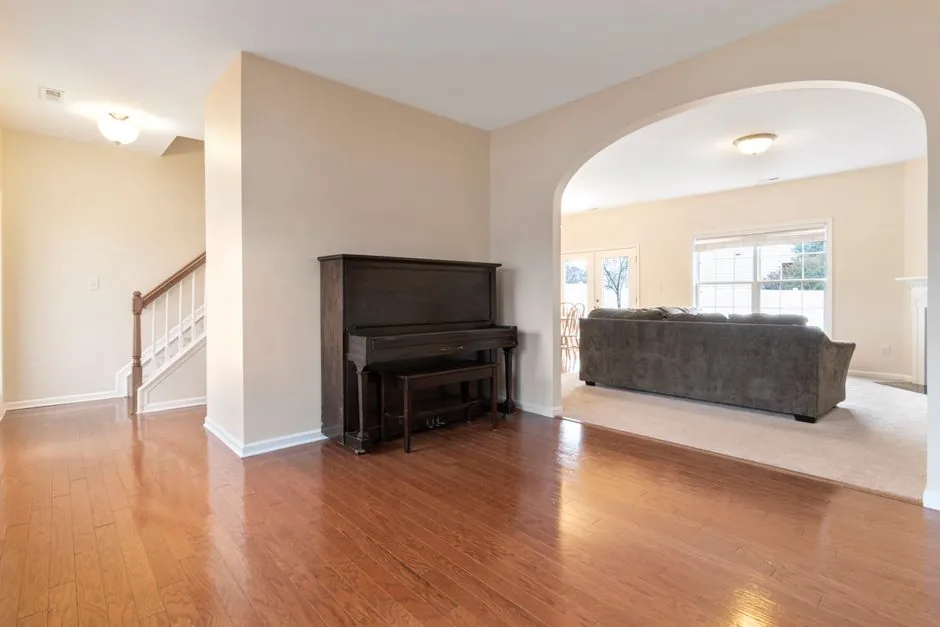
Drum floor sanders remove material 3–4 times faster than orbital sanders, making them the efficient choice for stripping thick finish on solid hardwood [S1].
Orbital floor sanders are slower but more forgiving, fitting first-time operators, engineered floors, lighter maintenance sanding, and work between finish coats [S1][S4].
Removal Capacity, Control, and Flooring Type
A drum sander uses a high-speed cylindrical drum covered with abrasive paper to strip finish, level old solid-hardwood surfaces, and remove decades of wear. That mechanism provides very high removal power and makes it the faster option for thick coatings, deep scratches, and bare-wood restoration [S1][S4]. Its abrasive contact is also unforgiving: hesitation, an uneven pass, or tilting the machine can quickly produce gouges [S1].
An orbital or square floor sander moves a flat pad in small circular orbits. It operates at medium aggressiveness and is better suited to light refinishing, engineered wood, softer species, beginners, and smoothing between stain or finish coats [S4]. The practical trade-off is capacity: an orbital sander generally will not remove thick coatings or deep scratches as efficiently [S4].
For solid hardwood with heavy old finish, choose the drum sander and accept that it demands deliberate, continuous movement. For engineered or thinner veneer flooring, choose the orbital sander because the veneer has less material available for correction. A belt sander is another aggressive option, but it is a separate class of machine rather than a middle setting between drum and orbital performance [S3][S4].
Decision Matrix for Hardwood Refinishing
Drum versus orbital selection is mainly a balance between removal rate, control, flooring thickness, and the extent of the repair: [S4]
The decisive question is not which machine produces a better finish in the hands of an experienced contractor. It is which machine matches the floor and the operator. For a large room of solid oak with old finish, drum capacity can outweigh its risk. For a first full refinishing attempt, the orbital machine’s slower pace and lower gouging risk usually produce a safer learning curve [S1][S4].
Sequencing, Grit Progression, and Floor Preparation
Heavy work generally requires coarse abrasives, followed by progressively finer grits. This sequence applies after the major surface has been levelled, not as a substitute for selecting the correct machine for the initial removal.
Before starting, remove furniture, verify that the floor is structurally sound, identify nails or fasteners, fill defects, and confirm that the intended grit sequence can level the surface without excessive veneer loss. Abrasion choice and grit progression must match the actual coating and wood condition rather than a generic room size.
Edges, Corners, and the Required Machine Combination
Neither a drum nor an orbital floor sander reaches tight corners, closets, or the perimeter along baseboards, so whole-floor work normally requires a separate edging sander [S1]. A 7-inch hardwood floor edger can blend the perimeter into the field produced by the main machine [S1].
Using an orbital machine for the field does not eliminate edging work.
For the most efficient professional workflow, use the drum for aggressive field preparation and an edger for the perimeter. For an owner-operated project, use the orbital sander for the field, plan extra hand-sanding around the room, and reserve the edger for areas where finish must blend cleanly. The comparison of belt, drum, and orbital operating characteristics is also covered in 3×21 vs 4×24 Belt Sander: Choose by Workload.
Operating Limits and Failure Modes
Drum sanding has four principal failure modes: gouging from hesitation, sanding marks from unstable technique, chatter from uneven surface conditions, and over-sanding that removes more wood than intended [S1][S2][S5]. A fast machine magnifies control errors because the drum continues removing material while the operator reacts.
Orbital sanding trades productivity for lower damage risk. The machine may take several times as long across the main field, and it can still leave deep defects that exceed its removal capacity [S1][S4]. On a heavily coated solid floor, using only an orbital sander may increase labor time without guaranteeing that the original defects have been removed [S2].
Neither type is designed for exterior decks. Gaps, fasteners, uneven boards, and weathered soft wood favor a belt, disc, or dedicated deck sander; if an interior floor machine must be used outdoors, the orbital model presents less risk of digging into soft boards [S1]. Outdoor use also introduces moisture, debris, and fastener hazards that are outside normal hardwood-floor operating conditions.
Rental Cost, Deposits, and Equipment Selection
Typical listed rental rates are $50–$75 per day or $150–$220 per week for a drum sander, compared with about $45–$65 per day for an orbital sander [S1]. These are reference prices rather than quotations, and model specifications, delivery charges, damage waivers, and local availability can change the actual cost.
Rental providers commonly require a refundable deposit of $50–$200 in addition to the rental charge, together with identification or a credit-card hold [S1]. Confirm the deposit, insurance terms, pickup time, abrasive charges, and dust-extraction requirements before booking. A light-duty orbital unit may also be supplied with a dust bag rather than a full vacuum connection, which matters for indoor work [S1].
Do not judge selection by horsepower alone. The decision matrix is more useful: drum for speed and heavy stripping, orbital for control and lighter work, and an edger for the perimeter. For a comprehensive taxonomy of power sanders, see the floor sander equipment guide before selecting attachments, grit, or dust control.
Recommendations by Project Condition
Choose a drum sander when the floor is solid hardwood, the old finish is thick or deeply worn, the floor area is large, and the operator can maintain steady forward motion. Expect the highest removal rate, but budget time for edging, screening, and correction of gouges or chatter [S1][S4].
Choose an orbital floor sander when the floor is engineered, the required work is light refinishing or between-coat smoothing, or the operator lacks drum experience. For new unfinished oak with substantial overwood, use it only when accepting a longer operation and first establishing that the surface can be leveled with a less aggressive machine [S5].
For a mixed project, the practical decision is tool pairing rather than a forced one-machine choice: drum for the main field and edger for the perimeter, or orbital for the field and edger plus hand sanding for edges. Verify the machine against the floor construction, coating thickness, required grit sequence, dust extraction, and operator skill level before rental.