Alibaba's drone category page indexes 6,000+ products from global suppliers under Trade Assurance, with verified manufacturer filters and dedicated subcategories for FPV, agricultural, VTOL, helicopter and glider airframes [S1]. That single category roll-up is the most useful entry point for a 2026 sourcing RFQ, because it forces the same buyer to compare MOQ, lead-time and inspection options across both factory-direct and trading-company listings on one screen.
The pricing spread in 2026 listings is wide enough to make platform choice matter as much as maker choice: a 25 L 4-axis agricultural spraying quadcopter is quoted at US$3,900–4,500 per set (MOQ 1) by Shenzhen Lxyee Electronics [S7], while a 6-axis 17-inch carbon-fiber FPV frame with 20 kg payload lists at US$750–768 per piece and a 10-inch FPV mini kit sits at US$151.42–171.42 per piece [S4]. For sourcing engineers, the gap between US$150 hobby frames and US$50,000+ unmanned-ship/drone combos defines three distinct supplier tiers rather than one continuous market.
Tier 1 – Factory-Direct OEMs on Made-in-China.com
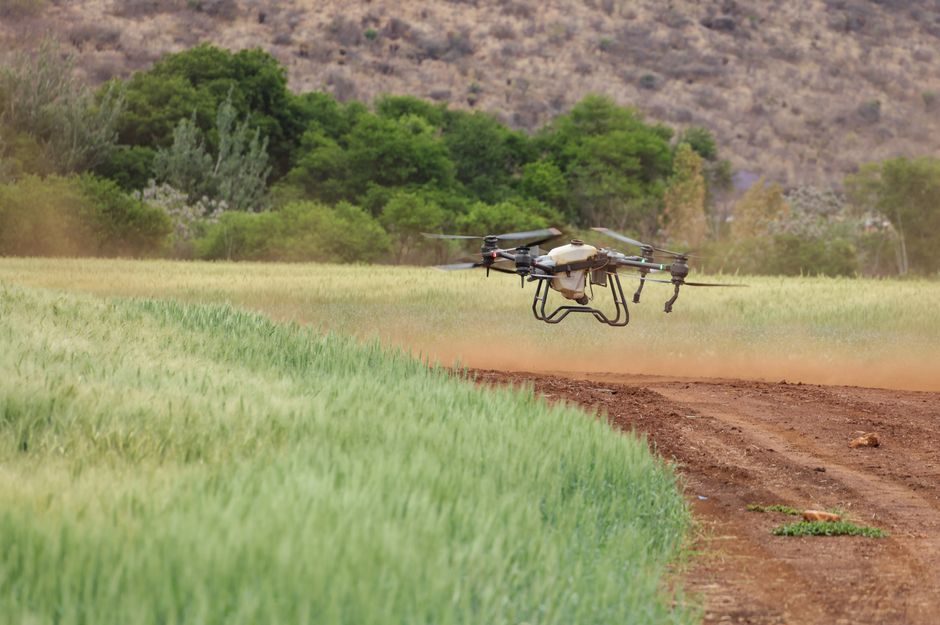
Made-in-China.com's Unmanned Drone search returned active listings on 2026-06-06 with verified Diamond Member and Audited Supplier badges; product lines split cleanly into multi-rotor, helicopter, VTOL, glider and specialised unmanned-ship categories [S7]. Shenzhen Lxyee Electronics Technology Co., Ltd. lists the 25 L 4-axis sprayer at US$3,900–4,500 per set MOQ 1, and Hangzhou Maixinminwei Technology Co., Ltd. offers a 3,700 m-satellite-free self-detection unmanned ship and drone combo at US$52,706 per piece MOQ 1 [S7]. Both sellers operate out of Guangdong and Zhejiang, the two provinces that dominate finished-drone OEM capacity.
Platform-level tooling on these pages is worth specifying in an RFQ: filters for Trade Assurance, Verified Manufacturer, Audited Supplier and Diamond Member status give buyers a way to separate factory-direct listings from trading-company pass-throughs [S1][S7]. The Shandong provincial landing page on Made-in-China.com shows the same trade-show model applied to consumer goods, illustrating how the platform normalises supplier presentation across mechanical, packaging and electronics categories [S5]. For drone buyers, the practical takeaway is that the verified-manufacturer filter is the single biggest lever for cutting trading-company noise on a price-only search.
Tier 2 – Dedicated Manufacturer Sites (SAT UAV, DEXA, et al.)
Single-brand factory sites expose product-line depth that B2B portals compress into one SKU per page. SAT UAV's corporate site lists four airframe families – Helicopter Drone, VTOL Fixed Wing Drone, Glider Drone/Runway Drone, Multi-Rotor Drone/Rotary Wing Drone – plus an Unmanned Robot and Drone Accessories line, with a German contact number (+49 911 2023-435) suggesting active EU export channels [S2]. That taxonomy is a better indicator of engineering capability than a price-list alone, because a maker that maintains four airframe architectures usually holds in-house CNC, composite layup and flight-controller integration tooling.
The implication for a 2026 procurement team: shortlist factory-direct sites that publish downloadable type certificates, ground-station protocol lists, or payload-interface drawings, because those documents are how Chinese OEMs pre-qualify for tenders from public-safety and surveying customers. The made-in-china.com Drone Definition Receiver Transmitter category shows the same pattern on the radio side – Shenzhen Xingkai Technology Co., Ltd. lists a UAV wave mobile relay / two-way radio / video data link at US$10,125–12,142 per set MOQ 1, and a Turkey-targeted VTOL software-defined radio at US$4,857+ per unit [S8]. RF chains in this price band carry vendor-specific waveform stacks, so a generic datasheet rarely survives a real integration test.
Tier 3 – FPV, Racing and Sub-US$1,000 Hobby Frames
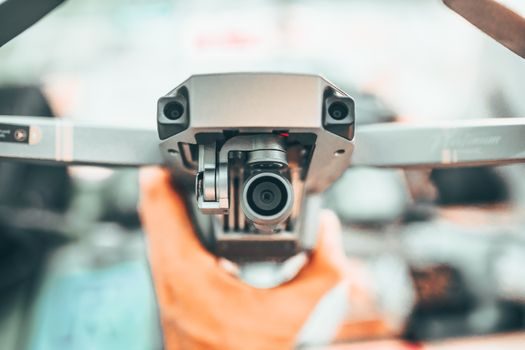
FPV frames occupy a distinct low-cost tier where shipping cost and carbon-fiber grade matter more than supplier vetting. Made-in-China.com's drone-fpv manufacturer page on 2026-01-06 returned 6-axis 17-inch carbon-fiber frames with 20 kg payload at US$750–768 per piece, 10-inch mini FPV racers at US$151.42–171.42 per piece, and 15-inch Mak4 FPV sets rated to 10 kg payload [S4]. The 17-inch and 15-inch frames in the US$750+ band are sold into industrial inspection and agricultural spraying niches, not the racing circuit, which is why payload rating appears in the SKU title.
For B2B buyers, the FPV tier is the place to compare small-batch MOQs, custom carbon layups and ESC stack choices; the higher price points in this tier mostly buy motor-mount geometry and arm thickness rather than avionics. Sourcing discipline here is to pin frame weight, wheelbase, motor-mount pattern and arm thickness in the RFQ, because FPV maker pages often publish only wheelbase and payload, leaving arm carbon to be negotiated.
Selection Criteria: MOQ, Payload, Protocol, Certification
Across the 2026 listings, four spec dimensions separate a workable supplier from a noise listing: MOQ bands, payload rating, datalink/control protocol, and airworthiness or export certification. MOQ is the most consistently disclosed metric: agricultural sprayer at 1 set, FPV frame at 1 piece, unmanned-ship combo at 1 piece, software-defined radio at 1 set [S4][S7][S8]. That consistency means a buyer can run a 5–10 unit pilot run on every category before committing to a production batch, which is unusual for industrial electronics and useful for 2026 sourcing.
Payload and protocol disclosure is less consistent: 25 L tank capacity is stated in litres for the Lxyee sprayer [S7], 10 kg and 20 kg payload are stated in kilograms for the Mak4 and 17-inch FPV frames [S4], and the Xingkai software-defined radio carries a country-specific (Turkey) waveform variant in the SKU title [S8]. For B2B integrators the rule is to convert litres to kg of liquid (water ≈ 1 kg/L, most agrochemicals 1.2–1.4 kg/L) before sizing motors and ESCs, and to require a waveform or protocol datasheet for any radio link above the US$1,000 per-set band. Buyers also working through industrial-automation BOMs can see the same trade-show-style supplier structure on the hydraulic system supplier map 2026 – tier separation by verified-manufacturer badge and MOQ band is platform-agnostic.
Cross-Platform Sourcing: Alibaba, Made-in-China and Asia Directories

Alibaba's drone category still shows 6,000+ products under the same Trade Assurance and verified-manufacturer filter stack used across the rest of the site's industrial categories [S1]. Made-in-China.com operates a parallel verified-supplier model with Diamond Member, Audited Supplier and Trade-Flag badges, and the provincial landing pages (e.g. Shandong) layer in manufacturer profile text and product-line counts [S5]. Asia-wide directories such as BombayHarbor aggregate cross-category B2B leads and let a buyer pivot from drone to fastener or lighting sourcing in the same session, which is the practical use-case for these aggregators rather than deep technical vetting [S6].
For a 2026 RFQ, the operational pattern is to start on Alibaba or Made-in-China.com for breadth, drill into the OEM's own site (e.g. SAT UAV) for type-certificate and payload data, and then use the regional B2B aggregators to triangulate export channels and price floors [S1][S2][S5][S6]. Buyers also scaling into the upstream electronics stack can see the same tier-1-to-tier-3 progression mapped for motors in the electric-motor supply 2026 brief – magnet, controller and motor-frame sourcing has the same Chinese OEM concentration as airframe manufacturing.
Limits of These Lists: Crystal Data, Stale PDFs, Toy-Grade Skew
The Springer Link chapter on "List of Manufacturers and Suppliers" carries a 1972 International Union of Crystallography copyright and Adelphi University authorship, with Reuben Rudman as editor [S3]. That entry has no operational value for 2026 drone sourcing and is included only to flag that academic aggregator pages in the same search results carry 50-year-old metadata; they should be filtered out before any RFQ is built. The remaining S1, S2, S4–S8 sources are all current B2B platforms or vendor sites.
Two platform-level limits apply across the rest. First, trade-show-style B2B portals list MOQ at 1 set for almost every category, but in practice factory-direct orders on sprayers, unmanned-ship systems and software-defined radios typically require a 5–10 unit commitment to clear the export-declaration workload; the listed MOQ is the floor, not the realistic batch. Second, the price bands for FPV frames (US$151–768) and for agricultural sprayers (US$3,900–4,500) differ by a factor of ~25x, which is too wide a single search to rely on – the RFQ must be split by use case before price comparison. The cross-category market structure – verified OEM badges, factory-direct sites, regional aggregators – is the same one used for power-grid hardware; the 2026 power-grid chain map uses the same tier-by-badge logic to separate transformer OEMs from cable and switchgear suppliers.
Trackable 2026 signals for the next sourcing cycle: (1) whether Alibaba's drone category count moves above 6,000 SKUs when the platform refreshes, and whether the verified-manufacturer share of that total grows with it; (2) whether Made-in-China.com adds country-specific waveform flags (the Turkey VTOL radio is the first such listing) to its software-defined radio category, which would signal that export-channel metadata is becoming a primary filter [S1][S8].
For component-level specifications, see pressure transmitter, flow meter, and industrial valve.