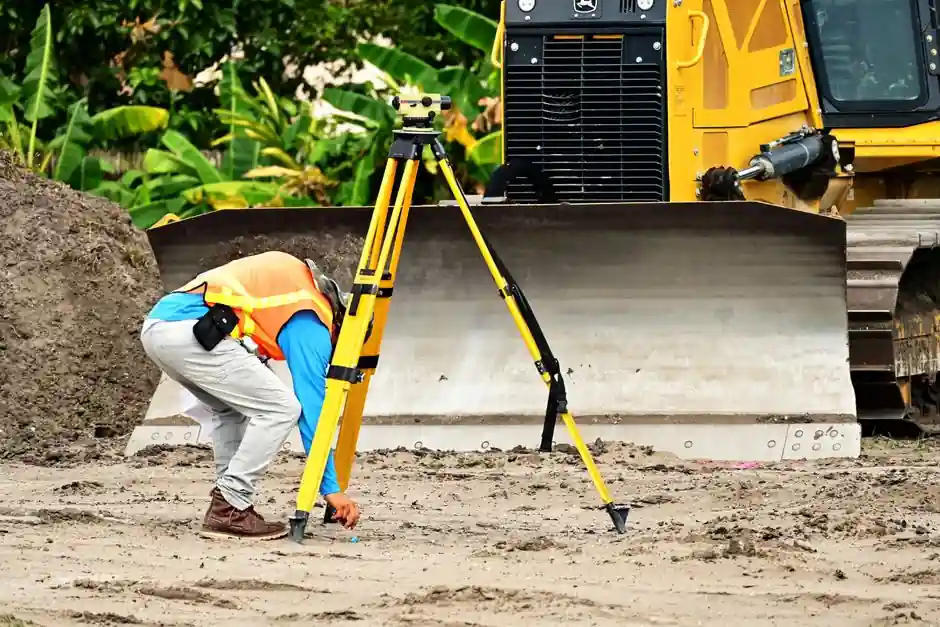
An automatic level is only as accurate as its suspended compensator, and the suspension is the part most likely to fail on impact. A drop or hard jar can stretch or snap the mylar or metal ribbons that hold the prism/mirror, after which the instrument will not shoot level and the only fix is a full compensator replacement [S4].
This concern is specific to instruments that use a gravity-referenced compensator, the mechanism that makes an automatic level self-correcting within a few arc minutes. Survey crews, civil contractors, and site engineers who rely on these instruments for sub-cm height work need to understand which failure modes are field-fixable and which send the instrument back to a service shop.
What the compensator suspension actually does
The compensator in an automatic level is a small prism or mirror hung from several metal or mylar ribbons in the telescope's light path; when the body is within a few minutes of level, gravity pulls the suspended element into a defined reference position and the line of sight stays horizontal even if the tripod is not perfectly level [S4]. The ribbons have to be stiff enough to hold the element linearly over a small angular range, but flexible enough to swing freely against the internal stops that cap travel at the design limit [S4]. That is a deliberately tight mechanical window, and it is the reason impact damage is dominated by suspension failure rather than by the optics themselves.
Drop damage vs vibration damage: how the two failure modes differ
Continuous vibration from wind, plant machinery, or passing traffic is a slow, fatigue-style stress that the compensator's dampening system is built to absorb; air-cup dampers and magnetic dampers both exist for this purpose and they generally keep sighting accuracy stable on busy sites [S4]. A drop is a single high-acceleration event: it overshoots the stops, shocks the ribbons, and either stretches them plastically or breaks them outright. Stretched ribbons disturb the linear correction range and can sometimes be brought back by re-biasing the weight on the compensator, while broken ribbons leave the unit unrepairable in the field [S4]. Severe vibration that the damper cannot absorb will also degrade accuracy, but it does not usually snap the suspension the way an impact does [S2].
Inspect the body before you ever trust the optics
Field practice after a known drop starts with the outside of the instrument, not the optics. Surveyors are taught to look for fresh dents or paint chips ("raspberries") that mark a fall, and to feel the foot-screw and tangent screws for any binding or bent shank that points to mechanical distortion [S4]. Any moisture visible on the internal optics must be air-dried with the case open before storage, or the level must not be closed up, since trapped condensation fogs the optics and creates a separate, repairable error path [S4]. These two checks cost under a minute and catch the cases where a level looks fine on the outside but has been quietly knocked out of spec.
Two-peg test and stadia check after a fall
Once the body looks clean, the compensator itself has to be verified. The standard field test is the two-peg (or reciprocal collimation) check: set the instrument midway between two staffs, take a reading at each, then swap the level to a station roughly one staff-length off the line and repeat; if the two height differences agree, the compensator is still linear, and if they do not, the suspension is suspect [S4]. A simpler sanity check is the stadia hair consistency test, which exposes compensator drift across the line of sight without needing a baseline. Both are practical on a construction site, and both are well within the capability of any two-person crew with a 30 m tape, which is why the instrument maker's manual treats them as the first line of post-impact verification.
What can be field-repaired versus what must go back
Stretched ribbons that have only shifted the weight bias can sometimes be corrected by adding or shifting a counterweight on the compensator assembly, a procedure that needs a stable test bench and known reference collimator rather than a tripod on dirt [S4]. Broken ribbons, snapped metal bands, or any case where the reticle itself has shifted on impact is not a field repair; the compensator has to come out and a replacement assembly is fitted, which is a service-shop job. The same drop that breaks a ribbon can also bend the foot-screws or shift the reticle, so a level that fails the two-peg test after a fall is generally a write-off for site use until the compensator has been swapped and re-collimated on a calibration bench [S4].
Comparing the failure modes on the main risk criteria
On four decision criteria that drive the post-drop call, the comparison reads: (1) impact drop: tends to break or stretch ribbons, requires replacement of the compensator assembly and a full bench collimation; (2) sustained vibration: degrades sighting accuracy via damper limits, often recoverable with a dampening collar or relocation; (3) moisture ingress: fogs internal optics, reversible with controlled drying and no mechanical repair; (4) reticle shift from a hard jar: combined with suspension stretch, leaves the instrument non-linear and forces a service-shop return [S4][S2]. The single-impact path is the only one that consistently destroys the suspension itself, which is why a level that has been dropped is treated differently from one that has merely been used on a vibrating slab.
How this maps to the rest of the level family
Automatic, self-compensating levels share the same suspended-mirror architecture described above, so the drop-failure logic applies across the whole family, from a builder's 28x automatic to a 1 mm/km engineering level [S4]. Non-compensating instruments, the older dumpy levels, do not have a suspension to break because their line of sight is fixed to the telescope and the operator levels the line by hand each time, so a drop on a dumpy level is mainly a reticle-and-collimation problem rather than a suspension problem. That is also why automatic levels are preferred on busy sites for speed, yet are the higher-maintenance choice in a crew environment where the instrument gets knocked off a tripod.
Practical signals a crew can watch for
Two trackable signals tell the rest of the story: first, run a two-peg test as the first job on site every time the instrument has been transported in a vehicle over rough ground, not only after a known fall, since the user often does not see the impact; second, log each compensator replacement against the instrument serial number, since a level that has taken one hard drop is statistically more likely to take another, and a service-shop history of compensator swaps is the cleanest trigger to demote the unit from precision levelling to rough site grading. The level switch and infrared level families use different operating principles and do not share this specific suspension-failure mode, so the drop-damage question is genuinely an automatic-level-only concern rather than a general surveying-equipment issue. [S4]
This topic is covered further in Secondary Safety Rope on Suspended Platforms: What the Code Actually Demands.