
Dry-mix mortar is a factory-blended combination of binder, graded aggregate 0–4 mm and additives, mixed with water on site, and in 2026 accounts for the majority of factory-produced masonry and render products specified on European and Middle-East commercial builds [S3].
Unlike site-batched mortar, every sack, silo or bulk tanker delivers the same water-to-binder ratio, aggregate grading and additive dose, which is why the spec question is not "is it good?" but "which family, which class, which joint?" [S1][S3].
Binding Family and EN 998 Designation: Where the Spec Starts
EN 998-1 splits factory-made renders and plasters into GP (general purpose), LW (lightweight), CR (coloured render), OC (one-coat), R (renovation), T (thermal) and GP-CS I–IV subclasses tied to 28-day compressive strength (1.5 / 3.5 / 6 / 12 N/mm² for CS I–IV); EN 998-2 governs masonry mortar with classes M1 / M2.5 / M5 / M10 / M15 / M20 (legacy designations dm, 1:1:6 etc. remain in common UK use) [S3]. A thin-bed tile adhesive, by contrast, sits under EN 12004 as C1 (≥ 0.5 N/mm² tensile) or C2 (≥ 1.0 N/mm²) and is NOT interchangeable with EN 998 masonry mortar — picking a C1 for a 600 × 600 mm porcelain on an external façade is a typical failure mode I have seen repeatedly.
Cement-based masonry mortars are the default for structural brick and block below the DPC and for any exposure class MX3 or above; gypsum-bound products (typically 25–50 kg/m² bulk density, λ ≈ 0.35–0.55 W/mK for plasters) suit internal wet rooms where a single-coat finish is wanted; lime-based or lime-cement blends remain the right answer for heritage masonry because their lower E-modulus and higher vapour permeability tolerate movement that cracks a rigid M10 cement mortar [S3].
Performance Levers: Compressive Class, Open Time, Water Demand and Yield
Compressive class is the headline lever, but the spec that actually drives callbacks is open time — the window after spreading during which the unit retains ≥ 0.5 N/mm² bond strength — and for cement-based tile adhesive that is typically 20–30 min at 23 °C / 50 % RH, falling to under 10 min above 35 °C or in direct sun. A polymer-modified C2 TE or C2 FT (fast-set) extends or compresses that window and also raises the 6-hour shear strength to the ≥ 1 N/mm² band. [S1]
Water demand, expressed as litres per 25 kg bag, is the second hidden cost lever: a 25 kg cement-bound masonry bag typically needs 3.5–4.5 L for a plastic, workable mix; adding an extra 0.5 L drops the 28-day strength by roughly one CS class and doubles the shrinkage risk. A standard 25 kg bag of M5 dry-mix mortar yields around 12–13 L of fresh mortar at the correct water dose, and a 1 t silo holds enough material to lay roughly 700–900 standard bricks depending on joint profile — a useful rule of thumb when sizing silos against the brick count on the drawing [S1].
Site Logistics: Bag, Silo or Bulk Tanker
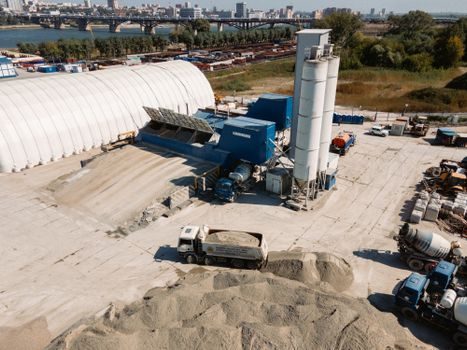
Bag supply is the default below ~3 t/week consumption and on small refurbishment jobs; the 25 kg paper sack stacks on a pallet at 48–56 bags (1.2–1.4 t) and suits sites without silo access or with a hoist. Above ~5 t/week a horizontal or vertical silo system becomes the economic answer, delivering 12–35 t of factory-blended dry mortar in a single refill, metered by a horizontal auger into a ribbon mixer, with batch times around 3–5 min and consistent water dosing that the silo controller monitors against a flow meter [S1].
For projects above ~50 t/week — high-rise masonry, large renders, infrastructure — a bulk tanker (road tanker typically 25–30 t payload) pneumatically blows the dry mortar into a site silo, eliminating bag-handling and dust at the bag-opening station. The trade-off is minimum order size: a partial tanker still pays the freight, so undersizing the silo is the most common reason dry-mortar programmes fail to deliver the cost saving the estimator promised.
Substrate and Exposure Match: The Real Selection Decision
The selection grid that survives 90 % of the spec decisions I see is short: (1) substrate — calcium silicate, dense concrete, AAC, brick, screed, existing render; (2) exposure — interior dry, interior wet, exterior sheltered, exterior exposed; (3) service class — purely cosmetic, structural, tiling substrate, renovation over salt-contaminated masonry. A renovation over salt-laden old masonry wants EN 998-1 R (renovation) with a porous aggregate that stores migrating salts and lets the wall dry, not a standard GP [S3].
For external tile-on-render assemblies, the route is: a CR/OC render → primer keyed to the render chemistry → C2 TE S1 flexible adhesive (S1 = deformable, ≥ 2.5 mm deflection) → grout rated CG2 WA for water absorption ≤ 5 % and abrasion ≤ 1000 mm³. Skipping the S1 deformable class and using a rigid C2 TE on a 6 m façade bay is a near-certain delamination within one thermal cycle; for more on the render-to-tile chain see the HVAC-side spec walk-through.
Comparison: Four Common Mortar Types on Four Decision Criteria
Cement-bound masonry (EN 998-2 M5): 28-day strength 5 N/mm², water demand 3.5–4.5 L per 25 kg, cost band lowest, best fit for load-bearing brickwork below DPC. Cement render (EN 998-1 GP CS III): 28-day strength 3.5–7.5 N/mm², higher polymer modification for adhesion, best fit for general exterior render on masonry. Gypsum plaster (EN 13279 B1–B7): 28-day strength 2–6 N/mm², single-coat internal finish, λ ≈ 0.35–0.55 W/mK, NOT for wet rooms unless rated H (hydrophobic). Polymer-modified tile adhesive (EN 12004 C2 TE S1): tensile adhesion ≥ 1.0 N/mm², deformable ≥ 2.5 mm, the only correct pick for large-format porcelain on heated screeds or façades. [S2]
A useful cross-check when the bid looks too cheap: the bag weight and the declared yield. A genuine M5 masonry mortar at 1.5 t/m³ fresh density and 25 kg bag should yield around 12–13 L; if a competing bag claims 18 L, the aggregate grading is too coarse, the water demand will be higher, and the 28-day strength will land in M2.5 territory regardless of the label.
Quality Control, Standards and Common Failure Modes
For tile adhesive, the field check is a 100 × 100 mm pull-off test at ≥ 0.5 N/mm² (C1) or ≥ 1.0 N/mm² (C2) per EN 1348. [S3]
The failure modes I see on real projects cluster into four buckets: (a) wrong water dose — over-watering drops the 28-day strength by one to two CS classes and raises shrinkage cracking; (b) wrong substrate prep — dusty, unprimed AAC or dense concrete kills adhesion regardless of adhesive class; (c) wrong product for exposure — standard GP render on a splash zone, or rigid C1 adhesive on a heated screed; (d) poor storage on site — bags left on a wet pallet pull moisture, hydrate prematurely, and the 28-day strength falls off 30 % or more. A 25 kg bag of cement-bound dry-mix mortar has a shelf life of 6–12 months in sealed packaging on a dry pallet; once a bag shows clumps that do not break up by hand, bin it [S1][S3]. For the broader project-supply chain view, the concrete-admixture maker map and the pallet-rack sizing guide cover adjacent supply decisions on the same job site.
Equipment Reference: Mixers, Pumps and Calibration

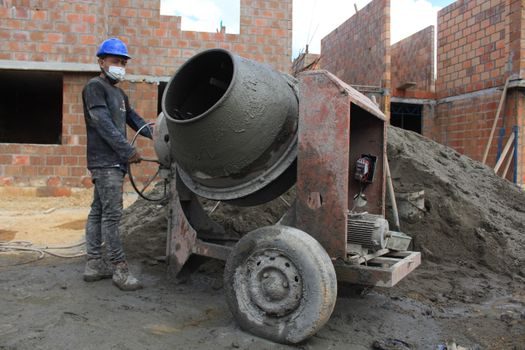
For silo-fed masonry work, a horizontal-paddle continuous mixer (typical 3–6 m³/h output) is the standard; for plaster and render, a forced-action pan or ribbon mixer gives the right shear to break up any silos-stored lumps. For site logistics above 5 t/week, the silo-mounted flow meter and water-dose pump should be calibrated at least quarterly — a 5 % drift in water dose shifts the 28-day strength by roughly the same percentage, and a 10 % drift is the difference between M5 and M2.5 in practice. A dry-block temperature calibrator on the QA bench is the right reference instrument to verify the 20 °C cure temperature in the site cure cabinet, since a 5 °C drift over 28 days can swing mortar strength results by 10–15 %. [S1]
For the broader decision tree on engineered dry products that sit alongside mortar on the same spec sheet — a dry-type transformer on the M&E package, a linear guide on the formwork table, a crossed-roller guide on the cut-and-bend station — the same "spec the class, then size the equipment" logic applies. The reference for material behaviour on the receiving end is the ready-mix concrete page, and the dry-mortar entry covers the broader chemistry of binders and additives used in these factory blends.
Watch Wacker, Mapei and PCI technical bulletins for draft-class test data through Q3–Q4 2026 [S3].