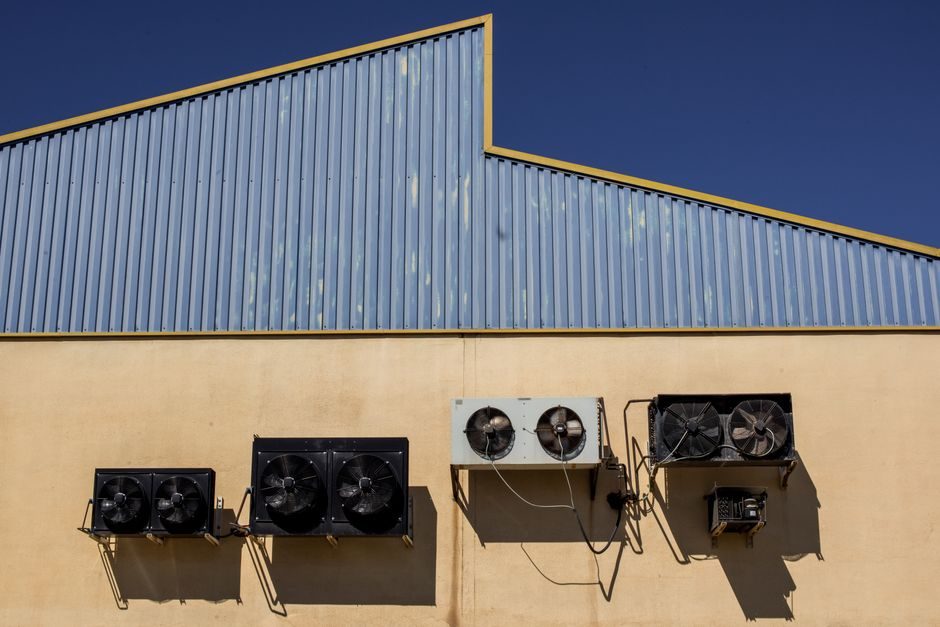
HVAC applications punish ordinary screeds: duct-penetration fire seals, plenum-wall patches, chiller-base grout pads, and condensate-tray bedding all sit on hot/cold, vibration-loaded, code-driven interfaces where M4-class masonry mortar fails within a heating season.
The shortlist is polymer-modified cementitious dry-mix mortar in the C2 TE S1 performance band of EN 12004 — a flexible, polymer-redispersible-powder (RDP) modified, thixotropic, water-resistant formulation supplied as a factory-batched dry premix from a dry mortar tower line. Generic site-mixed sand-cement screed at 1:4 ratio is not a substitute; its 0.5–1.0 MPa bond strength on concrete and near-zero flexibility will crack on the first thermal cycle of an operating duct or chiller pad.
Defining the HVAC Mortar Use Case vs. Standard Tile or Screed Mortar
HVAC mortar is a working sub-category inside the broader dry-mix mortar family, not a separate chemistry. EN 12004 classifies cementitious tile adhesives as C1 (normal) or C2 (improved), with extra class tags T (slump/thixotropic for vertical), E (extended open time ≥ 30 min), and S1/S2 (deformable: S1 ≥ 2.5 mm and < 5 mm; S2 ≥ 5 mm per EN 12002). For HVAC, the typical minimum envelope is C2 TE S1; S2 is reserved for highly deformable façades and large-format external cladding, not normally required for mechanical-room grouting. [S1]
Two functional groups dominate the HVAC scope. (1) Sealing and patching mortars — used to fire-stop around duct penetrations, seal cable trays, repair plenum-wall openings, and patch concrete housings — must carry an F-rating (fire resistance) per EN 1366-3 or ASTM E814 when the assembly is rated; many of the same products also double as tile adhesives on plant-room floors and walls. (2) Grouting and bedding mortars — chiller-base grout, generator-base grout, pump-base grout, and rail/bearing-plate bedding — need high early strength (≥ 40 MPa at 24 h for precision grout), low shrinkage, and non-shrink behaviour per EN 1504-6 for anchoring products, plus oil-resistance where the chiller is refrigerant-charged. Site-batched ready-mix concrete is too fluid and too coarse for the 10–50 mm typical grout lift.
Performance Criteria That Separate HVAC-Grade Dry-Mix From Commodity Screed
Five spec criteria separate an HVAC-rated dry-mix mortar from a commodity 1:4 site screed, and every one of them must be on the data sheet before purchase. [S2]
Adhesion (bond strength). EN 12004 mandates ≥ 1.0 MPa for C1 and ≥ 1.0 MPa for C2 (with the C2 test performed after water immersion and heat-ageing cycles). Substrate pull-off on the parent concrete or masonry should be ≥ 0.5 MPa minimum — failing substrates must be primed, not just re-skimmed. Cycle-tested bond on steel-duct wrap requires a polymer-rich formulation with ≥ 8 % RDP (redispersible polymer powder, typically VA-VE or VAc-E type) by dry mass of the cement.
Flexibility / deformability. S1 class requires ≥ 2.5 mm transverse deformation per EN 12002; S2 ≥ 5 mm. HVAC ductwork expands roughly 0.012 mm/m·K on galvanised steel — for a 10 m hot-air run at ΔT 60 K that is over 7 mm of axial growth, and a rigid screed will delaminate within weeks.
Thermal conductivity and fire. For plenum and duct-wrap applications, the mortar layer should not form a thermal bridge. Where a fire-rating applies, specify the F-rating in hours (e.g. EI 120) and the test standard (EN 1366-3 / EN 1364-1, or ASTM E814 for North American projects). Polymer-modified mortars with vermiculite or perlite fillers (λ ≈ 0.10–0.20 W/m·K) outperform sand-cement screeds (λ ≈ 1.0–1.4 W/m·K) by 5–10× on insulation value, which matters at duct-penetration sleeves where condensation is a real risk.
Open time, pot life, and workability. Look for EN 12004 'E' class (≥ 30 min open time) and a 60–90 min pot life at 20 °C. In summer plant-room conditions at 30–35 °C, expect pot life to drop to 30–45 min. The supplier should publish water demand (typically 18–22 % by mass) and trowel consistency (slump 150–170 mm) on the TDS. Tower-produced dry mixes from established OEM lines such as those built by Fujian NanAn H-TEC [S1] and NFLG [S2] typically achieve ±1 % batch accuracy on binder, sand, and additive fractions — a level of consistency hand-batching cannot reproduce.
Compressive and early strength. For chiller-base and equipment grout, EN 1504-6 sets 30 MPa at 28 d as the floor, but precision non-shrink grouts reach 50–80 MPa at 24 h and 70–95 MPa at 28 d. Floor screeds under raised-access plant-room floors need ≥ 25 MPa at 28 d (C25 grade) and should be fibre-reinforced (PP fibres ≥ 0.6 kg/m³) to control plastic-shrinkage cracking on the 30–50 mm typical lift.
Comparing the Main Dry-Mix Mortar Options for HVAC
Four dry-mix mortar families cover almost every HVAC application. They differ on binder, polymer loading, aggregate, and the standards they meet, and the selection falls out cleanly when cost, movement tolerance, fire rating, and load are lined up against the same criteria. [S3]
Cementitious tile adhesive (C2 TE S1, RDP-modified). The default choice for plant-room floor tiling, plenum-wall ceramic lining, and duct-sleeve sealing where EN 12004 governs. Bond ≥ 1.0 MPa, transverse deformation ≥ 2.5 mm, water-resistant, cost-effective at roughly USD 0.8–1.5 per kg of dry mix. Not a grout.
Polymer-modified grout (EN 1504-6). The correct product for chiller-base, generator-base, and pump-base grout pads. Non-shrink, high-early (40–60 MPa at 24 h), oil- and refrigerant-resistant when formulated with nitrile or epoxy-modified binders. More expensive (USD 2.0–4.0 per kg) and must be placed by a specialist grouting crew — the 60–90 min pot life and the 10–50 mm lift tolerance leave no room for a general plasterer.
Lightweight insulating / fire-rated mortar (LW + F-class). Perlite or vermiculite aggregate with calcium-aluminate or gypsum binder, λ ≈ 0.06–0.20 W/m·K, densities 250–600 kg/m³. Used for duct-wrap penetration seals, fire-stop collars, and plenum back-fill. Compressive strength is intentionally low (1–5 MPa) — never use as a load-bearing grout. Cost sits between the two previous options at USD 1.5–2.5 per kg.
Site-batched sand-cement screed (1:3 or 1:4). The option to avoid. No RDP, no EN 12004 classification, no F-rating, no deformability. It is cheap (USD 0.2–0.4 per kg equivalent) but the cost of the first re-patch, plus downtime, will exceed the saving within one heating season on any ducted HVAC interface.
A second dimension matters for sourcing: factory-batched dry-mix produced on a dry mortar tower line (vertical aggregate grading, automatic weighing, ≤ 1 % batch tolerance) gives a more consistent water demand and pot life than horizontal pan-mixer systems, which is exactly the consistency HVAC specifiers need when they want a one-batch lift to meet a rated assembly [S1][S2].
Standards, Certification, and Application Limits
Four standards frame the HVAC mortar specification: EN 12004 (cementitious adhesive classification, C1/C2, T, E, S1/S2 tags), EN 12002 (transverse deformation test method), EN 1504-6 (anchoring / non-shrink grout), and EN 1366-3 or ASTM E814 (fire-resistance of service penetrations). For duct and pipe insulation interfaces, EN 14303 (factory-made mineral wool) and EN 13162 cover the insulation layer, with the mortar providing the fire-stop and the vapour seal at the penetration. [S1]
Two product-line points from the research feed. Wacker's VINNAPAS RDP (redispersible polymer powder) seminars train formulators on the correct RDP loading to hit C2 TE S1 in a cementitious dry-mix system, including HVAC-grade applications [S3]. The Wacker Academy is the most-cited public training source for the polymer side of EN 12004 C2 S1 formulation work, useful as a specifier reference when auditing an unfamiliar OEM's TDS. NFLG publishes case studies on Yunnan Best and Chongqing Kaizhou concrete lines covering high-end green building materials production, which gives a working reference for tower-line output at the supplier level [S2]. Fujian NanAn H-TEC supplies tower-type dry-mix mortar production lines and the upstream mixer / packing chain that downstream HVAC-mortar blenders run on, so the OEM equipment base for the product family is well established in 2026 [S1].
Application limits are concrete. Do not use a C1 normal adhesive where the substrate moves more than 0.1 mm under thermal or vibration load — that rules out C1 on any hot duct or chiller pad. Do not use a polymer-modified tile adhesive as a precision grout: pot life and aggregate grading are wrong. Do not apply any of these products below 5 °C or above 35 °C ambient without climatic conditioning; EN 12004 tests are run at 23 °C / 50 % RH, and field results deviate quickly outside that envelope. For external chiller pads exposed to freeze-thaw, demand a documented FT rating per EN 1367-1 or CEN/TS 12390-9 on the TDS.
Who Should Specify HVAC Dry-Mix Mortar (and Who Should Not)
Specify C2 TE S1 polymer-modified cementitious dry-mix mortar for: MEP contractors sealing duct and pipe penetrations through fire-rated walls and floors; HVAC-OEM plant rooms where floor tiling and equipment grout are being installed in a single shift; facility maintenance teams patching plenum walls and chiller pads without a full shutdown; and cleanroom / data-centre builds where the floor finish must be both tile-grade and load-bearing. [S2]
Specify non-shrink precision grout (EN 1504-6) instead when: equipment alignment under dynamic load is critical (chillers, rotary screws, generator sets); the lift is 10–50 mm and tolerance is ±2 mm; or the substrate is contaminated with oil that an RDP-cement system will not tolerate. Specify a lightweight fire-rated mortar instead when: the application is a penetration seal with an F-rating, a back-fill on a fire-rated plenum, or an external duct wrap where thermal bridging matters more than compressive strength.
Do not specify any of these products for: cast-in-place structural slabs (use ready-mix concrete at C25/30 or higher); structural beams and columns (use ready-mix concrete, not mortar); and exterior façade cladding above 10 m height (use a dedicated C2 TE S2 façade system, not an S1 HVAC mortar). Spec engineers working on power-transformer foundations, where vibration and oil contamination both apply, should also cross-reference the dry-type transformer base-mounting spec since transformer-base grout follows the same EN 1504-6 envelope as chiller-base grout. The selection of a flow meter for chilled-water monitoring, or a pressure transmitter for the same loop, sits downstream of the mortar spec and is unaffected by the choice of dry-mix product family.
Real HVAC Applications and the Mortar That Fits
Plant-room floor tiling uses a C2 TE S1 tile adhesive on a cured screed, with joints grouted in CG2 WA class (EN 13888) for water-absorption and abrasion resistance. A 50 m² plant room typically takes 1.0–1.2 tonnes of dry-mix mortar at 3 mm bed thickness, including wastage. Duct-penetration fire-stopping is the highest-stakes application: a single unsealed penetration on a 2-hour-rated wall can drop the wall to 0-hour, and an F-rated mortar tested to EN 1366-3 is the only acceptable product. Chiller-base grout (50–100 mm lift) on a concrete housekeeping pad uses an EN 1504-6 non-shrink grout, placed by the pour-and-headbox method, and cured under wet hessian for 72 h. Plenum-wall patching on return-air shafts in commercial buildings typically takes a polymer-modified fairing coat 3–6 mm thick over a primed substrate, with no F-rating requirement unless the wall is fire-rated. A broader view of how to choose dry-mix mortar for productivity, batching, and sourcing is laid out in a separate sourcing guide. [S3]
Admixture interaction is the most-overlooked HVAC-specific risk. Calcium-chloride-based accelerators corrode the galvanising on ductwork and the rebar in concrete pads; specify a non-chloride accelerator where metal contact exists. Where the chiller pad is also receiving a chemical admixture to control the ready-mix concrete substrate, the admixture selection guide for 2026 mixes is the relevant cross-reference, because admixtures and mortar polymers must be compatible — usually a quick TDS check on plasticiser type (PCE vs lignosulphonate) is enough to clear the risk.
Failure Modes, Constraints, and Common Sourcing Errors
The four common failure modes in HVAC mortar are predictable and avoidable. (1) Delamination from a smooth duct wrap or pre-cast plenum wall because the substrate was not primed — every TDS now requires a bonding primer on non-absorbent substrates. (2) Cracking on the first thermal cycle because a C1 normal adhesive was specified instead of C2 S1 — the polymer content is the entire reason C2 exists. (3) Loss of fire-rating on a rated wall because the penetration was sealed with a generic acrylic sealant instead of an F-rated mortar tested as a system with the wall assembly. (4) Chiller-base grout cracking from late-water addition on site — the water-to-powder ratio is published for a reason, and re-tempering past the pot life drops strength 30–50 %. [S1]
Sourcing-side constraints are equally real. Lead time for a fresh production run is 3–5 weeks against 1–2 weeks for stocked SKU. Specifying engineers should request the EN 12004 / EN 12002 test report dated within 24 months of the shipment, and should reject any TDS that does not list the S1 transverse-deformation number explicitly. Background reading on adjacent plant-room equipment is in the power transformer buying guide for 2026 and the dry-type transformer selection guide — both are useful cross-references when the HVAC spec shares a plant room with MV/LV switchgear.
Trackable next signals for spec engineers: (1) a fresh EN 12004 / EN 12002 third-party test report from the chosen OEM, dated within the past 12 months; (2) confirmation of Wacker VINNAPAS or equivalent RDP grade and loading on the TDS for any C2 S1 product; and (3) the OEM's tower-line production tolerance, which should be ≤ ±1 % per batch on binder and ≤ ±2 % on aggregate for HVAC-grade consistency.