
Chain conveyors for apparel distribution are typically specified as multi-strand plate or slat conveyors running at 0.3–0.6 m/s with carton footprints between 300×200 mm and 800×600 mm, diverging sharply from the heavy-armoured plate designs used in bulk-mineral duty [S2].
Apparel DCs handling hanging garments, poly-bagged soft packs, and shelf-ready cartons require a chain conveyor spec set that emphasises surface finish, sortation hand-off geometry, and cleanability over the abrasion and pressure ratings that dominate cement, gypsum, or coal-handling selections [S1][S2].
Load Geometry and Garment-Safe Surface Specs
Apparel cartons and totes demand a flat, snag-free slat top with 25–50 mm pitch and no exposed chain pin heads, because protruding fasteners tear poly-bag film and snag knitwear at induction [S1]. Standard roller chain link geometry is typically replaced with a low-profile flat-top chain or a wear-strip-backed plate, where the conveyor chain family is selected for the 8–12 mm slat thickness rather than the 100+ mm armoured plates used for gypsum reclaim [S2].
For a typical 3-shift DC handling 8,000–15,000 units/hour, line speeds land in the 0.3–0.6 m/s band so a sorter operator or scan tunnel can read a 600×400 mm carton label with a fixed-mount camera; this is roughly one-third the chain speed tolerated on a roller chain-driven accumulation table for palletised case goods. Carton weight on each slat is usually 5–25 kg, well below the 100+ kg/unit typical of mineral-duty chain conveyors [S2].
Throughput, Footprint, and Sortation Hand-Off
Apparel DC throughput is sized in cartons-per-hour, not tonnes-per-hour, and most projects land between 5,000 and 20,000 units/hour on the main feed line; suppliers such as Jiangsu Yuante Intelligent Technology integrate chain conveyors with high-speed swing-arm and cross-belt sorters within a 12,000 m² Jiangsu plant footprint serving global cargo-handling OEMs [S1]. The chain conveyor itself typically occupies 15–25% of the total sortation footprint because the cross-belt sorter carries the diverting function, not the chain [S1].
For comparison, an apparel feed line at 0.5 m/s with a 500 mm slat width carries roughly 60–80 cartons/minute per lane, while a coal-mill chain conveyor type TKF at the same width moves bulk material in a closed trough at far higher mass flow but with no sortation interface [S2]. Sortation hand-off accuracy for cross-belt units is commonly specified at 99.5%+, and the upstream chain conveyor must hold carton pitch within ±25 mm at the merge to keep the divert gap clean [S1].
Noise, Cleanliness, and Hygiene Envelope
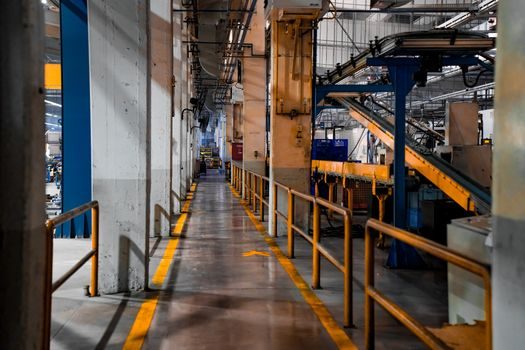
Noise is a hard constraint in apparel DCs because pickers and sorters work within 1.5 m of the conveyor; specifying below 75 dB(A) at 1 m is standard, achieved through UHMW wear strips, plastic chain bushings, and chain-velocity caps around 0.6 m/s rather than the 1.0–1.5 m/s common in cement-clinker or FGD-gypsum reclaim [S2]. Lube-free engineered polymer chain bushings dominate apparel selection because fabric fibres and cardboard dust accumulate on oil-wet surfaces and become a snagging hazard [S1].
Enclosed-trough chain conveyors like the LOUISE TKF family used for hot boiler ash and FGD gypsum [S2] are deliberately NOT the right answer for apparel because the sealed trough traps lint, blocks wash-down access, and adds unnecessary mass; the equivalent apparel spec is an open-slat frame with a chain-shroud cover only over pinch points. A directly comparable selection problem for high-throughput logistics lines is covered in the chain conveyor spec map for e-commerce fulfillment, where similar low-noise, high-divert-rate constraints apply.
Drive Sizing, Floor Load, and Modular Layout
Drive kW for an apparel chain conveyor scales with total moving mass and friction, not the bulk-material column load that drives TKF or PKF selection; a 50 m apparel feed line with 30 kg/m of chain and slat mass plus 15 kg/m of live carton load typically lands at 1.5–3.0 kW, against the 11–30 kW envelope of a 40 m armoured plate conveyor for limestone or coal-mill feed [S2]. Floor-load limits in mezzanine apparel DCs often cap at 500–800 kg/m², and the conveyor frame must be specified with a galvanised or stainless support at 1.5 m centres to keep point loads inside that envelope [S1].
Modularity is a non-negotiable spec for apparel DC projects because seasonal SKU re-slotting forces line re-layout every 6–18 months; the Jiangsu group serving the segment supplies 1,000 mm and 1,500 mm module lengths with bolted frame splices and supports over 150 partner integrations, while armoured plate chain conveyors for bulk solids are almost always engineered-to-order and field-welded [S1][S2]. The control side typically uses VFD drives with 4–20 mA or fieldbus speed reference so the chain conveyor synchronises with the upstream distribution cabinet-fed sorter PLC rather than a standalone starter.
Selection Comparison: Apparel DC vs Bulk-Material Chain Conveyor
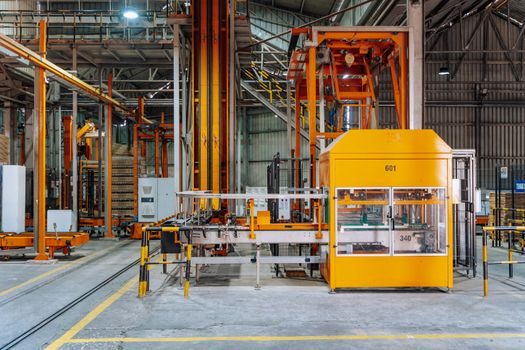
Side-by-side, the spec envelopes diverge on at least four decision criteria: chain speed (0.3–0.6 m/s apparel vs 0.5–1.5 m/s bulk), surface (flat slat with snag-free slat top vs armoured plate or drag flights), enclosure (open frame with point guarding vs closed trough), and drive power (1.5–3.0 kW for a 50 m apparel line vs 11–30 kW for a 40 m PKF or TKF bulk unit) [S1][S2]. Selecting the wrong family — for example, dropping a closed-trough TKF into a hanging-garment DC — costs 3–5× the necessary drive power, blocks wash-down, and traps lint at every joint [S2].
For a closely related spec problem where polymer-wear-strip chain drives must interface with batch dosing, see chain conveyor selection for chemical shipping duty; the corrosion and washdown envelopes differ, but the drive-sizing logic is the same. A non-conveying but adjacent electrical spec is the explosion-proof distribution panel sizing that feeds the VFD, which on apparel lines is usually IP54 rather than ATEX-rated, but the cabinet selection rules around harmonics and short-circuit duty are identical.
When Chain Conveyor Is the Wrong Choice for Apparel
Chain conveyors lose to belt or roller accumulation when the apparel mix is dominated by poly-bagged hanging garments on overhead conveyors, because garments cannot ride a flat slat; in that case a powered overhead conveyor or a garment-on-hanger (GOH) system is the correct selection and the chain conveyor only appears at the carton-pack station [S1]. Belt conveyors win for shrink-wrapped multi-pack lanes where the carton base is irregular and would rock on a slat top, and motorised roller accumulation beats chain conveyors where zero-pressure merging is needed upstream of a scan tunnel [S1].
Chain conveyors also lose for very short transfer sections under 3 m, where a simple belted or gravity roller saves cost; reserve chain conveyors for runs above 8 m, for inclined spans above 5°, and for any line that must interface with a slat-driven cross-belt sorter [S1][S2]. Floor-load limits below 400 kg/m² push the spec back to a belt conveyor with a lighter footprint.
Sourcing and Standards Discipline
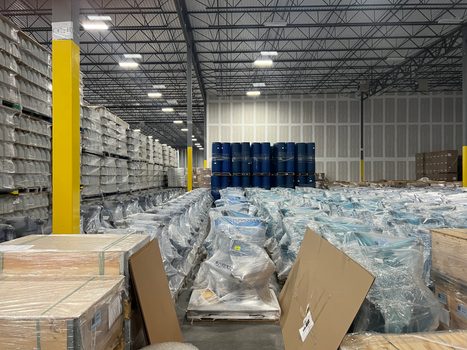
Apparel DC chain conveyors are typically sourced from Chinese material-handling OEMs in Jiangsu and Guangdong — Legend Automation reports 12,000 m² plant, 60+ patent certifications, and 150+ partner integrations serving global cargo handling [S1], while Krius Intelligent Manufacturing in Jiangmen supplies the mechanical-component backbone for one-stop conveyor integration. For bulk-mineral reference, AUMUND's PKF and TKF lines document the heavy-duty shock-pressure design (resistant up to 3.5 bar) that is explicitly NOT what an apparel line needs [S2].
Apparel-side standards discipline focuses on ISO 340 chain conveyor safety guarding, IEC 60204-1 electrical equipment of machines, and the supplier's internal slat-flatness tolerance (commonly ±0.5 mm/m for snag-free garment handling) rather than the ATEX or coal-mill pressure-proof envelopes relevant to bulk-material duty. Track the next node by confirming slat pitch, surface finish, and VFD harmonics on the supplier data sheet before sign-off, and verify the power distribution box feeding the drive has the inrush headroom for the 1.5–3.0 kW motor under cyclic stop-start sortation duty.