
A dry-type transformer TCO analysis should evaluate at least six cost buckets over 30 years or more: acquisition, installation, energy losses, maintenance, downtime exposure and end-of-life cost [S3][S4][S7].
The lowest bid price is not necessarily the lowest cost of ownership because no-load and load losses continue for every operating hour, while transformers in most applications remain in service for 30 years or more [S3][S4].
What belongs in a dry-type transformer TCO?
Total cost of ownership covers the complete economic life of the transformer rather than the purchase order alone. A practical model includes the bid price, transport, installation, energization, loss electricity, maintenance, inspections, downtime risk and disposal, less residual value [S7].
The financial horizon must match the planned service life. Transformer economic studies commonly evaluate 30 years or more, and some equipment may operate beyond that period [S3][S4]. A shorter spreadsheet horizon can make a low-efficiency unit appear economical by excluding future energy and maintenance costs.
The core loss model separates two quantities. No-load loss, expressed in watts, is associated with core magnetization and continues while the transformer is energized. Load loss, also expressed in watts, varies with loading. The U.S. Rural Utilities Services method calculates capacity factor from annual kilowatt-hours sold divided by 8,760 hours multiplied by nameplate kilovolt-amperes, with 8,760 hours used unless a seasonal or special duty cycle requires another value [S1].
Loss valuation: the dominant operating-cost mechanism
Transformer electricity losses are valued by converting watts into annual kilowatt-hours, multiplying by the applicable energy price, and then discounting the resulting expenditure to a common present-value date [S3][S4]. The discount rate, escalation for electricity prices, inflation, load profile and analysis period all change the result.
This example demonstrates the calculation structure, but its coefficients are local bid assumptions rather than universal rates.
Loss selection should follow the nameplate rating and the duty expected at the site. No-load loss is often evaluated over the full energized period, while load loss must be adjusted for the actual loading profile. A transformer that idles for much of its life cannot be compared with one that operates near its design loading by using identical coefficients [S5].
Compare bids with a consistent present-value method
The comparison method must retain units and apply the same assumptions to every candidate. A simplified utility formula may use a price plus a no-load-loss coefficient and a load-loss coefficient, but the coefficients should be derived from the project’s energy price, load profile, service life and discount rate [S1][S5].
Loss savings do not necessarily have to be large to matter. The implication is precise, not promotional: even small efficiency changes deserve valuation when annual operating hours are high.
Installation and site integration can erase the bid advantage
Installation cost includes more than equipment placement. The analysis must account for foundations, enclosures, ventilation, protection, cable terminations, controls, testing, commissioning and any modification needed to connect the unit to the existing electrical system. These items should be priced for each candidate configuration rather than hidden in a generic installation allowance [S7].
Supplier response time belongs in the risk analysis because the financial impact of emergency downtime and a supplier's ability to respond to transformer needs are relevant to total cost of ownership [S2]. A long lead time does not automatically make the product more expensive, but it can expose the owner to outage, temporary equipment and project-delay costs that the purchase price omits.
These costs belong in TCO for facilities where compatibility and replacement speed affect continuity.
Maintenance, cooling and reliability affect lifecycle cost
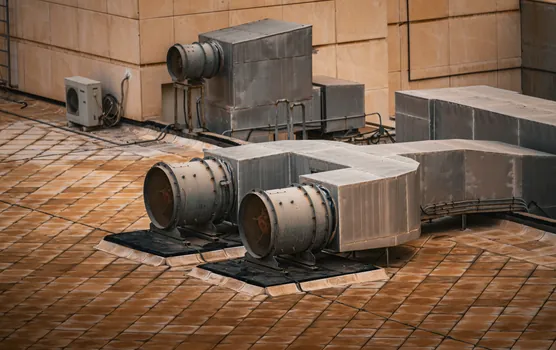
Dry-type transformers require evaluation of inspection, cleaning, connection maintenance, thermal condition, protective devices and the cooling arrangement in service. The dry-type transformer has no liquid-insulation maintenance regime, but air-core ventilation, heat, contamination and connection condition still create service requirements and failure exposure. [S5]
Higher-efficiency units can operate cooler, reducing the cooling burden and potentially extending component life [S3]. Dry-type construction also makes busway and distribution cabinet interfaces relevant during an installed-cost review, because the transformer is part of a larger distribution system rather than an isolated asset.
Downtime cost should be calculated from the facility’s own loss rate. Manufacturing interruptions, hospital backup-system operation and campus research interruptions have different financial consequences [S2]. The TCO model should therefore use an outage duration distribution and the actual operating cost per hour, not a generic downtime penalty.
Who benefits from a TCO comparison?
TCO is most useful for facilities with sustained loading, 30-year or longer planning horizons, high electricity prices or several parallel transformers where a small loss reduction at rated load materially affects the fleet [S3][S4]. It also supports industrial, mining and utility procurement where tenders can be normalized through a present-value formula [S3].
The method is less decisive for an emergency replacement with no technically acceptable alternative, a temporary installation, or a site expected to be decommissioned before the analysis period ends. Purchase price, compatibility and restoration time then carry more weight than a multi-decade loss calculation. Even for short-life equipment, the owner should still document the assumed service period and avoid using a long-term efficiency factor that the asset cannot recover.
Standards, assumptions and auditable inputs

The International Electrotechnical Commission publishes transformer TCO methodology and equations in IEC TS 60076-20:2017, Annex A [S4]. The framework capitalizes the future value of losses and can be applied from small distribution units through network and transmission transformers [S4]. Compliance with the methodology does not replace project-specific engineering.
Minimum auditable inputs are bid price, no-load loss in watts, load loss at the stated reference loading, annual and hourly loading, energized hours, energy price, escalation, inflation, discount rate, service life, installation cost, maintenance plan, outage exposure, disposal cost and residual value [S1][S4][S7].
Loss values should be taken from the same test basis for every bid. The separation between no-load and load loss must remain visible because their operating patterns differ [S1][S3]. Any residual-value credit should be presented separately from avoided operating costs, and disposal should not be netted against a premium unless both are valued on the same basis.
Cost drivers and the procurement decision
Materials and core design move purchase price because low-loss core steel, optimized magnetic configuration, high-conductivity windings and low current density require additional material and manufacturing control [S3]. Certification and factory testing raise the quality of the offer but add cost, while volume tier and customization affect price and labor content. These drivers should remain separate from lifecycle operating benefits.
The decisive comparison is not lowest price versus highest price. It is the premium for a lower-loss or better-integrated transformer versus the present value of energy, installation, maintenance, downtime and disposal consequences [S3][S4][S7]. One historical example found annual savings of $95 would recover about 62% of an efficiency premium after roughly 3,100 years, illustrating why discount rate, load and energy price must be explicit rather than implied [S8].
The next procurement checkpoint is a bid-normalization sheet showing identical loss definitions, service life, discount rate, load profile and installation scope for every candidate. If one vendor cannot substantiate the required loss values, lead time or interface assumptions, its apparent TCO advantage is not yet bankable.