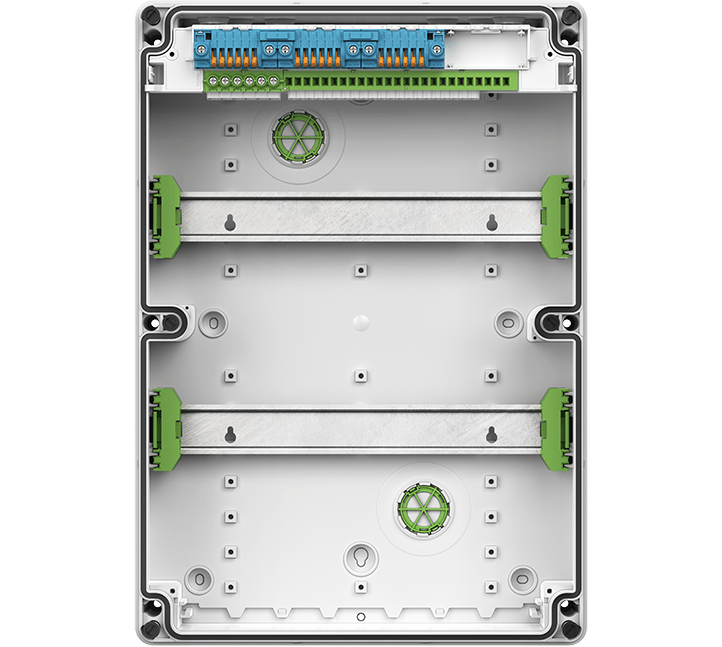
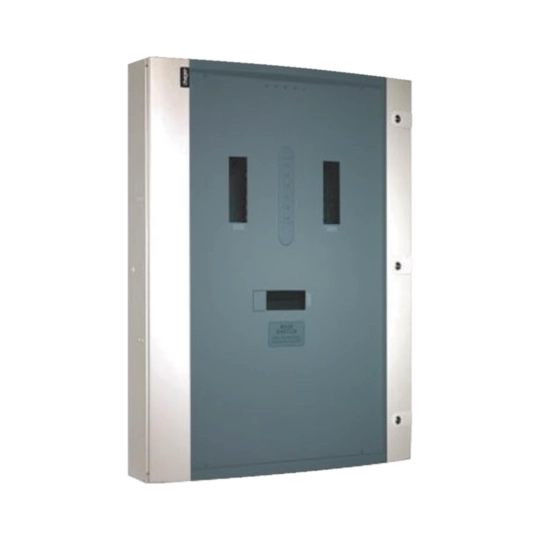
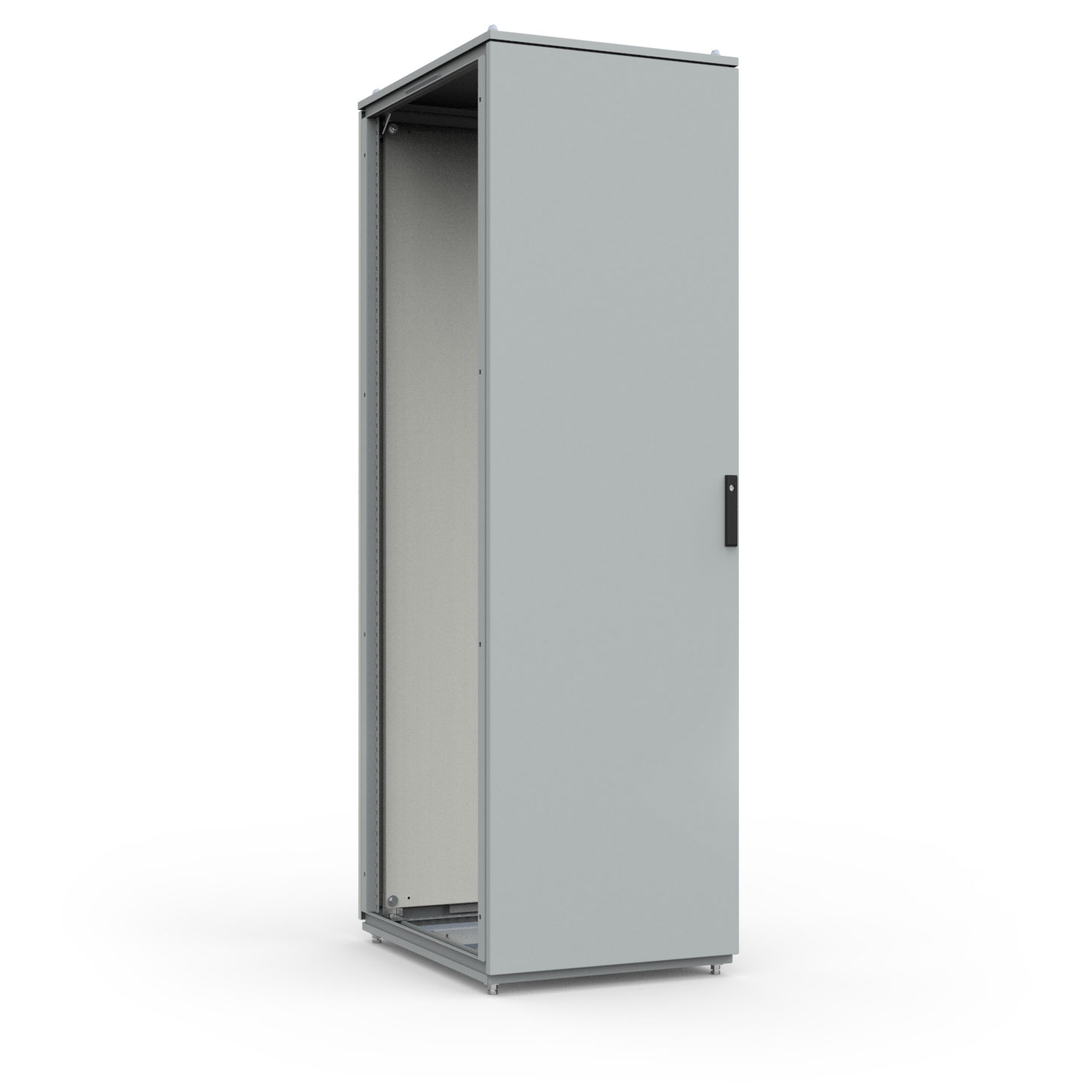
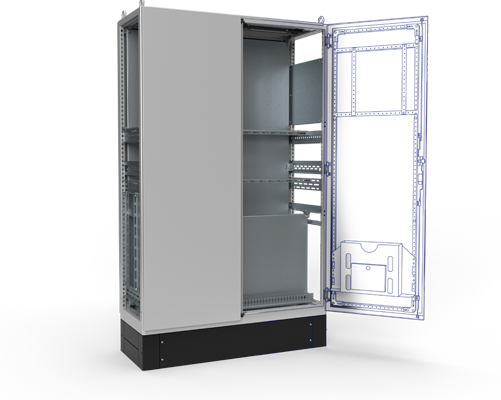
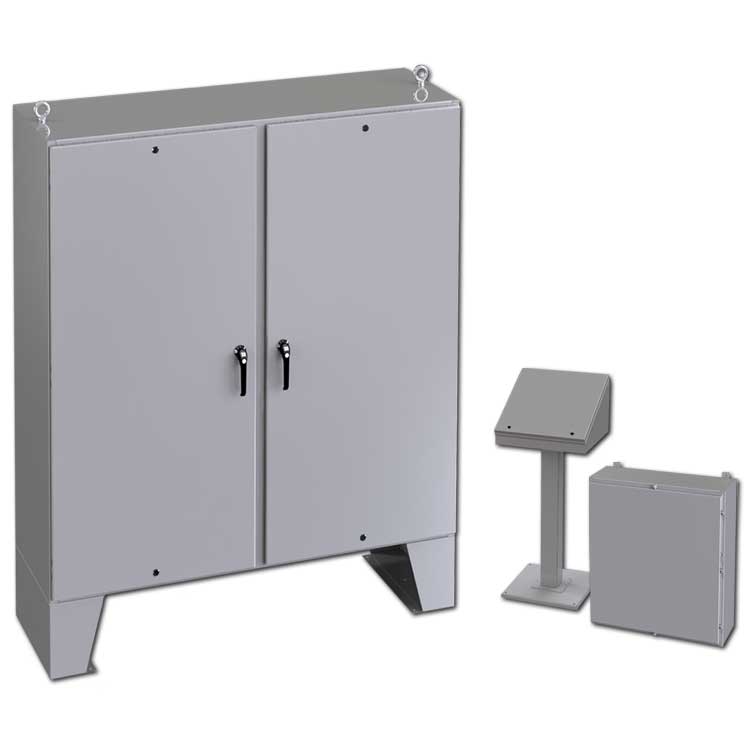
A distribution cabinet is a floor-standing or wall-mounted low-voltage assembly that receives incoming power and divides it into protected, metered, and controlled outgoing circuits. In the international standards world it is a low-voltage switchgear and controlgear assembly, governed by the IEC 61439 series, while North America calls the equivalent floor-standing unit a switchboard under UL 891. The cabinet houses busbars, circuit breakers, fuses, contactors, instruments, and wiring inside a metal enclosure that protects both the equipment and the operator.
This guide treats the distribution cabinet as an engineered assembly rather than a box of parts. The numbers that matter, rated current, short-circuit withstand, form of separation, temperature rise, and ingress protection, are properties of the verified assembly, not of the loose devices inside it. Getting them right is what separates a cabinet that runs for 25 years from one that overheats or fails to clear a fault.
This guide is aimed at industrial purchasing engineers and electrical design engineers. It covers 6 chapters from what a distribution cabinet is, assembly types, forms of separation, busbar and enclosure construction, to spec-sheet decoding and selection decisions, with 7 selection FAQs and manufacturer comparisons. All parameters reference the IEC 61439 series (Parts 1 to 6), IEC 60529 (IP code), IEC 62262 (IK code), and UL 891 public standards.
Chapter 1 / 06
What is a Distribution Cabinet
A distribution cabinet is a complete low-voltage assembly that takes one or more incoming feeders, typically from a transformer secondary or an upstream switchboard, and distributes the power to many outgoing circuits, each individually protected against overload and short circuit. The incoming feeder usually arrives from the secondary of an upstream power transformer. The international standard term is a low-voltage switchgear and controlgear assembly, defined by IEC 61439-1 as a combination of switching devices with associated control, measuring, signaling, protective, and regulating equipment, with all the internal electrical and mechanical interconnections and structural parts. The rated voltage does not exceed 1000 V AC or 1500 V DC.
Functionally a distribution cabinet performs four jobs at once: it receives and isolates incoming power; it protects each outgoing circuit so a downstream fault trips locally without dropping the whole board; it measures and meters voltage, current, energy, and power quality; and it provides a safe operator interface so an engineer can switch, test, and maintain circuits without exposure to live parts. When the assembly is dominated by motor starter circuits rather than simple feeders, the same hardware family is called a motor control center, but the standards and construction principles are shared.
Structurally a cabinet is built from a few repeating elements: a sheet-steel or aluminum-zinc frame and enclosure that sets the ingress protection; horizontal main busbars running along the top or rear that carry the full incoming current; vertical distribution busbars that feed each column; functional units, meaning the breaker, fuse, or starter assemblies that make up each outgoing way; and a wiring and terminal zone, built up from rows of terminal blocks, where field cables land. The way these zones are physically separated from one another defines the form of separation, covered in Chapter 3, and is one of the most consequential and most misunderstood selection choices.
The industrial lineage runs from open knife-switch boards of the early twentieth century, through the introduction of the molded-case circuit breaker in the 1930s, to the standardization of type-tested assemblies under IEC 60439 from 1990. In 2009 to 2014 IEC 60439 was replaced by the modern IEC 61439 series, which introduced a single design-verification framework and the precise vocabulary of the original manufacturer, the assembly manufacturer, InA, Icw, RDF, and the forms of separation. Today a compliant distribution cabinet is not hand-judged but verified against this standard before it leaves the factory.
Four engineering properties dominate cabinet quality and total cost of ownership: rated current with its diversity factor, short-circuit withstand, form of separation and serviceability, and verified temperature rise. A cheap cabinet that skips full design verification may look identical from the front yet fail to carry its nameplate current at the real ambient, or fail to contain a fault. Because a distribution cabinet sits in the power path for decades and a single failure can shut down a plant, the assembly verification documentation matters as much as the brand on the breakers.
Chapter 2 / 06
Assembly Types and Standards
Distribution cabinets divide along two axes: the standard part that governs the assembly, and the mechanical construction of the functional units. The IEC 61439 series splits low-voltage assemblies into application-specific parts, all built on the general rules of Part 1. Choosing the wrong part, for example specifying a board for ordinary persons where a skilled-person power assembly is required, leads to an assembly that is either over-built or non-compliant. The table below maps the series.
Standard part
Assembly type
Operator
Typical rated current
IEC 61439-1
General rules (base)
n/a
up to 6300 A
IEC 61439-2
Power switchgear (PSC)
Skilled
up to 6300 A
IEC 61439-3
Distribution board (DBO)
Ordinary
up to 250 A
IEC 61439-4
Construction sites (ACS)
Skilled
site dependent
IEC 61439-5
Public networks (PENDA)
Skilled
network dependent
IEC 61439-6
Busbar trunking (BTS)
Skilled
up to 6300 A
IEC 61439-2 covers the power switchgear and controlgear assembly, the heavy floor-standing distribution cabinet at the heart of an industrial or commercial low-voltage room. These are operated by skilled or instructed persons, carry full short-circuit ratings, and reach rated currents of 6300 A. IEC 61439-3 covers the distribution board intended for operation by ordinary persons, the consumer unit or final distribution board, typically rated up to 250 A and limited to circuits the public can safely operate. The third edition of Part 3 was published in 2024.
IEC 61439-4 adds particular requirements for assemblies used on construction sites, where the unit is moved, exposed to weather, and subject to rough handling, so mechanical robustness and ingress protection are emphasized; the second edition dates from 2023. IEC 61439-5 covers public electricity network distribution assemblies, the street cabinets and cable distribution pillars utilities use, with a third edition in 2023. IEC 61439-6 covers busbar trunking systems, the pre-engineered busway runs that replace cable between a cabinet and distributed loads.
The second axis is the mechanical construction of the functional units. Fixed designs bolt each device permanently in place, so servicing a circuit requires de-energizing and partial disassembly. Withdrawable or drawer designs make each functional unit a removable module that plugs onto the vertical busbar and can be isolated, racked out, and swapped while neighboring circuits stay live. A third style, the plug-in unit, sits between the two, offering quick replacement without the full racking mechanism of a true withdrawable drawer.
In the Chinese market four legacy type designations remain common and map cleanly onto this axis. GGD is a fixed type rated to 3150 A. GCK, GCS, and MNS are withdrawable drawer types, with MNS originating from ABB technology and offering the finest 1/4-module (62.5 mm) drawer pitch for high circuit density. Internationally the major branded systems, such as ABB MNS, Schneider Blokset and Okken, and Siemens SIVACON S8, offer fixed-mounted, plug-in, and withdrawable construction within one verified platform so the buyer can mix construction styles in a single lineup.
Chapter 3 / 06
Forms of Internal Separation
The form of internal separation describes how the busbars, the functional units, and the field terminals are physically partitioned inside the cabinet using metallic or insulating barriers. The form is chosen for operator safety during maintenance and for the ability to work on one circuit while neighbors stay energized; it does not change the electrical rating but heavily affects price, footprint, and downtime. IEC 61439-2 defines four base forms, with a and b sub-variants for Forms 2 to 4. The table below summarizes them.
Form
Busbar from units
Units from each other
Terminals separated
Typical use
Form 1
No
No
No
Simple feeder boards
Form 2a / 2b
Yes
No
2b only
Basic distribution
Form 3a / 3b
Yes
Yes
3b only
General industrial
Form 4a
Yes
Yes
Yes (shared space)
High maintainability
Form 4b
Yes
Yes
Yes (own compartment)
Data center, critical loads
Form 1 has no internal separation: the busbars, devices, and terminals share one open volume. It is the cheapest construction and acceptable where the whole board is switched off for any work, but a fault or a maintenance error can propagate across the entire assembly. Form 2 separates the busbars from the functional units with a barrier, so an engineer working in the device zone is shielded from the live main busbars. In Form 2b the field terminals are additionally separated from the busbar; in Form 2a they are not.
Form 3 goes further by separating the functional units from each other in addition to separating them from the busbars. This means a fault or a maintenance task in one outgoing circuit is contained from neighboring circuits, a major step up in maintainability for plants that cannot shut the whole board to service one feeder. The 3a and 3b variants differ in whether the terminals are separated from the busbar zone. Form 3b is a common industrial baseline.
Form 4 is the highest level: the functional units and their associated field terminals are all separated from each other and from the busbars. In Form 4a the terminals for a unit may share the unit's own space; in Form 4b each functional unit and its terminals occupy a fully dedicated compartment. Form 4b lets an engineer isolate, open, and re-cable a single drawer while every other circuit, and the main busbar, remains live and safe to approach. This is why data centers, hospitals, and continuous-process plants specify Form 4b despite its higher cost and larger footprint.
A related but separate property is internal arc containment, verified to IEC TR 61641. A high form of separation improves but does not by itself guarantee arc-fault performance; arc-resistant construction is a distinct test and rating. Confusing the two is a common selection error. Specify the form for routine maintainability and specify arc classification separately if personnel will stand in front of an energized assembly during operation.
Chapter 4 / 06
Busbars, Enclosure, and Protection
The busbar system is the spine of a distribution cabinet, carrying the full incoming current to every column. Busbars are flat bars or laminated stacks, almost always copper for industrial assemblies, sometimes aluminum where weight and cost dominate. The cross-section sets both the continuous current capacity and the temperature rise, so a 3200 A main busbar is not just a bigger version of a 1600 A bar, it is sized so that under verified test the temperature rise stays within the IEC 61439-1 limits.
Those limits are explicit. Bare copper busbars are allowed a temperature rise of 105 K above the reference ambient, tinned or plated busbar joints 90 K, and insulated cable terminals 70 K when the connected cable is PVC-rated. The reference ambient in IEC 61439 is a 35 degrees Celsius average over 24 hours with a 40 degrees Celsius peak. If the actual switchroom runs hotter, the assembly must be derated, because rated current without a stated ambient and a verified temperature-rise test is meaningless. Plated joint surfaces and correct bolt torque are what keep joints from becoming hot spots over years of thermal cycling.
The enclosure sets the environmental protection. The ingress protection code under IEC 60529 has two digits, the first for solids and dust, the second for water, optionally followed by an IK impact code under IEC 62262. The table below lists common ingress levels and where they apply. In North America the parallel scheme is the NEMA enclosure type; NEMA and IP are not one-to-one because NEMA also covers corrosion and construction, so a project specifies one scheme and stays with it.
IP code
Solids / dust
Water
Typical environment
NEMA analogue
IP31
Tools, >2.5 mm
Vertical drips
Clean indoor electrical room
NEMA 1
IP41
Wires, >1 mm
Vertical drips
Indoor, light contact risk
NEMA 1
IP54
Dust protected
Splashing
Industrial dust, light washdown
NEMA 12
IP55
Dust protected
Water jets
Workshop, semi-outdoor
NEMA 3R / 4
IP65
Dust tight
Water jets
Outdoor, harsh / coastal
NEMA 4
Inside the enclosure, the protective devices define the cabinet's electrical behavior. The incoming circuit usually carries an air circuit breaker for ratings above roughly 1600 A, where its high short-circuit withstand and adjustable trip unit are needed; outgoing circuits use molded-case circuit breakers, fuse switches, or, for motor duty, contactor and overload combinations. The coordination between these devices and the assembly determines the rated conditional short-circuit current Icc, because a current-limiting device lowers the let-through energy the structure must survive.
Two structural fault ratings describe the assembly itself. The rated short-time withstand current Icw is the RMS fault current the busbar structure carries for a defined time, typically 1 second, with no help from upstream protection. The rated peak withstand current Ipk is the first-cycle peak the structure resists, derived from Icw using a peak factor n between 1.5 and 2.2 depending on the power-factor of the fault loop. Both stress the busbar mechanically and thermally during a fault and must exceed the prospective fault level at the cabinet.
Chapter 5 / 06
Key Specification Parameters
Reading a distribution cabinet data sheet means separating ratings that belong to the verified assembly from ratings that belong to the loose devices. The same lineup may list 20-plus parameters, but a handful drive selection: rated voltage, rated current with diversity, short-circuit ratings, form of separation, ingress and impact, insulation coordination, and the verified temperature rise. Each is explained below.
Rated voltage appears as rated operational voltage Ue, the working line voltage such as 400 V or 690 V AC, and rated insulation voltage Ui, which sets the insulation dimensioning and is equal to or greater than Ue. A third figure, the rated impulse withstand voltage Uimp, defines surge immunity; a 400 V assembly in overvoltage category III typically carries Uimp of 8 kV, paired with pollution degree 3 for industrial environments. These three voltages together, not Ue alone, determine whether the assembly's clearances and creepage are adequate.
Rated current and diversity begin with the assembly incoming current InA, sized to the upstream feeder, in standard busbar steps such as 630, 800, 1000, 1250, 1600, 2000, 2500, 3200, 4000, 5000, and 6300 A. The rated diversity factor RDF then accounts for the fact that not every outgoing circuit draws full load simultaneously. Representative RDF values are 1.0 for 2 main circuits, 0.9 for 3 circuits, 0.8 for 4 to 5 circuits, 0.7 for 6 to 9 circuits, and 0.6 for 10 or more circuits. Applying RDF correctly avoids both oversizing the busbar and overloading it.
Short-circuit ratings are the assembly's fault survival figures, and they must be read as a set:
Icw, rated short-time withstand current, the unconditional 1 second RMS rating, with floor-standing values of 50, 65, 85, or 100 kA.
Ipk, rated peak withstand current, the first-cycle mechanical peak derived from Icw via the peak factor n of 1.5 to 2.2.
Icc, rated conditional short-circuit current, the prospective fault the assembly survives when a specified protective device limits the fault.
Form of separation, ingress, and impact are the construction ratings: Form 1 to 4b per Chapter 3, the IP code per IEC 60529, and the optional IK code per IEC 62262 from IK00 to IK10. These do not change the ampere rating but determine maintainability, environmental survival, and resistance to mechanical knocks, so they belong on the purchase specification alongside the electrical figures.
Verified temperature rise is the parameter buyers most often ignore and most often regret. A rated current is only valid at the stated reference ambient and under a verified temperature-rise test. Ask for the test report and the reference ambient; if your installation runs hotter than 35 degrees Celsius average, derate accordingly. Optional thermal monitoring on busbar joints catches a loosening connection before it becomes a hot spot, which is increasingly standard on modern systems such as Schneider Blokset and Okken with built-in thermal monitoring.
Chapter 6 / 06
Selection Decision Factors
To turn the preceding five chapters into a specific lineup, follow the decision sequence below. Most cabinet selection mistakes are not a single wrong number but a decision made at the wrong level, for example fixing the footprint before the form of separation is known. These eight steps can serve as a fixed RFQ template.
Standard and assembly type: Confirm the governing part, usually IEC 61439-2 for an industrial power cabinet, IEC 61439-3 for an ordinary-person board, or UL 891 for a North American switchboard. This sets the verification framework and the operator assumptions.
Rated current and diversity: Size InA to the upstream transformer or feeder, then apply the RDF for the circuit count so the busbar is neither oversized nor overloaded. Reserve roughly 20 to 30 percent spare ways for load growth.
Short-circuit rating: Determine the prospective fault current at the cabinet and select Icw and Ipk, or Icc with a coordinated device, to exceed it with margin. Verify device-to-assembly coordination, not just the breaker's own kA.
Form of separation: Choose Form 1 to 4b from the maintainability requirement: how often must one circuit be serviced while neighbors stay live, and does personnel safety demand each unit in its own compartment.
Construction style: Fixed for stable feeder circuits, plug-in for moderate change, withdrawable drawer for motor-control duty and minimum downtime. Match drawer pitch to the required circuit density.
Enclosure and environment: Set the IP code from dust and water exposure, the IK code from impact risk, and confirm corrosion protection for coastal or chemical sites. Indoor rooms often use IP31 or IP41; outdoor and harsh sites need IP65 or above.
Certification and verification: Require design verification to IEC 61439-1 plus the relevant part, by test, calculation, or design rules, with the original-manufacturer documentation. Confirm arc containment to IEC TR 61641 separately if needed, and a verified temperature-rise report with its reference ambient.
Total cost of ownership: Weigh purchase price against downtime cost. A withdrawable Form 4b lineup costs more upfront but a single drawer swap on a live board can save days of plant outage over a 20 to 25 year service life.
One last commonly overlooked dimension is manufacturer serviceability: availability of replacement drawers and devices, the original manufacturer's verification documentation on file, local field-service and thermographic inspection capability, and the ability to extend the lineup with matching columns years later. These seem irrelevant at purchase but determine how a plant copes with a fault or a load change a decade on. ABB, Schneider Electric, Siemens, and Eaton all maintain verified platforms (MNS, Blokset and Okken, SIVACON S8, and xEnergy) with regional spares and service, which is why large projects favor them despite higher upfront cost than unbranded local builds.
FAQ
What is the difference between a distribution cabinet, a distribution board, and a switchboard?
All three are low-voltage assemblies governed by the IEC 61439 series, but they differ in operator and scale. A distribution board (DBO) under IEC 61439-3 is intended for operation by ordinary persons in homes and small commercial buildings, typically rated up to 250 A. A distribution cabinet or power switchgear and controlgear assembly (PSC-ASSEMBLY) under IEC 61439-2 is a larger floor-standing assembly operated by skilled persons, rated up to 6300 A with high short-circuit withstand. Switchboard is the North American term under UL 891 for the equivalent floor-standing distribution assembly. In short: same family, different operator, current rating, and regional standard.
What do the four forms of separation in IEC 61439 mean?
Forms of internal separation define how busbars, functional units, and terminals are physically segregated inside the cabinet for operator safety and maintainability. Form 1 has no internal separation. Form 2 separates the busbars from the functional units. Form 3 additionally separates the functional units from each other. Form 4 separates the functional units and their terminals from each other and from the busbars. Forms 2, 3, and 4 split further into a and b variants depending on whether terminals are separated from the busbar and whether each terminal sits in its own compartment. Form 4b, where each unit and its terminals occupy a dedicated compartment, gives the highest maintainability and is common in data centers and critical industrial loads.
What is the difference between a fixed and a withdrawable distribution cabinet?
In a fixed (fixed-mounted) cabinet, the functional units are bolted in place, so the circuit must be de-energized and partly disassembled to service a device. Fixed designs such as the Chinese GGD type are cheaper and suit feeder circuits that rarely change. In a withdrawable (drawer) cabinet, each functional unit is a removable module that plugs onto the vertical busbar and can be isolated and swapped while the rest of the assembly stays energized, which slashes downtime for motor control duty. ABB MNS, Schneider Blokset and Okken, Siemens SIVACON S8, and the Chinese GCS and GCK types are withdrawable. Withdrawable assemblies cost more but lower total downtime over a 20-year service life.
What is Icw and how is it different from Icc?
Icw, the rated short-time withstand current, is the RMS fault current the assembly can carry for a defined time, usually 1 second, without help from any upstream protective device. It is the unconditional structural rating, with typical floor-standing values of 50, 65, 85, or 100 kA for 1 second. Icc, the rated conditional short-circuit current, is the prospective fault current the assembly can survive when a specified short-circuit protective device (a breaker or fuse) limits and clears the fault. Icc is usually higher because the device cuts the let-through energy. The related peak rating Ipk is derived from Icw with a peak factor n of 1.5 to 2.2 depending on power factor. Match all three to the system fault level at the cabinet location.
What does the IP rating on a distribution cabinet tell me?
The IP code under IEC 60529 has two digits: the first is protection against solid objects and dust, the second against water. Indoor electrical rooms commonly use IP31 or IP41 fronts. Industrial dust and washdown areas use IP54 or IP55. Outdoor and harsh sites use IP65 or IP66. An optional IK code under IEC 62262 rates impact resistance from IK00 to IK10. In North America the equivalent system is the NEMA enclosure type, for example NEMA 1 indoor, NEMA 3R outdoor rainproof, and NEMA 12 industrial dust and oil. NEMA and IP are not directly interchangeable because NEMA also covers corrosion and construction, so specify the system that matches your project standard rather than converting one to one.
What certifications and tests should a compliant distribution cabinet have?
For IEC markets the cabinet must show design verification to IEC 61439-1 plus the relevant part: 61439-2 for power assemblies, 61439-3 for distribution boards, 61439-4 for construction sites, 61439-5 for public network assemblies, and 61439-6 for busbar trunking. Verification is achieved by testing, by calculation, or by design rules comparison with a tested reference design, and the original manufacturer issues the documentation. Internal arc containment can be verified to IEC TR 61641. For North America the assembly is built and listed to UL 891 for switchboards or UL 845 for motor control centers. The nameplate must declare Ue, InA, Icw or Icc, IP and IK codes, and the standard applied. Always confirm the rating is for the complete assembly, not just the loose components.
Why does temperature rise matter when comparing cabinets with the same current rating?
Two cabinets can both claim 3200 A yet behave very differently because rated current is only valid at a stated ambient temperature and with verified temperature rise. IEC 61439-1 caps temperature rise at 105 K for bare copper busbars, 90 K for tinned busbar joints, and 70 K for insulated cable terminals on PVC-rated cable. If a maker rates the busbar at a 35 degrees Celsius average ambient but your switchroom runs at 45 degrees Celsius, the usable current drops and you must derate. Tight cabinets with poor ventilation, undersized busbars, or no thermal monitoring run hotter, accelerate insulation aging, and trip on overtemperature. Ask for the verified temperature-rise test report and the reference ambient, not just the headline ampere number.
Distribution Cabinet Manufacturers
Source-backed product routes. Open a company dossier for procurement scope and cited evidence.