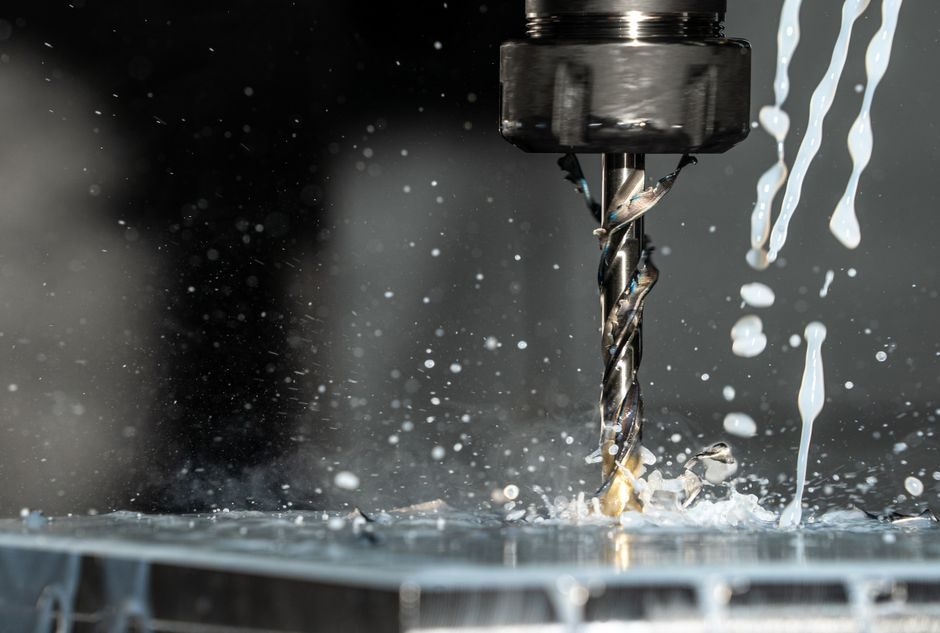
DTH rigs in the GL726-class deliver 90-130 mm diameter holes at 25 m vertical / 30 m horizontal depth in rock of f=6-20 with working air pressure 0.7-1.6 MPa and air consumption 7-12 m³/min, while rotary piling rigs in the Yahe Heavy Industry 5-40 m class ship at FOB US$131,000-180,000 per unit with 260 HP ratings [S1][S3].
Both categories show up in the same Made-in-China product mix alongside water-well, core, and CFA rigs, but the operating envelope — hole size, depth, rock hardness, and prime-mover type — separates them cleanly [S1][S4][S5]. For a procurement engineer the question is not "which is newer" but which spec envelope matches the job.
Headline Specs Side by Side
DTH rigs are percussion-class machines: the GL726 crawler weighs 4 t, runs on a six-cylinder diesel driving both rotation and an on-board air supply, and delivers 950-1500 blows/min through a DTH impactor at rotating speeds 0-70 r/min and 1500 N·m torque [S3]. The same spec sheet lists 5620x2045x1950 mm overall dimensions, 2.5 km/h walk speed, 25° climb grade, and 300 mm ground clearance, with a 3000 mm one-shot feed and 1200 mm propellant compensation [S3].
Rotary rigs in the Yahe piling line share a 260 HP power pack, container-form 13000x2800x3550 mm transport envelope, and a 5-40 m depth window across the listed SKU range at FOB US$131,000-180,000/piece with 1-piece MOQ [S1]. Hanfa Imp & Exp and Songte Machinery list rotary rigs alongside DTH rigs in the same product tree, confirming both stay in active catalog rotation as of July 2026 [S4][S5].
Working Principle and Power Path
A DTH rig couples a down-the-hole hammer to a rotary head and an air compressor on the same carrier: the piston in the hammer strikes the bit 950-1500 times per minute while rotation at 0-70 r/min indexes the bit between blows, breaking rock chip-by-chip that is flushed out by the exhaust air at 7-12 m³/min [S3]. On medium-hard rock the GL726 spec sheet states drilling speed runs 2-3 times that of low-pressure rigs because the impact energy is delivered at the bit face, not through the drill string [S3].
A rotary rig converts diesel or electric power through a hydraulic system to torque on a kelly bar and crowd force on the bit, cutting or scraping large-diameter holes in soil, clay, and soft rock [S2]. Recent structural studies confirm mast design is dominated by the main-winch mounting position, and energy-recovery hydraulic circuits using hydro-pneumatic accumulators on the main winch have been demonstrated to cut engine power demand by recycling kelly-bar gravitational potential energy [S2]. Vibration analysis on rotary drillpipe shows first-section axial displacement peaks around 6×10⁻⁴ m while transverse displacement reaches roughly 0.03 m, the kind of data that drives fatigue checks on the kelly bar [S2].
Where Each Type Wins — Use-Case Map
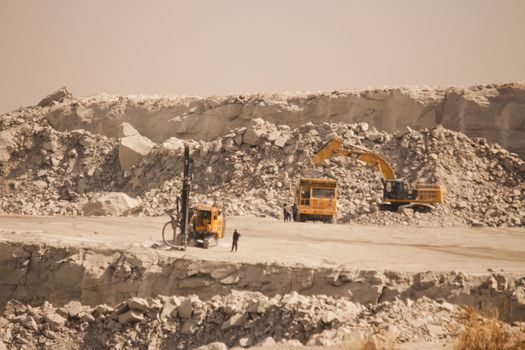
DTH rigs are the right call for hard-rock production drilling: quarry blast holes, open-pit bench drilling, foundation anchor holes in competent rock, and trenching in f=6-20 formation, where the 0.7-1.6 MPa working air window and 90-130 mm hole range cover the standard blast-pattern grid [S3]. Crawler mounting with 25° gradeability and 3500 mm max horizontal drilling height lets the GL726 sit on uneven bench floors without pad prep [S3].
Rotary rigs are the right call for civil-engineering piling: high-rise building foundations, port and dock caissons, dam cut-off walls, transmission-line excavated foundations, and bridge piers — exactly the application bucket the Chinese 工程钻机 definition covers [S6]. A 250 kN·m-class rotary rig is described as the most widely used size class for deep foundation drilling in Chinese public works, and excavated-foundation work for transmission lines is a documented growth application for rotary piling machines because it preserves undisturbed soil bearing capacity [S2]. For a fuller hole-size / rock / mobility decision grid, see the DTH drilling rig selection spec map companion piece.
Selection Criteria — Five Variables to Lock First
1) Target hole diameter. Below ~150 mm in rock, DTH is the production-rate winner; above 600 mm in overburden for piling, rotary is essentially the only option — no DTH hammer in this spec class covers that range [S3]. 2) Target depth. GL726 caps at 25-30 m; Yahe rotary rigs span 5-40 m across SKUs and the structural literature targets deep-foundation work in the same band [S1][S2][S3]. 3) Rock strength. DTH on f=6-20 delivers the cited 2-3× speed advantage; in soil or very soft rock, the rotary cutting action wastes less energy per cubic meter [S3]. 4) Carrier and site access. Crawler DTH rigs at 4 t with 2.5 km/h walk speed move on rough bench floors; container-form rotary rigs at 13000x2800x3550 mm ship in standard ISO containers and are crane-lifted onto prepared pads [S1][S3]. 5) On-site air. DTH demands an integrated 0.7-1.6 MPa / 7-12 m³/min air supply; rotary needs hydraulic power and crowd force, not compressed air [S3].
For background on how these rigs interact with other foundation and drill-string equipment, the rotary drilling rig encyclopedia entry walks through the kelly-bar and mast subassembly, and the rotary hammer page covers the percussion principle that bridges the two categories.
Limitations, Failure Modes, and Watch-Outs

DTH rigs are bottlenecked by air supply: pushing the impactor past 1.6 MPa stresses the bit bearing and accelerates wear, and falling below 0.7 MPa stalls hammer energy and stalls the 2-3× speed advantage on medium-hard rock [S3]. Drill-bit diameter is hard-locked to hammer size — going outside the 90-130 mm GL726 window needs a different hammer, not just more pressure. Crawler undercarriage wear is real at 4 t with 25° continuous grade rating, and the 300 mm ground clearance limits soft-ground site access [S3].
Rotary rigs are bottlenecked by torque and mast strength: finite-element mast subassembly analysis on a 250 kN·m-class rig shows the rotary-drive elevation along the mast is a design variable that directly affects operational safety, and drillpipe transverse vibration on the order of 0.03 m amplitude drives fatigue life on the first section [S2]. Main-winch mounting position changes both axial force and bending moment in the mast, so relocating the winch to the lower mast section — a common modification — must be re-validated structurally rather than assumed equivalent [S2].
Standards, Sourcing, and Supplier Landscape
No single IEC or ISO standard governs DTH-vs-rotary selection; the spec window is driven by project geotech (rock f-value, hole diameter, depth) and carrier-class regulations on the job site. Core-drill and hydraulic-drill Chinese product standards define the full-hydraulic drill class (全液压岩心钻机) as machines using high-pressure variable pumps and motors for stepless speed control, which is the architecture both modern DTH and modern rotary rigs share [S7].
On the sourcing side, Made-in-China lists Yahe Heavy Industry, JC Drill (Beijing), and Hehai Machine (Kaifeng, Henan) as Diamond Members carrying rotary, DTH, and water-well product lines in the same catalog [S1]. Zhengzhou Hanfa Imp & Exp Trading and Henan Songte Machinery (founded 2008) both market rotary, DTH, and water-well rigs from the same Zhengzhou base, and Gengli Machinery publishes the GL726 spec sheet in English as of the December 2024 product-page update that remains the public reference for that model [S3][S4][S5]. For the broader piling-equipment context that a rotary rig often pairs with — hammers, drives, casing — the rotary hammer encyclopedia entry and the crawler crane vs truck crane decision map round out the foundation-site spec picture.
Track these next nodes: any new GL726-class SKU that breaks the 130 mm hole-diameter ceiling, and any 250 kN·m-class rotary rig product page that publishes measured drillpipe vibration under Newmark-β simulation against the cited 0.03 m transverse benchmark [S2][S3].
The underlying component specifications are covered under rotary encoder.