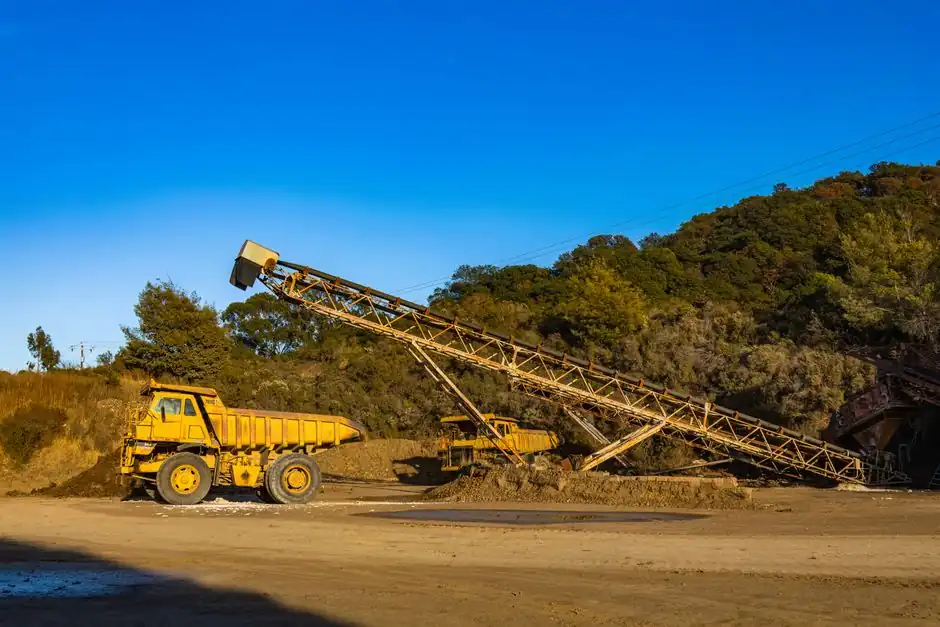
Under 29 CFR 1926.1408, no part of a dump truck, load line, or load may come closer than 20 feet to an energized power line rated up to 350 kV unless Option 1 (deenergize and ground) or Option 3 (Table A minimum approach distance) is applied [S1].
Dump trucks have been the leading cause of overhead powerline contacts in heavy-equipment incident data over the past decade, and a Michigan review of 2000-2023 electrocutions lists dump-truck box contact as a distinct, named source category [S3][S4]. A raised bed changes the truck's effective working envelope from roughly 13 ft (operating height of a typical Class 8 tri-axle dump truck) to more than 20 ft, which is the precise reason the 20 ft rule exists.
What the rule actually says: 20 ft default, Table A for higher voltages
29 CFR 1926.1408(a)(2) gives three compliance options for lines up to 350 kV: deenergize and ground the line, hold a 20 ft clearance, or meet the Table A minimum approach distance tied to the line's actual voltage [S1]. For voltages above 350 kV, Table A distances increase, and 1926.1408 also requires a 50 ft clearance envelope for the largest transmission classes, a number echoed in the Michigan State University OEM hazard alert of 2026-02-27 [S4].
The 20 ft figure is measured from any part of the equipment, load line, or load, including rigging and lifting accessories, not just from the truck body, so a tilted bed, an open tailgate, and aggregate piled above the bed rails all count toward the minimum distance [S1]. This is the wording that puts the box, the load, and even a tag line into the same envelope.
Why dump trucks trigger the rule: bed height plus arc-over
When a dump truck operator raises the bed without first checking the air space, the box itself can enter the energized zone, and a bed tilted near a line can also draw an arc across the air gap before metal-to-metal contact, energizing the chassis and the ground around the tires [S3][S5]. Two distinct mechanisms are documented: direct contact (the box touches the line) and indirect contact (arc-over at sub-contact spacing), both of which put the truck, the tires, and any worker touching the frame at line potential.
Voltage gradient at the surface (step potential) is the third hazard, and it is what kills bystanders standing on the ground near an energized truck rather than the operator inside the cab [S4]. Tire explosions, cab fires, and ground-step injuries to spotters and ground crew are the downstream failure modes that the 20 ft buffer is sized to prevent.
Site controls: spotter, warning line, planning meeting
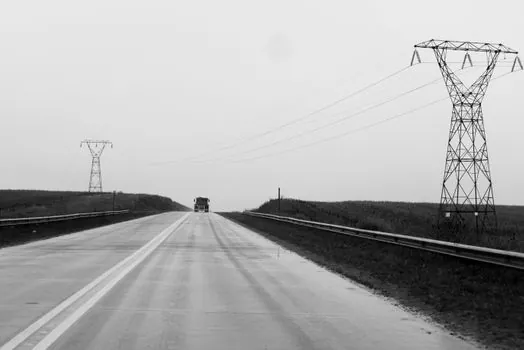
When the employer chooses the 20 ft clearance path (Option 2) under 1926.1408(b), three controls are mandatory: a pre-lift planning meeting with the operator and nearby workers, an elevated warning line or barricade with flags placed at 20 ft from the conductor, and at least one of a proximity alarm, a dedicated spotter in continuous radio contact, a range-limit device, an insulating link, or a written clearance procedure [S1]. If the operator cannot see the elevated warning line from the cab, a dedicated spotter is added on top of the other selected measure.
The dedicated spotter sits outside the 20 ft envelope, in continuous contact with the operator, with a clear line of sight to both the truck and the conductor [S1][S3]. For dump-truck unloading specifically, best-practice guidance from HSSE World places the signaller at least 10 m (30 ft) from the truck, which is wider than the OSHA minimum because the spotter also needs to be outside any potential step-potential footprint if a contact occurs [S3].
Comparison: minimum clearance approaches for a raising dump-truck bed
The table below lines up the three OSHA options and one cross-border reference value for the same activity (raising a dump-truck bed to dump a load near an energized line), against four decision criteria that drive the choice on site. [S1]
Option 1, deenergize and ground: confirmed by the utility owner/operator that the line is open and visibly grounded at the worksite. Voltage range: any. Limitation: requires utility cooperation and scheduled outage; not always available for unplanned haul cycles.
Option 2, 20 ft clearance (1926.1408(a)(2)(ii)): applies to lines up to 350 kV. Implementation: planning meeting, 20 ft elevated warning line with flags, plus one of proximity alarm, dedicated spotter, range-limit device, insulating link, or written clearance. Best fit for routine aggregate haul and asphalt lay-down where a spotter can be dedicated.
Option 3, Table A minimum approach distance: required when the line is above 350 kV, or when voltage-specific distancing is preferred. Distances grow with system voltage (typical 345 kV transmission sits well above 20 ft on Table A). Use when a higher-voltage line crosses the dump corridor and Option 1 is not available.
ESFI heavy-truck operator guidance, 3 m (10 ft) from the box to any line for the truck at normal ride height, with the 20 ft trigger activating the moment the bed starts to raise [S2]. This is not an alternative to OSHA, but it is the lower in-cab visual reference operators use to decide when to call the spotter in.
Operating procedure: look up, spotter, drop before move
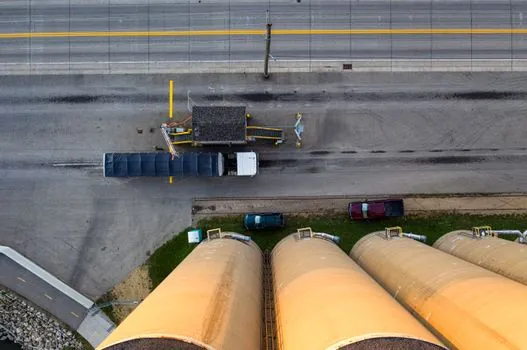
The pre-dump checklist used in published best practice has four steps: on arrival, walk the site and visually locate every overhead wire; during setup, keep the entire truck (not just the body) at least 3 m (10 ft) from any line and at least 10 m (30 ft) from the signaller; before raising, confirm the spotter has clear sight to the conductor and the cab; after dumping, lower the box before driving away [S3]. The "drop the box before you move" rule is the single most common-sense control, because most documented contacts occur when a truck drives off with the bed still raised.
Tag lines, when used for load control during dumping near lines, must be non-conductive per 1926.1408(b)(2), and a clearly visible ground reference (painted line, stanchions, or fixed landmarks) is what the spotter uses to call distance, since estimating 20 ft by eye in a dusty yard is unreliable [S1]. The overhead powerline hazard alert from Michigan State University, published 2026-02-27, also flags the entire category of truck-mounted equipment (digger derricks, Christmas-tree painting booms, post-pounders, pumper conveyors) at the same clearance regime, which is directly relevant to fleets that run mining dump truck configurations with on-board conveyors or jib cranes [S4].
Failure modes the rule is sized against
Three failure modes show up repeatedly in the cited incident record: contact while the bed is raised and the truck creeps forward under load, contact when the truck is repositioned with the bed still up, and contact during a second lift cycle after the operator has already dumped once and assumed the envelope is clear [S3][S5]. The Michigan data for 2000-2023 shows 42 of 68 overhead-line electrocutions were indirect (arc or step-potential), and dump-truck box contact is one of the named contact-source categories in the same dataset, alongside truck-mounted equipment, cranes, earthmoving equipment, and raised roll-off dumpsters [S4].
The lower-voltage residential 240 V service drop and the 765 kV long-distance transmission line are both in scope of the same rule set, only the Table A column changes, so the procedural envelope (planning meeting, warning line, spotter) is identical at a suburban subdivision haul and at a mine haul-road lay-down [S4]. Where the rule does not help is the in-cab blind spot created by the headliner and the A-pillar, which is the geometric reason the dedicated spotter is mandatory under 1926.1408(b)(4)(ii) when the elevated warning line is not visible from the operator's seat [S1].
Sourcing and standards
Primary regulatory source: 29 CFR 1926.1408, Power line safety (up to 350 kV), equipment operations, which defines the three options, the 20 ft default, Table A for higher voltages, and the encroachment-prevention controls in paragraph (b) [S1]. Operator-facing reinforcement: ESFI, Avoid Overhead Power line Contact, Heavy Truck Operator, which holds the 10 ft (3 m) cab-side buffer for the truck at ride height and the "look up" signage requirement [S2]. Best-practice field procedure: HSSE World, Powerline Safety Best Practice For Dump Truck Operators, which codifies the 3 m/10 m/30 ft spacing for the truck, the spotter, and the public, and the drop-the-box-before-moving rule [S3]. State-level hazard alert: Michigan State University OEM, Overhead Power Lines, 2026-02-27, with 2000-2023 electrocution data naming the dump-truck box as a contact source [S4]. Insurance-carrier safety talk: CompSource Mutual, Power line hazards for dump trucks, which covers the direct-contact, arc-over, and bring-down-wires failure modes for raising a bed under a line [S5].
Two trackable signals to watch: any state OSHA plan adopting a stricter Table A default (Michigan's 2026 hazard alert suggests movement on truck-mounted equipment), and any fleet-side deployment of proximity alarms that meet 1926.1408(b)(4)(i) in lieu of a dedicated spotter on high-cycle haul routes. Related overhead-bridge-crane and overhead-conveyor equipment shares the same "stay clear of energized overhead conductor" logic, so the spotter-and-warning-line pattern transfers directly to indoor crane bays where bus bars run above the lift envelope. For a comparison of operator-side blind-spot geometry on a different machine class, see the analysis of 36 m placing boom minimum unfolding height under overhead obstructions.