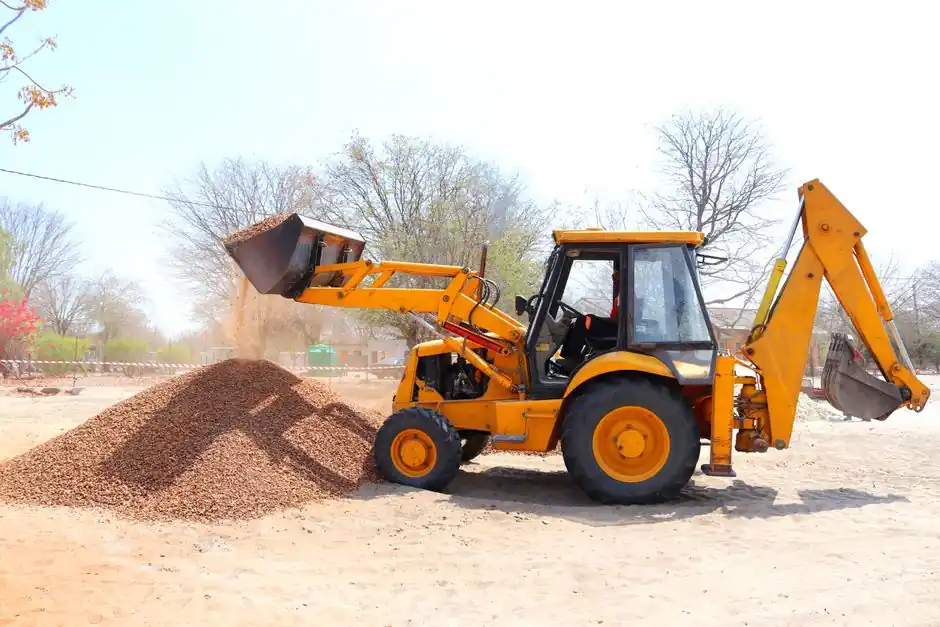
Mini excavators between 1 and 6 metric tons split into three tail-swing families: zero tail swing (ZTS, the rear stays within the track width), reduced tail swing (RTS, a small rear overhang), and conventional tail swing, with the 3–4 ton class dominating fleet sales in North America per Doosan product data [S1][S4].
Operating weight, not horsepower, is the spec most rental fleets and contractors use to size a job, and weight class directly constrains trailer size, transport permit needs, and the access width a machine can pass through [S2][S5].
How 1–6 Ton Weight Classes Are Defined
Compact excavator operating weight in the 1–6 ton bracket typically divides into micro (under 1.5 t), light mini (1.5–3.5 t), and compact (3.5–6.0 t) sub-classes, with engine power scaling from roughly 7–12 kW at the bottom to 22–38 kW at the top of the range [S3].
Cat's North American compact line follows a parallel cut: the 3-ton class ships only as compact radius, the 4–6 ton class offers both compact radius and conventional radius (CR) configurations, and a 306 model is badged compact radius but is functionally a reduced radius design [S4]. Bobcat covers 2,593 lb (E10) up to the 6-ton (E60/E62) class, with both zero and conventional tailswing options within that span, giving buyers a like-for-like tail-swing comparison inside the 1–6 t bracket [S2].
Zero Tail Swing: The Default for Confined Sites
Zero tail swing machines keep the upperstructure within the track width at full rotation, so a 1.7-ton sub-3-foot micro can pass through a standard 36-inch garden gate while still rotating 360 degrees without striking fencing [S5].
Design cost is a real factor: the engine and cab must be repackaged inward, the counterweight often sits inside the tail radius, and breakout force at the bucket tends to be lower than a same-weight conventional machine of the same generation [S4]. For a 3-ton class machine, Doosan market data lists the zero tail swing configuration as the best-selling variant inside that weight band, which is why most OEMs run multiple ZTS models in the 2.5–4.5 t range [S4][S7].
JCB's current mini line shows the design spread: four conventional and six zero tail swing models, covering 1.8 to 10 t, with the 35Z-1 (24.7 hp, 7,840 lb / 3.55 t) sitting squarely in the 3–4 ton ZTS zone that rental fleets order in volume [S4][S9].
Reduced Tail Swing: The Middle Ground

Reduced tail swing machines let the upperstructure overhang the tracks by a small, controlled amount, typically a few inches, so they trade a little clearance for a longer boom arc and a heavier counterweight than a same-class ZTS unit [S4].
Cat's 304 ships in both reduced radius and conventional radius configurations, which is the cleanest apples-to-apples comparison inside a single model number: same chassis, same powertrain, two tail-swing options, and the operator chooses based on site clearance and lift needs [S4]. The Bobcat E26 (6,489 lb / 2.94 t) is badged "minimal" tail swing in the 2–3 t band, a useful data point because "minimal" sits between true ZTS and full RTS in practice [S2].
Conventional Tail Swing: Where Lift Capacity Wins
Conventional tail swing keeps the rear of the upperstructure well outside the track width, which lets OEMs fit a larger counterweight and a longer boom, two changes that raise lift capacity at the side and at full reach over the tracks [S4].
The trade-off is well documented: a 6 t conventional machine in the 3.5–6.0 t class needs at least 250–300 mm of extra clearance behind the tracks to slew safely, so it is the wrong pick for a lane-closure urban trench where traffic is 1 m behind the machine [S3][S4]. Cat ships the 7–10 ton class as a mix of two CR and two conventional models because above 6 t, lift capacity starts to dominate the buying decision, and below 6 t, clearance tends to dominate [S4].
For more on how transport and lift weight classes overlap with crane and lifting decisions on site, see Luffing Jib vs Fixed Jib Crawler Crane: A Spec-Driven Selection, which uses a similar spec-by-spec comparison structure for crane tail and jib design.
Tail-Swing Comparison by Class: 1–6 t
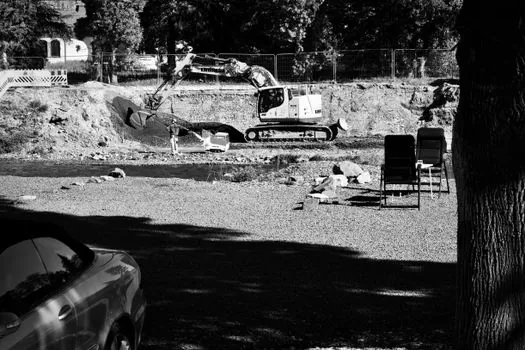
Selection inside the 1–6 t bracket reduces to four decision variables: site clearance, transport width, required dig depth, and side lift at full reach. The 1–2 t micro class is almost always zero tailswing, with operating weight of 2,000–5,000 lb and dig depth of 5–8 ft, because access is the entire point of the machine [S5]. The 3–4 t class is split, with ZTS variants (Bobcat E38 at 7,893 lb and JCB 35Z-1 at 7,840 lb) selling alongside reduced-radius options for mixed sites [S2][S9]. The 5–6 t class carries the widest tail-swing spread: Doosan's 5 t DX50Z-7 ships as a ZTS at 48.8 hp, while other OEMs in the same weight band offer CR and conventional options with deeper dig depth (3.2–4.0 m) and bucket capacity up to 0.18 m³ [S3][S7].
For long reach and production trenching inside this bracket, the conventional 5–6 t machine typically beats its ZTS sibling by 5–10% on breakout force, but loses the ability to work inside a single traffic lane without outrigger pads, a limit that often decides urban utility work [S3][S4].
Failure Modes and Common Sizing Mistakes
Three mistakes drive most returns on 1–6 t mini excavator purchases: choosing a ZTS machine on an open rural site and leaving lift capacity on the table, choosing a conventional machine on a tight urban site and clipping walls on every slew, and under-weighting transport weight, since a 6 t machine on a 7 t trailer needs a different tow vehicle class than a 3 t machine on the same trailer [S3][S5].
Component-wise, the higher hydraulic pressure and tighter packaging of ZTS designs put more thermal load on the swing motor and the hydraulic tank return line, which shortens service intervals if the machine is run at full throttle in hot conditions; conventional designs spread that heat over a larger oil reservoir and a longer swing circle, so the same duty cycle is easier on the fluids [S3][S4]. The practical limit of a 1–2 t micro is volumetric, not hydraulic: the bucket only moves 3–5 yd³/hr in ideal ground, so any job larger than about 50 m³ of dig should step up to the 3–4 t class before buying a second micro [S5].
Who Should Buy Which Tail Swing in 1–6 t
Pick ZTS for urban utility, landscaping, interior demolition, and any work within 300 mm of a wall or fence, with operating weight up to about 5 t where most ZTS models cap out [S1][S3][S5]. Pick RTS for mixed sites where clearance is tight but the operator still needs the boom reach of a heavier machine, with the 4–6 t class the most common RTS band [S2][S4]. Pick conventional tail swing for rural trenching, agricultural work, canal digging, and any site where side lift over the tracks is the binding constraint, with the 5–6 t compact class the entry point where conventional designs start to outperform on breakout and lift [S3][S4][S5]. For fleet buyers tracking how engineering specs interact with site logistics, the excavator reference covers the wider class definitions beyond 6 t.
Track two signals through 2026: whether more 5–6 t ZTS models appear with the breakout force of current conventional units, which would close the performance gap; and whether rental fleet ordering data for the 3–4 t class continues to skew toward ZTS in urban markets, a trend Doosan flagged as already dominant in its 2022 product guidance [S4].
Spec-level background on the components involved: swing check valve, and pressure transmitter.