
UK HSE guidance FOD 2/2014 makes the parking condition explicit: a luffing jib tower crane left unattended must be in free slew with the jib at a safe out-of-service radius, otherwise the crane cannot weathervane and the jib or whole crane can collapse in high winds [S3].
BS 7121 Part 5:2006 underpins that requirement, and HSE flags that some manufacturers have revised their out-of-service radius guidance after three documented wind-induced collapses, so the operator manual for the specific crane supersedes any generic rule [S3].
Why the parking angle is the radius control, not just a setpoint
The "out-of-service angle" is effectively a radius command. On luffing jib designs the working envelope runs from roughly 15° (near horizontal, maximum radius) to about 85° (near vertical, minimum radius), so selecting an angle below 30° leaves a large back-sail area exposed to gusts [S2].
Park at too small a radius, with the jib almost horizontal, and the windage area is multiplied; HSE explicitly warns that a luffing jib left with the slew brake engaged and the jib at too small a radius cannot weathervane, concentrating load into the slewing ring and the jib structure [S3]. The remedy is to release the slew brake, raise the jib to the OEM's minimum out-of-service radius, and verify free-slew function after erection and periodically in service [S3].
Wind-speed bands and the parking-angle envelope
Operator guidance groups tower cranes by out-of-service wind tolerance: typical hammerhead or saddle-jib machines are parked with the slew brake released at winds of 20–40 mph, while a luffing jib tower crane with the jib raised (near-vertical) can remain in free slew up to roughly 85–110 mph before being pinned or taken out of service entirely [S6].
That spread is why the parking angle is paired with a wind ceiling in the crane's parking-configuration table, not specified as a single number. Manufacturer tables typically list a small set of approved storage angles (commonly 0°, 20°, and 40° offsets for lattice jibs, or a near-vertical 88° main jib with 10°–20° offset on crawler units) and a maximum wind speed for each [S4]. The operator's job is to read the table for the shift's forecast, not to default to the most compact position.
Manufacturer devices that physically enforce the parking angle
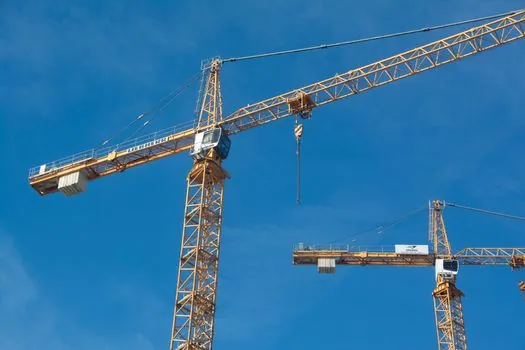
OEMs ship two practical enforcement layers. A "park radius device" mechanically limits how far down the luffing winch can pay out, so the jib cannot be left below the OEM's minimum out-of-service radius without deliberate override [S1]. A separate anti-weathervaning alarm or indicator warns the operator when the jib is parked below the correct out-of-service radius or the slew brake is still engaged [S3].
Both are subject to HSE-mandated periodic checks. After every erection, and on a documented in-service cadence, the operator must verify that the slew-brake release trips, that the slew drive motors, gearboxes, and slew ring bearing still let the upper structure rotate freely, and that any warning device for incorrect parking angle is still functional [S3]. A luffing jib relies on free rotation to shed wind energy; a seized slew bearing turns the crane into a 360° wind vane and loads the jib structurally.
Out-of-service planning against neighbouring plant and structures
Free slew only works if the surroundings permit it. HSE requires periodic checks that adjacent buildings under construction, other tower cranes, or high-reach plant are not blocking the jib or the rear counter-jib from weathervaning, because a constrained crane re-enters the same high-load failure mode the parking rule is meant to prevent [S3].
Urban luffing-jib deployments add a second constraint. Zoning devices are commonly used to electronically limit over-sailing of schools, public areas, main highways, and are typically mandatory next to railway and electrical installations [S1]. When free slew is permitted at the out-of-service angle, the zoning limits must be re-validated against the parked jib footprint; an 18 t class luffing jib with a 60 m jib, for example, swings a 60 m arc and a 3.2 t tip load envelope that the zoning map has to honour even with no load on the hook [S1].
Comparison: parking-angle options for a luffing jib tower crane
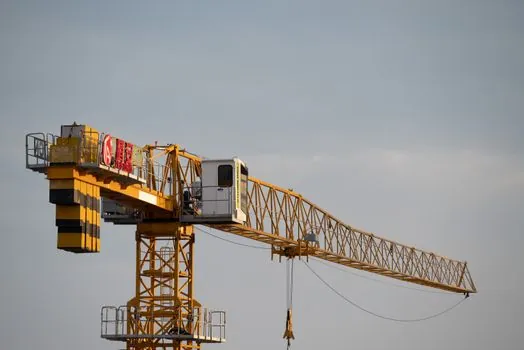
Three configurations are routinely available, and the choice is governed by wind forecast, neighbouring plant, and zoning limits, not by operator preference. [S4]
1. Near-vertical parking, jib raised to roughly 85° or higher. Smallest windage area, highest in-service wind tolerance (up to about 85–110 mph in free slew for a luffing jib tower crane) [S6]. Best for storm standby and exposed sites, but raises the parked centre of gravity and the rear counter-jib windage.<br>2. Mid-angle parking, typically above 30° but well below the maximum. Common default for routine overnight parking in urban sites, balancing reduced radius against manageable back-sail [S2][S6]. Wind tolerance sits below the raised-jib case.<br>3. Low-angle parking, jib near horizontal at roughly 15° or below. Used only for short, supervised moves or specific erection tasks; not an unattended out-of-service state because the crane cannot weathervane safely [S2][S3].
Failure modes and operator actions to plan against
The dominant failure mode is structural overload of the jib or the slewing ring when free slew is prevented and wind direction loads the jib asymmetrically [S3]. A secondary mode is unintended back-sailing during gusts, where the jib drifts past the OEM's minimum out-of-service radius and the parking limit does not re-engage [S5].
Operator actions are codified. Read the manufacturer-specific minimum out-of-service radius from the manual for the exact crane configuration, never from a generic table [S3]. Verify that the slew brake has released, not just been switched off, before leaving the crane unattended. Confirm the anti-weathervaning alarm or radius indicator is functional for the shift [S3]. Evacuate an area at least equal to the full jib length plus counter-jib length when moving between operational and parking positions, because most documented injuries during parking occur in that transition, not while the crane is stationary [S4].
Standards, references, and what to verify on site
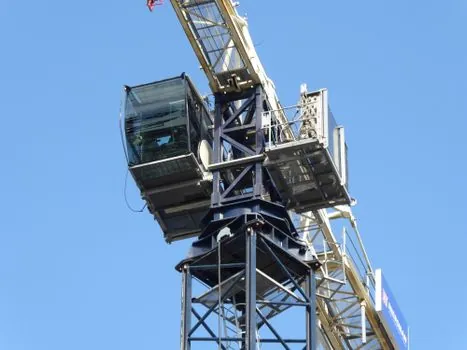
The governing reference in the UK is BS 7121 Part 5:2006, "Code of practice for safe use of cranes: Tower cranes," supplemented by HSE safety alert FOD 2/2014 and Construction Plant Hire Association (CPA) best-practice guides on maintenance, thorough examination, operator handbooks, and out-of-service wind speeds [S3]. On multi-crane sites, the CPA guide "Leaving Tower Cranes Out-of-Service When Other Cranes Are Working on Multiple Tower Crane Sites" controls interaction between adjacent out-of-service and operating machines [S3].
On site, the verifiable items are the manufacturer-stated minimum out-of-service radius for the specific crane, the function of the slew-brake release, the condition of the slew drive and ring bearing, the function of the parking-radius warning device, and a documented sweep that confirms no building, crane, or high-reach plant is blocking free rotation of either the front jib or the rear counter-jib [S3]. Any item that fails the check downgrades the crane to supervised-only operation until it is restored, because the safety case for unattended out-of-service parking depends on all of those elements working together.
Trackable signals to watch next: a revision of BS 7121 Part 5 covering luffing-jib out-of-service conditions, OEM-issued updates to minimum out-of-service radii for in-service fleets after HSE FOD 2/2014, and the next round of CPA multi-crane out-of-service guidance revisions [S3]. For urban sites, also watch zoning-device map updates whenever an 18 t to 64 t class luffing jib with a 60–70 m jib is added to the perimeter [S1].
The underlying component specifications are covered under angle grinder, pressure transmitter, and flow meter.
For related coverage, see Industrial Barcode Scanners for Damaged and Low-Contrast Codes.