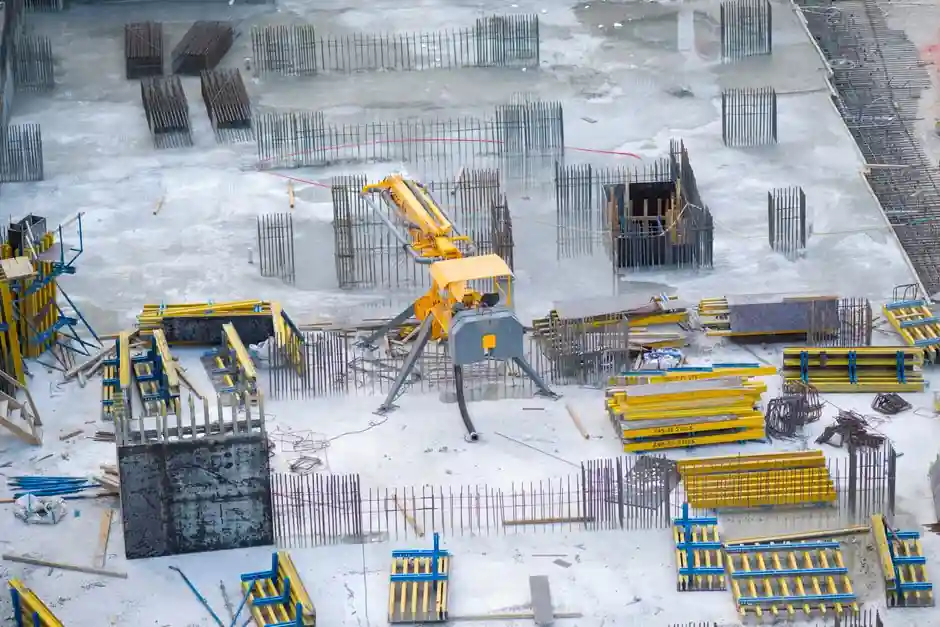
A 36 m 4-section Z-folding concrete placing boom requires 8.66 m (28'5") of vertical clearance to deploy, based on current OEM spec sheets from Concrete Placement Inc. and similar North American 4-section Z-boom designs [S3]. That figure is the binding constraint when pouring under formwork, bridge soffits, mezzanines, or existing structure, and it is roughly 3 m taller than the 5.65 m envelope of a 20 m class spider placer [S1].
For site planning under obstructions, contractors default to three strategies: drop the boom length to a 20–32 m class machine, switch to a tracked spider placer with a 4–5.7 m opening requirement [S1][S2], or use a stationary self-climbing placer anchored inside the elevator shaft with horizontal reach of 21–32 m [S5]. The 36 m size only enters the picture when the overhead envelope sits above roughly 8.7 m and the horizontal radius requirement exceeds what a 32 m boom can deliver.
What "minimum unfolding height" actually measures
Minimum unfolding height is the vertical envelope a placer boom sweeps while transitioning from travel/transport position to fully deployed working position, and it is the single number that governs whether a machine can be erected on a given floor or under a given soffit. For a 36 m 4-section Z boom the published value is 28'5" (8.66 m), with an outrigger front spread of 20'8" (6.30 m) and outrigger rear spread of 24'0" (7.32 m) [S3]. The same 4-section Z family steps up at the 38 m class to 28'5" as well, then climbs to 32'0" at 41 m and 39'4" at 48 m 5-section RZ geometry [S3].
For comparison, the 33 m 5-section RZ boom folds down to 20'3" (6.17 m), about 2.5 m lower than a same-class 4-section Z, which is why RZ (Roll-and-Z) geometry tends to win on tight decks. A typical 20 m boom truck for indoor pours can operate under much lower ceilings because its segments telescope rather than fold through a high arc [S2]. The spider placer family, exemplified by the Con Forms 18-3 with a 5.65 m (18'5") minimum opening, is designed specifically for jobs where the 8–9 m envelope of a 36 m cannot be cleared [S1].
Clearance thresholds by machine class
Spec sheets published for 2025–2026 fleets cluster into three working envelopes: indoor-class booms under 6 m, mid-range 28–38 m booms at 6.5–8.7 m, and high-reach 41 m+ booms above 9.7 m. The 36 m 4-section Z sits at the high end of the mid-range at 8.66 m, while the 32 m 4-section Z lands at 25'3" (7.70 m) and the 28 m 4-section Z at 21'4" (6.50 m) [S3]. A 5-section 47 m RZ unit requires 31'2" (9.50 m) and a 56 m RZ climbs to 40'11" (12.47 m), confirming that boom length and unfolding height scale together but not linearly [S3].
For a site where overhead clearance sits at 7 m, the workable options narrow to: 32 m 4-section Z at 7.70 m (no, exceeds 7 m); 28 m 4-section Z at 6.50 m (yes, with 0.5 m margin); 33 m 5-section RZ at 6.17 m (yes, with 0.83 m margin); or any spider placer with opening heights of 4–5.65 m [S1][S3]. For ceiling heights between 5 m and 6 m, only spider placers and short-boom truck pumps remain viable. The Worksafe Queensland concrete pumping code of practice treats freestanding height and the head-room above the boom as primary planning factors for satellite placing booms [S6].
Who the 36 m is for, and who it is not for
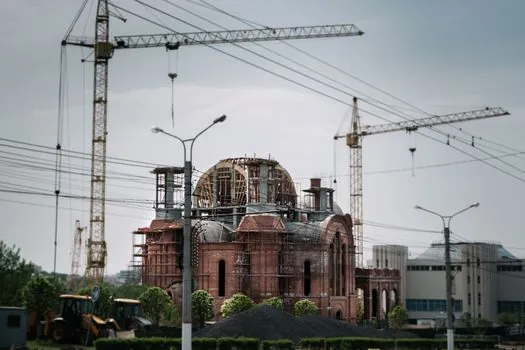
The 36 m class fits mid-rise commercial decks, bridge pier caps, and large industrial slabs where the slab-to-soffit envelope sits above 9 m and horizontal reach must clear 32 m plus 4 m for hose swing. A KCP KB M36R delivers 35.7 m (117'3") of horizontal reach and proportional radio control, sized for exactly this duty [S7]. Outrigger loads on a 36 m 4-section Z are 41,590 lbs front and 41,590 lbs rear, balanced for slab pours on prepared subgrade [S3].
The 36 m is the wrong machine for warehouse mezzanines (typical 6 m clear height), indoor commercial pours, parking deck retrofits with low soffits, and tunnel work, where the 8.66 m unfolding envelope either cannot be achieved or leaves no margin for the placers hose and end-hose sag. In those cases, the 20 m Putzmeister/Alliance class with 65 ft vertical reach and short unfolding geometry is the standard rental answer, and spider placers cover the sub-5 m ceiling bracket [S2]. For high-rise cores where the building climbs around the equipment, a stationary self-climbing placer installed in the elevator shaft with 21–32 m horizontal radius is the more common engineering choice than a 36 m truck boom [S5].
Spec comparison for 28–41 m Z-fold and RZ placers
Selection across the 28–41 m bracket hinges on four criteria: minimum unfolding height, horizontal reach, outrigger envelope, and outrigger point load. The 28 m Z folds at 21'4" (6.50 m) with 78'0" horizontal reach and 35,970 lb front outrigger load, making it the lightest in the band [S3]. The 32 m Z lifts unfolding to 25'3" (7.70 m) and horizontal reach to 92'0", with 42,715 lb front load [S3]. The 33 m 5-section RZ drops unfolding back to 20'3" (6.17 m) at 93'5" horizontal reach, the lowest-folding 30 m-plus option on the standard list [S3]. The 36 m Z locks at 28'5" (8.66 m) and 105'0" horizontal, with balanced 41,590 lb outriggers [S3]. The 41 m Z then steps unfolding to 32'0" (9.75 m) and horizontal reach to 117'0", with the heaviest front outrigger load in the band at 49,458 lb [S3].
For engineers sizing a deck pour under a 9 m soffit, the trade is straightforward: every additional metre of unfolding height above 7 m buys roughly 4–6 m of additional horizontal reach, and roughly 3,000–8,000 lb of additional outrigger load that the slab or subgrade must carry. A flow-meter reading on the pump line will confirm whether the boom can sustain full-pressure placement at the extended radius, since pumping pressure loss grows with hose run length and elbow count.
Operational limits and failure modes under low clearance
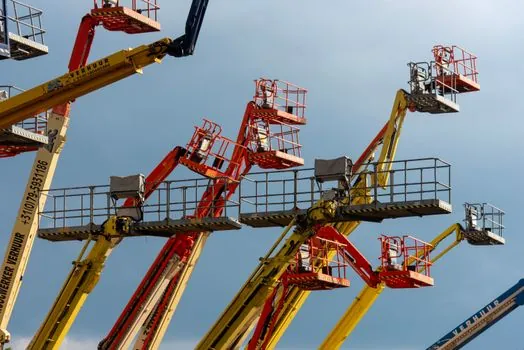
Three failure modes drive most under-obstruction placement incidents. First, the operator attempts to unfold the boom before full vertical clearance is verified, leading to a hydraulic segment striking the soffit and bending a knuckle; spec sheets warn that the unfolding envelope is the swept arc, not a static dimension. Second, the outrigger pad sinks under the 41,590–49,458 lb point load on a slab not designed for that bearing pressure, cracking the deck and destabilising the boom during the second unfold. Third, the end hose whips against a column or formwork tie when the operator tries to compensate for low clearance by over-rotating the base. [S1]
For stationary self-climbing placers, the worksafe code of practice 2019 explicitly lists freestanding height, footing type, and adjacent tower-crane interaction as planning inputs, on top of the horizontal reach selection [S6]. A 36 m truck boom is never freestanding; it relies on outrigger pads and a fully deployed boom, which is why the 8.66 m unfolding height must be cleared at the boom base, not just at the tip. Hydraulic pressure monitoring on the placers pressure transmitter line should be cross-checked against the pump-rated pressure curve before each pour, since pressure spikes during unfold under load are a leading indicator of segment binding.
Sources, standards, and what to verify before specifying
The published 8.66 m (28'5") figure for a 36 m 4-section Z boom comes from Concrete Placement Inc. spec sheets (2025 working fleet data) and is consistent with the 36 m 4-section Z geometry used by Putzmeister/Alliance and Schwing class machines in the same envelope [S3]. Spider placer data of 5.65 m opening height for an 18 m machine (Con Forms 18-3) and 4.0 m for a 16Z-class unit are pulled from the Con Forms equipment catalog, which has been the North American spider reference since the 16Z introduction in 2017 [S1]. The KCP KB M36R 35.7 m horizontal reach figure is published on the KCP product page for 2025 inquiries [S7]. The 20 m–32 m indoor-capable boom range with low unfolding heights is documented on the Premier Concrete Pumping fleet guide, dated 2025-10-17 [S2]. The self-climbing placer envelope of 21–32 m horizontal radius is the standard published range from HAMAC and SinoTech for elevator-shaft installations [S4][S5].
Standards governing placement under obstructions are mostly national codes of practice rather than ISO/IEC product standards, with Australias Worksafe Queensland concrete pumping code 2019 being the most explicit published document on freestanding-height planning for satellite booms [S6]. Before specifying a 36 m under a known soffit, verify: (1) published unfolding height for the exact model and folding geometry, not the boom length alone; (2) outrigger point load and required pad size; (3) tip hose length and sag envelope during the final unfold stage; (4) local code-of-practice requirements for satellite boom footings. The dominant limit in practice is almost always the unfolding envelope, not the static vertical reach figure, and a pressure sensor log on the placers lift cylinder can confirm whether the boom was ever brought to full reach in a clean arc or stalled against an obstruction.
Trackable signals for the next planning cycle: a PLC-controlled unfolding sequence with real-time clearance envelope monitoring, more 5-section RZ geometry at the 36 m class to drop the 8.66 m figure closer to 7 m, and OEM-published unfolding-height-vs-reach curves that replace the single-number spec sheets used today. Standardisation of unfolding-height reporting under a single ISO or EN test procedure would also reduce the spec mismatches that show up when a 36 m is mobilised to a site expecting a 32 m class footprint.
For related coverage, see Extra-Long 6 mm MI Pt100 Probe: Bending and Immersion Above 3 m.